


In short ⚡
Disintermediation is the process of eliminating intermediaries from the supply chain, allowing manufacturers or suppliers to sell directly to end customers. This strategy reduces costs, improves margins, and enables greater control over customer relationships and brand experience in international trade.
Introduction
Many businesses struggle with shrinking profit margins due to multiple intermediaries taking their share in the distribution chain. Each middleman adds costs, delays, and distance between the brand and its customers.
Disintermediation addresses this challenge by removing these layers. In international logistics, this transformation fundamentally reshapes how goods move from production facilities to consumers.
Key characteristics include:
- Direct customer access: Manufacturers control the entire customer journey
- Cost reduction: Elimination of distributor and retailer margins
- Data ownership: Direct collection of consumer insights and preferences
- Brand control: Complete management of messaging and customer experience
- Logistics complexity: Increased operational responsibility for shipping and fulfillment
Mechanisms & Strategic Implications
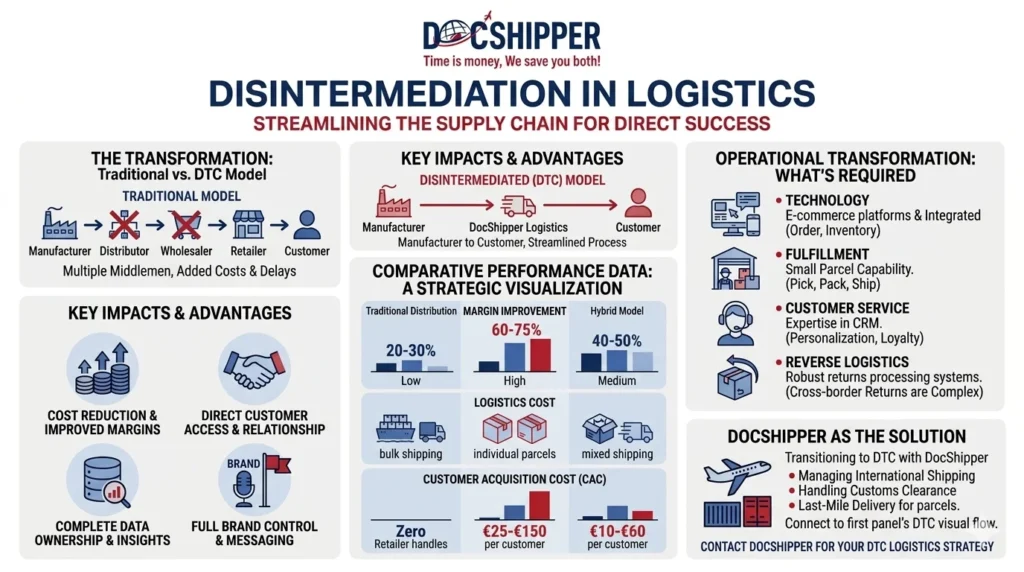
Disintermediation fundamentally alters the traditional distribution model. Instead of selling to wholesalers who sell to retailers who sell to consumers, companies establish direct-to-consumer (DTC) channels through e-commerce platforms, brand websites, or company-owned stores.
The legal implications vary by market. Companies must comply with consumer protection laws in each target country, handle customs declarations directly, and manage tax obligations across jurisdictions. According to EU Customs regulations, businesses shipping directly to consumers must register for VAT in destination countries when exceeding certain thresholds.
Operational transformation requires significant investment. Companies must develop fulfillment capabilities, customer service infrastructure, and reverse logistics systems. At DocShipper, we help manufacturers transition to DTC models by managing international shipping, customs clearance, and last-mile delivery across multiple markets.
The technological infrastructure becomes critical. Integrated systems must connect inventory management, order processing, payment gateways, and shipping platforms. Real-time tracking, automated customs documentation, and multi-currency processing become essential capabilities.
Customer relationship management shifts entirely to the manufacturer. This creates opportunities for personalization and loyalty programs, but also demands expertise in customer service, returns processing, and complaint resolution across different languages and cultural contexts.
Concrete Examples & Data
The impact of disintermediation varies significantly across industries and business models. Real-world data demonstrates both the opportunities and challenges.
| Model | Margin Improvement | Logistics Cost | Customer Acquisition Cost |
|---|---|---|---|
| Traditional Distribution | 20-30% | Low (bulk shipping) | Zero (retailer handles) |
| Direct-to-Consumer | 60-75% | High (individual parcels) | €25-€150 per customer |
| Hybrid Model | 40-50% | Medium (mixed shipping) | €10-€60 per customer |
Case Study: European Fashion Brand
A mid-sized clothing manufacturer in Italy previously sold exclusively through retailers. In 2022, they launched a DTC channel:
- Revenue impact: 35% increase in gross margins on DTC sales
- Shipping costs: Rose from €2.50/unit (bulk) to €8.50/unit (individual parcels)
- Customer lifetime value: Increased by 180% due to repeat purchases and upselling
- Customs complexity: Required compliance in 27 EU markets plus UK, Switzerland, Norway
- Return rate: 22% (vs. 8% in traditional retail), requiring robust reverse logistics
DocShipper managed their cross-border fulfillment, reducing average delivery times from 12 days to 5 days across Europe while handling all customs documentation and VAT compliance.
Key Performance Indicators
Companies implementing disintermediation should monitor:
- Contribution margin per order: Must exceed traditional wholesale margins after accounting for shipping and marketing
- Fulfillment cost ratio: Target below 15% of order value for sustainable operations
- Customer retention rate: DTC models require 40%+ repeat purchase rates to offset acquisition costs
- Customs clearance time: Average 2-4 days for express shipments, critical for customer satisfaction
- Returns processing cost: Typically 20-30% of original order value in cross-border scenarios
Conclusion
Disintermediation offers substantial margin improvements and customer control, but demands significant operational capabilities in logistics, compliance, and customer service. Success requires balancing increased profitability against higher complexity and investment.
Need support implementing a direct-to-consumer logistics strategy? Contact DocShipper for customized international shipping and fulfillment solutions.
📚 Quizz
Test Your Knowledge: Disintermediation
Q1 — What does disintermediation mean in the context of international logistics?
Q2 — A manufacturer switches from bulk B2B shipments to individual consumer parcels after going direct-to-consumer. What typically happens to per-unit shipping costs?
Q3 — An Italian clothing brand launches a DTC channel and starts shipping directly to consumers across 27 EU markets. Which challenge is most likely to arise from this disintermediation strategy?
🎯 Your Result
📞 Free Quote in 24hFAQ | Disintermediation: Definition, Impact & Concrete Examples in Logistics
Disintermediation specifically refers to removing existing intermediaries from an established distribution chain, while direct sales may have always been the business model. Disintermediation represents a strategic shift in go-to-market approach.
Shipping costs typically increase 3-4x per unit when moving from bulk B2B shipments to individual consumer parcels. However, higher product margins often compensate for increased logistics expenses in successful DTC models.
Companies must handle individual customs declarations for each shipment, register for VAT in multiple countries, comply with consumer protection regulations, and manage de minimis thresholds across different markets.
No. High-value, differentiated products with strong brand loyalty perform best. Commoditized, low-margin products typically cannot support the higher logistics and marketing costs of direct-to-consumer models.
DTC return rates average 18-25% compared to 5-10% in traditional retail, particularly in fashion and electronics. Cross-border returns add complexity due to customs procedures and higher reverse logistics costs.
Essential systems include e-commerce platforms, inventory management software, automated customs documentation tools, multi-carrier shipping integration, payment gateways supporting multiple currencies, and CRM systems for customer data management.
Initial cash flow often worsens due to marketing investments and infrastructure costs. However, direct customer payments improve long-term cash conversion cycles compared to traditional 60-90 day payment terms from distributors.
Yes, hybrid models are common. However, channel conflict must be managed carefully through differentiated product offerings, pricing strategies, or exclusive collections to avoid alienating existing distribution partners.
Key risks include underestimating fulfillment complexity, inadequate customer service capacity, customs compliance failures, cash flow strain from infrastructure investment, and potential retaliation from displaced intermediaries.
Most companies require 12-24 months to establish operational capabilities, build customer acquisition channels, and achieve profitability. Technology setup takes 3-6 months, while market development and brand building require longer-term investment.
Freight forwarders become critical partners for managing international shipping complexity, customs clearance, last-mile delivery, and returns processing. Their expertise enables manufacturers to focus on product and customer experience rather than logistics operations.
Inventory complexity increases significantly. Companies must manage stock across multiple fulfillment centers, forecast demand without retailer buffer inventory, and balance holding costs against service level requirements for fast delivery expectations.
Need Help with
Logistics or Sourcing ?
First, we secure the right products from the right suppliers at the right price by managing the sourcing process from start to finish. Then, we simplify your shipping experience - from pickup to final delivery - ensuring any product, anywhere, is delivered at highly competitive prices.


Fill the Form
Prefer email? Send us your inquiry, and we’ll get back to you as soon as possible.
Contact us




