


In short ⚡
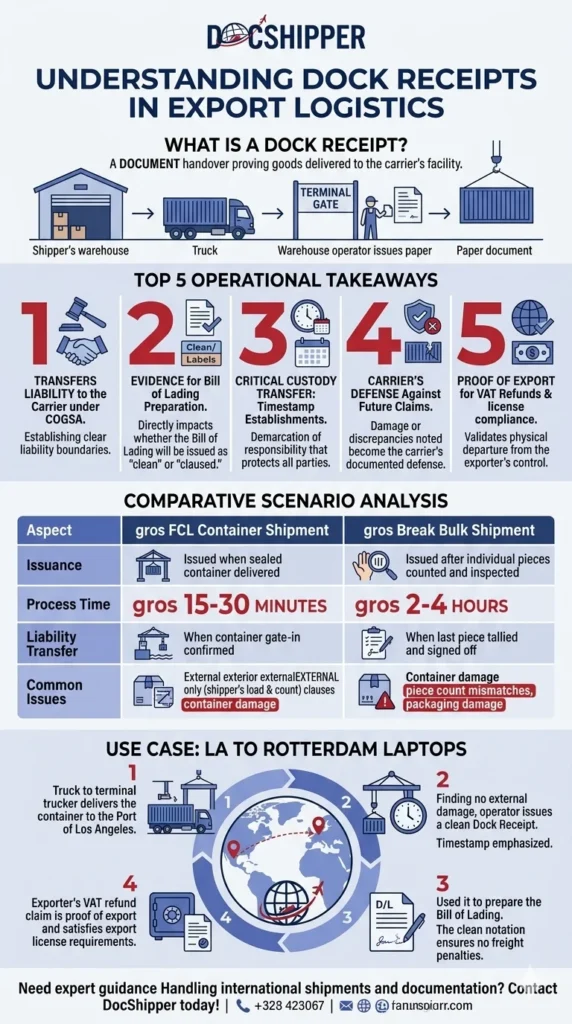
A Dock Receipt is a document issued by a warehouse or terminal operator confirming receipt of cargo for export shipment. It serves as proof that goods have been delivered to the carrier's facility and acts as a critical handover document between the shipper and the ocean carrier in international trade.
Introduction
In export logistics, confusion often arises regarding who holds responsibility for cargo once it leaves the shipper’s premises. The Dock Receipt eliminates this ambiguity by providing documented proof of transfer.
This document plays a pivotal role in the export supply chain. It bridges the gap between inland transportation and ocean freight, ensuring accountability at the critical moment when cargo enters the carrier’s custody.
Key characteristics of a Dock Receipt include:
- Issued by the terminal operator or warehouse upon cargo delivery
- Contains detailed cargo description, marks, and condition notes
- Serves as evidence for preparing the Bill of Lading
- Transfers liability from shipper to carrier
- Required for customs clearance and export documentation
Technical Framework & Legal Implications
The Dock Receipt operates within a specific regulatory framework governed by international shipping conventions. Under the Carriage of Goods by Sea Act (COGSA), the carrier’s liability begins when cargo is received at the terminal, making the Dock Receipt a legally binding document.
This document contains critical information that determines subsequent liability. The cargo condition notation recorded on the Dock Receipt directly impacts whether the Bill of Lading will be issued as “clean” or “claused.” Any damage or discrepancies noted become the carrier’s documented defense against future claims.
The transfer of custody is precisely timestamped on the Dock Receipt. This timestamp establishes when the shipper’s insurance coverage ends and the carrier’s coverage begins, creating a clear demarcation of responsibility that protects all parties.
For customs purposes, the Dock Receipt serves as proof of export. According to U.S. Customs and Border Protection regulations, this document validates that goods have physically left the exporter’s control and entered the export stream, which is essential for VAT refunds and export license compliance.
The information hierarchy on a Dock Receipt follows a standardized format. It includes shipper details, consignee information, vessel name, booking number, container numbers, cargo description, weight, volume, and special handling instructions. At DocShipper, we systematically verify every field on the Dock Receipt to prevent documentation mismatches that could delay shipment or trigger customs holds.
Practical Examples & Use Cases
Understanding the Dock Receipt through real-world scenarios clarifies its operational importance and potential complications.
Comparative Scenario: Container vs. Break Bulk Shipment
| Aspect | FCL Container Shipment | Break Bulk Shipment |
|---|---|---|
| Dock Receipt Issuance | Issued when sealed container delivered to terminal | Issued after individual pieces counted and inspected |
| Condition Verification | External container condition only (shipper’s load & count) | Each piece examined for visible damage |
| Time to Process | 15-30 minutes average | 2-4 hours depending on cargo volume |
| Liability Transfer Point | When container gate-in confirmed | When last piece tallied and signed off |
| Common Issues | Seal discrepancies, container damage | Piece count mismatches, packaging damage |
Use Case: Electronics Export from Los Angeles to Rotterdam
Scenario: A manufacturer ships 500 laptops in 10 pallets via container from LA to Rotterdam.
Step 1 – Delivery to Terminal: The trucker delivers the container to the Port of Los Angeles terminal at 10:00 AM. The terminal operator inspects the container seal and exterior condition.
Step 2 – Dock Receipt Generation: Finding no external damage, the operator issues a clean Dock Receipt at 10:25 AM, noting container number TCLU1234567, seal number 987654, and “Shipper’s Load, Stow & Count” clause.
Step 3 – Documentation Flow: This Dock Receipt is transmitted electronically to the ocean carrier, who uses it to prepare the Bill of Lading. The clean notation ensures no freight charges penalties.
Step 4 – Insurance Transition: The shipper’s inland insurance coverage ends at 10:25 AM. The carrier’s liability under the ocean cargo policy begins simultaneously, creating seamless protection.
Outcome: The shipment proceeds without delay. The Dock Receipt serves as proof for the exporter’s VAT refund claim and satisfies export license requirements for high-value electronics.
Conclusion
The Dock Receipt serves as the critical custody transfer document in export logistics, establishing clear liability boundaries and enabling smooth documentation flow. Its proper execution prevents disputes and ensures regulatory compliance.
Need assistance managing export documentation or ensuring proper Dock Receipt handling? Contact DocShipper for expert guidance on your international shipments.
📚 Quizz
Test Your Knowledge: Dock Receipt
Q1 — What is the primary purpose of a Dock Receipt in export logistics?
Q2 — A Dock Receipt is marked "claused" due to visible packaging damage at the terminal. What is the most likely consequence?
Q3 — A sealed FCL container is delivered to the terminal. The Dock Receipt includes the clause "Shipper's Load, Stow & Count." What does this mean in practice?
🎯 Your Result
📞 Free Quote in 24hFAQ | Dock Receipt: Definition, Purpose & Practical Examples
A Dock Receipt confirms cargo delivery to the terminal, while a Bill of Lading is the contract of carriage issued by the carrier. The Dock Receipt precedes and provides information for creating the Bill of Lading.
The terminal operator, warehouse, or consolidation facility issues the Dock Receipt upon receiving cargo. The ocean carrier does not issue this document directly, though they may receive copies electronically.
Not universally required, but standard practice for containerized ocean freight. Air freight uses different documentation (Air Waybill). Some carriers may waive it for established shippers with electronic systems.
Noted damage results in a "claused" Dock Receipt, which leads to a claused Bill of Lading. This may affect payment under letters of credit and trigger insurance claims processes immediately.
Amendments are possible but require written authorization from both the shipper and terminal operator. Changes must be documented with timestamps to maintain legal validity and chain of custody integrity.
Retain for minimum seven years per standard commercial documentation retention policies. This period aligns with statute of limitations for cargo claims and tax audit requirements in most jurisdictions.
No. The Dock Receipt is a custody receipt only, not a document of title. Title transfer occurs through the negotiable Bill of Lading or other contractual arrangements between buyer and seller.
Essential elements include shipper/consignee names, cargo description, marks and numbers, quantity, weight, condition notation, receiving date/time, terminal location, and authorized signature with stamp.
Yes. Electronic Dock Receipts are widely accepted and increasingly standard. They must contain digital signatures and comply with UNCITRAL Model Law on Electronic Commerce for legal equivalence.
This clause indicates the carrier received a sealed container and did not verify contents. The shipper remains responsible for accuracy of cargo description, quantity, and internal packing condition.
It establishes the cargo condition baseline when entering carrier custody. Clean receipts support claims for damage occurring during ocean transit; claused receipts may limit carrier liability for pre-existing damage.
Primarily an export document, though import terminals may issue delivery receipts with similar functions. The import equivalent is typically the Equipment Interchange Receipt or container release documentation.
Need Help with
Logistics or Sourcing ?
First, we secure the right products from the right suppliers at the right price by managing the sourcing process from start to finish. Then, we simplify your shipping experience - from pickup to final delivery - ensuring any product, anywhere, is delivered at highly competitive prices.


Fill the Form
Prefer email? Send us your inquiry, and we’ll get back to you as soon as possible.
Contact us




