


In short ⚡
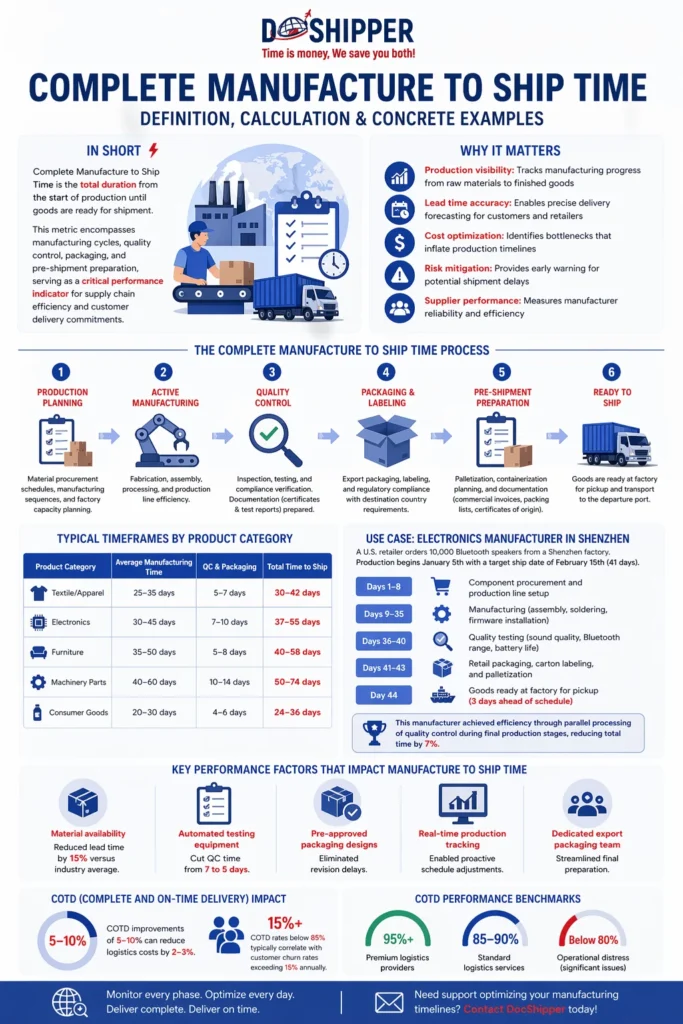
Complete Manufacture to Ship Time is the total duration from the start of production until goods are ready for shipment. This metric encompasses manufacturing cycles, quality control, packaging, and pre-shipment preparation, serving as a critical performance indicator for supply chain efficiency and customer delivery commitments.
Introduction
Many importers struggle to predict when their goods will actually be ready for shipment. Production delays cascade into missed shipping windows, resulting in costly air freight premiums or lost sales opportunities.
Understanding Complete Manufacture to Ship Time is essential for international trade operations. This metric directly impacts inventory planning, customer satisfaction, and overall logistics costs.
- Production visibility: Tracks manufacturing progress from raw materials to finished goods
- Lead time accuracy: Enables precise delivery forecasting for customers and retailers
- Cost optimization: Identifies bottlenecks that inflate production timelines
- Risk mitigation: Provides early warning for potential shipment delays
- Supplier performance: Measures manufacturer reliability and efficiency
In-Depth Analysis & Expertise
Complete Manufacture to Ship Time comprises multiple sequential phases. Each stage contributes to the total timeline and presents distinct optimization opportunities.
The production planning phase establishes material procurement schedules and manufacturing sequences. Delays here compound throughout the entire cycle. Raw material availability, supplier lead times, and factory capacity directly influence this initial stage.
During active manufacturing, the actual fabrication, assembly, and processing occur. Production line efficiency, workforce availability, and equipment reliability determine this duration. Complex products with multiple components naturally require longer manufacturing windows.
The quality control phase involves inspection, testing, and compliance verification. International shipments require adherence to destination country standards. Documentation like certificates of conformity or test reports must be prepared during this stage.
Packaging and labeling prepare goods for international transit. Export packaging must withstand handling, climate variations, and customs inspections. Proper labeling ensures regulatory compliance with requirements from authorities like U.S. Customs and Border Protection.
Finally, pre-shipment preparation includes palletization, containerization planning, and documentation assembly. Commercial invoices, packing lists, and certificates of origin must be finalized before goods reach the departure port.
At DocShipper, we monitor each phase to identify delays before they impact shipping schedules, ensuring your cargo meets departure deadlines consistently.
Concrete Examples & Data
Manufacturing timelines vary significantly by product category and complexity. Understanding typical durations helps set realistic expectations.
| Product Category | Average Manufacturing Time | QC & Packaging | Total Time to Ship |
|---|---|---|---|
| Textile/Apparel | 25-35 days | 5-7 days | 30-42 days |
| Electronics | 30-45 days | 7-10 days | 37-55 days |
| Furniture | 35-50 days | 5-8 days | 40-58 days |
| Machinery Parts | 40-60 days | 10-14 days | 50-74 days |
| Consumer Goods | 20-30 days | 4-6 days | 24-36 days |
Use Case: Electronics Manufacturer in Shenzhen
A U.S. retailer orders 10,000 Bluetooth speakers from a Shenzhen factory. Production begins January 5th with a target ship date of February 15th (41 days).
- Days 1-8: Component procurement and production line setup
- Days 9-35: Manufacturing (assembly, soldering, firmware installation)
- Days 36-40: Quality testing (sound quality, Bluetooth range, battery life)
- Days 41-43: Retail packaging, carton labeling, and palletization
- Day 44: Goods ready at factory for pickup (3 days ahead of schedule)
This manufacturer achieved efficiency through parallel processing of quality control during final production stages, reducing total time by 7%.
Key Performance Factors:
- Material availability reduced lead time by 15% versus industry average
- Automated testing equipment cut QC time from 7 to 5 days
- Pre-approved packaging designs eliminated revision delays
- Real-time production tracking enabled proactive schedule adjustments
- Dedicated export packaging team streamlined final preparation
Conclusion
Complete Manufacture to Ship Time directly determines your ability to meet market demands and control logistics costs. Accurate tracking transforms this metric from a reactive measure into a strategic planning tool.
Need expert guidance on optimizing your manufacturing timelines? Contact DocShipper for comprehensive supply chain management support.
📚 Quiz
Test Your Knowledge: Complete Manufacture to Ship Time
Q1 — What does "Complete Manufacture to Ship Time" measure?
Q2 — Does Complete Manufacture to Ship Time include customs clearance at the destination country?
Q3 — A Shenzhen electronics factory reduces its total manufacture-to-ship time by running quality control checks in parallel with the final production stages. What supply chain principle does this best illustrate?
🎯 Your Result
📞 Free Quote in 24hFAQ | Complete Manufacture to Ship Time: Definition, Calculation & Concrete Examples
Material shortages, unexpected quality failures, production line breakdowns, and packaging supply delays are the primary causes. Seasonal factory capacity constraints during peak periods also extend timelines significantly.
Implement advanced material planning, establish quality checkpoints during production rather than only at the end, maintain approved packaging inventory, and use production monitoring systems for real-time visibility.
No. This metric ends when goods are ready for pickup at the factory or delivered to the departure port. Customs clearance is part of the separate shipping and logistics timeline.
Standard consumer electronics typically require 37-55 days from production start to ship-ready status, including quality testing and export packaging. Complex products with certification requirements may extend to 70+ days.
Larger volumes benefit from economies of scale but may face capacity constraints. Initial setup time becomes proportionally smaller, but quality control and packaging stages extend linearly with quantity.
Yes, through premium material sourcing, overtime production shifts, parallel processing of quality control, and pre-positioned packaging materials. Expect cost increases of 15-30% for rush production.
Commercial invoices, packing lists, certificates of origin, test reports, compliance certificates, and product specifications are typically finalized before goods reach ship-ready status.
Chinese New Year, summer shutdowns in Europe, and year-end holidays can add 2-4 weeks. Factory capacity constraints during peak seasons (September-November) may extend timelines by 20-30%.
Lead time encompasses the entire period from order placement to delivery at destination. Complete Manufacture to Ship Time covers only the production phase until goods are ready for shipment departure.
Yes. Third-party inspections conducted before shipment are part of the pre-shipment preparation phase. Budget 2-3 days for inspection scheduling and report generation.
Products requiring multiple components, specialized assembly, or extensive testing naturally extend manufacturing duration. Custom specifications can add 15-40% to standard production times.
Location affects material sourcing speed and workforce availability. Coastal factories near major ports may offer faster component delivery but face higher labor costs, while inland facilities provide cost advantages with slightly longer material transit.
Need Help with
Logistics or Sourcing ?
First, we secure the right products from the right suppliers at the right price by managing the sourcing process from start to finish. Then, we simplify your shipping experience - from pickup to final delivery - ensuring any product, anywhere, is delivered at highly competitive prices.


Fill the Form
Prefer email? Send us your inquiry, and we’ll get back to you as soon as possible.
Contact us




