


In short ⚡
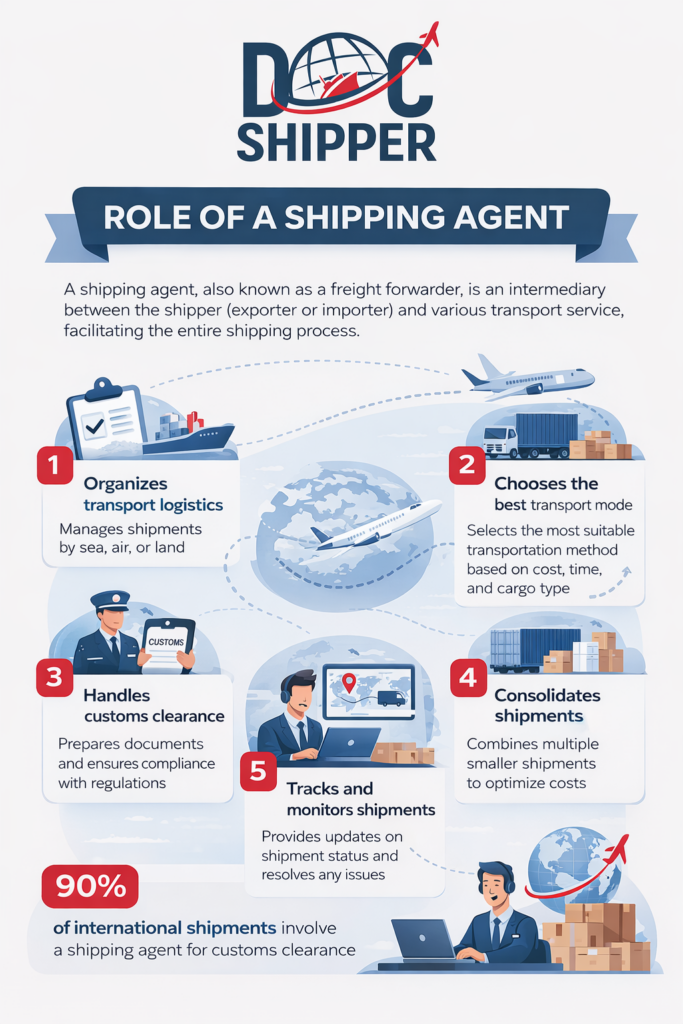
A shipping agent is a specialized intermediary who represents shipowners, carriers, or charterers at ports of call. They handle administrative, operational, and commercial tasks including customs clearance, cargo documentation, port formalities, crew assistance, and coordination between vessels and local authorities to ensure smooth port operations.
Introduction
Many importers and exporters underestimate the complexity of port operations. A vessel arriving at port triggers dozens of administrative, legal, and logistical requirements that must be handled within tight timeframes.
The shipping agent acts as the shipowner’s local representative, managing all interactions with port authorities, customs, terminal operators, and service providers. Without this critical intermediary, vessels would face delays, penalties, and operational chaos.
Key characteristics of shipping agents include:
- Port expertise: Deep knowledge of local regulations, infrastructure, and procedures
- Multilateral coordination: Interface between shipowners, cargo interests, and authorities
- Time-critical execution: Managing port stays to minimize demurrage costs
- Legal representation: Acting on behalf of principals with full authority
- Financial responsibility: Handling disbursements and settling port-related expenses
Role & Responsibilities in Depth
The shipping agent’s mandate begins before vessel arrival and extends beyond departure. Their scope encompasses operational, commercial, and legal dimensions of port calls.
Pre-arrival documentation includes submitting advance cargo manifests, crew lists, and dangerous goods declarations to customs and maritime authorities. Agents must comply with the IMO FAL Convention standardized forms and local port regulations.
Berth booking and pilotage arrangements require negotiating with terminal operators, securing suitable berths, and coordinating pilot services, tugboats, and mooring gangs. Timing precision is critical to avoid costly waiting periods.
Customs clearance coordination involves preparing import/export documentation, ensuring cargo compliance with health and safety regulations, and facilitating inspections. At DocShipper, we work closely with shipping agents to streamline this process and prevent documentation-related delays.
Crew welfare and assistance includes arranging shore leave, medical services, repatriation, visa processing, and emergency support. Agents must understand maritime labor conventions and local immigration laws.
Financial disbursements cover port dues, pilotage fees, canal tolls, bunker supplies, provisions, repairs, and agency fees. Agents advance these funds on behalf of shipowners and reconcile accounts through detailed disbursement statements.
Practical Examples & Data
Understanding shipping agent operations through concrete scenarios reveals their impact on supply chain efficiency and costs.
Case Study: Container Vessel Port Call
A 4,500 TEU container ship arrives at Rotterdam with 2,800 containers for discharge and 2,200 for loading. The shipping agent coordinates:
| Task | Timeline | Cost Impact |
|---|---|---|
| Pre-arrival customs filing | 48h before arrival | Prevents €15,000 delay penalty |
| Berth allocation negotiation | 72h before arrival | Saves 6h waiting time = €8,400 |
| Pilotage & tug coordination | On arrival | €5,200 disbursement |
| Port dues settlement | Within 24h of departure | €42,000 advance payment |
| Crew change logistics | During port stay | €3,800 for 8 crew members |
Total port stay: 28 hours. Agent fee: €2,500. Total disbursements: €76,700. The agent’s efficiency reduced potential demurrage costs by €23,400.
Key Performance Metrics
Industry data reveals shipping agent impact on operational efficiency:
- Documentation accuracy: Professional agents achieve 98.5% first-time customs clearance rates versus 76% for self-handled operations
- Port stay reduction: Experienced agents reduce average container vessel port time by 4-7 hours
- Cost optimization: Agents negotiate port fees saving shipowners 8-12% on disbursements annually
- Emergency response: 24/7 agent availability prevents average €18,000 loss per incident through rapid problem resolution
- Compliance rates: Agent-handled vessels face 92% fewer regulatory violations and penalties
Conclusion
Shipping agents are indispensable facilitators in international maritime logistics, transforming complex port operations into streamlined processes. Their local expertise, regulatory knowledge, and coordination capabilities directly impact vessel turnaround times and operational costs.
Need expert support coordinating your shipping operations? Contact DocShipper for comprehensive logistics solutions tailored to your international trade requirements.
📚 Quiz
Test Your Knowledge: Shipping Agent
1. What best defines the primary role of a shipping agent?
2. A shipping company decides to handle its own port operations at a foreign port without a local agent. What is the most likely outcome?
3. A container vessel is arriving at Rotterdam in 48 hours. Which task would a shipping agent handle at this stage?
🎯 Your Result
📞 Free Quote in 24hFAQ | Shipping Agent: Definition, Role & Practical Examples
A shipping agent represents the vessel/carrier at ports, handling port operations and formalities. A freight forwarder represents cargo owners, arranging transportation and documentation for goods. They serve different principals with distinct responsibilities.
Agency fees typically range from €1,500 to €5,000 per port call depending on vessel size, cargo complexity, and port location. Fees cover coordination services; disbursements (port dues, pilotage) are separate and passed through to shipowners.
Technically possible but highly impractical. Most ports require local representation for legal and operational reasons. Self-handling lacks local expertise, relationships, and 24/7 availability, resulting in delays, higher costs, and compliance risks.
Agents typically hold maritime business degrees, customs brokerage licenses, and port authority certifications. Essential skills include maritime law knowledge, customs regulations expertise, multilingual communication, and financial management capabilities.
Agents maintain 24/7 operations centers to address vessel casualties, medical emergencies, cargo damage, crew issues, and regulatory inspections. They coordinate with authorities, service providers, and principals to resolve situations rapidly and minimize losses.
Generally no. Agents act as intermediaries representing shipowners for port operations. Cargo liability rests with carriers under bills of lading. However, agents may be liable for errors in their specific duties like incorrect documentation or missed deadlines.
Agents submit electronic manifests, cargo declarations, and crew lists through port community systems. They facilitate inspections, provide required documentation, resolve discrepancies, and ensure compliance with import/export regulations and security protocols.
Disbursement accounts detail all port-related expenses: port dues, pilotage, towage, berth charges, cargo handling, customs fees, crew costs, supplies, repairs, agency fees, and applicable taxes. Agents provide itemized statements with supporting invoices.
Yes, agents coordinate fuel bunkering, fresh water, provisions, spare parts, and technical supplies. They obtain competitive quotes, arrange delivery timing, supervise quality, and handle payment processing on behalf of shipowners.
Agents arrange crew transportation, hotel accommodation, visa processing, immigration clearance, and embarkation/disembarkation logistics. They coordinate with manning agencies, consulates, and immigration authorities to ensure smooth crew rotations.
Agents utilize port community systems, vessel tracking platforms, electronic data interchange (EDI), customs clearance software, financial management systems, and mobile applications for real-time coordination and documentation management.
Evaluate agents based on port expertise, service network coverage, financial stability, technology capabilities, response times, customer references, and industry certifications. Established agents with FONASBA membership demonstrate professional standards and reliability.
Need Help with Logistics or Sourcing ?
First, we secure the right products from the right suppliers at the right price by managing the sourcing process from start to finish. Then, we simplify your shipping experience - from pickup to final delivery - ensuring any product, anywhere, is delivered at highly competitive prices.


Fill the Form
Prefer email? Send us your inquiry, and we’ll get back to you as soon as possible.
Contact us


