


In short ⚡
A container depot is a secured facility where shipping containers are stored, inspected, repaired, and prepared for transportation. These strategic hubs enable efficient container management between maritime terminals, inland destinations, and shippers, optimizing logistics flows in international trade.Introduction
Confusion often arises between container depots, container yards, and freight stations. Many importers struggle to understand where their containers are stored and which facility charges apply. This distinction matters because depot fees represent 8-15% of total logistics costs in international shipping.
Container depots serve as critical nodes in the supply chain. They bridge the gap between ocean terminals and final destinations, enabling flexible container positioning and maintenance operations outside congested port areas.
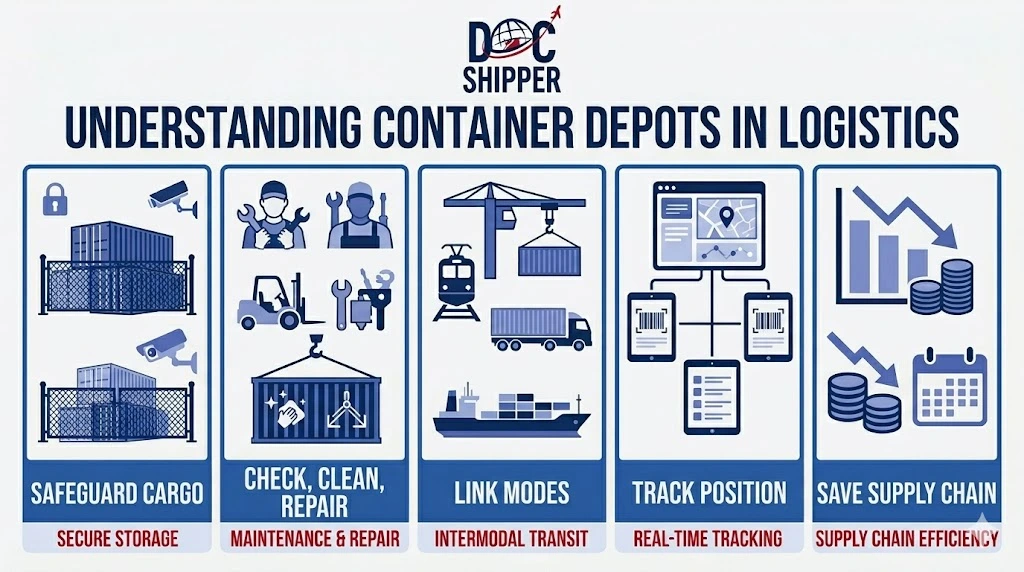
- Storage capacity: Depots handle both empty and laden containers awaiting pickup or return.
- Maintenance services: Facilities provide container inspection, cleaning, and repair operations.
- Documentation processing: Depots manage gate-in/gate-out procedures and customs documentation.
- Equipment availability: They maintain pools of various container types for immediate allocation.
- Intermodal connectivity: Strategic locations enable seamless transfers between rail, road, and maritime modes.
In-Depth Analysis & Expertise
Container depots operate under strict security protocols and international standards. The facility must comply with ISO 28000 supply chain security management and ISPS Code requirements when handling export cargo.
The gate operations system tracks every container movement. Advanced depots use RFID technology and automated optical character recognition to record container numbers, seal integrity, and damage assessments. This digital trail proves essential for liability determination.
Depots distinguish themselves through specialized services. Container maintenance includes structural repairs, refrigeration unit servicing, and tank container certification. According to Institute of International Container Lessors, proper maintenance extends container lifespan by 30-40%.
The detention and demurrage calculation begins at the depot level. Containers remaining beyond free time trigger daily charges. At DocShipper, we monitor depot cut-off times meticulously to avoid unnecessary fees for our clients.
Empty repositioning represents a major depot function. Shipping lines store empty containers at strategic depots to balance supply and demand across trade lanes. This positioning reduces deadhead movements and improves equipment utilization by 20-25%.
Legal frameworks govern depot liability. The Hague-Visby Rules and local regulations define responsibility for cargo damage occurring during depot storage. Depots maintain mandatory insurance and implement surveillance systems to mitigate risk exposure.
Concrete Examples & Data
Understanding depot operations requires examining real-world scenarios and comparative metrics. The following data illustrates typical depot configurations and cost structures.
| Service Type | Port Terminal | Inland Depot | Cost Difference |
|---|---|---|---|
| Storage (per day) | $45-75 | $25-40 | 40-45% cheaper |
| Container inspection | $85-120 | $60-90 | 25-30% cheaper |
| Basic cleaning | $150-200 | $100-140 | 30-35% cheaper |
| Minor repairs | $300-450 | $200-320 | 28-33% cheaper |
Use Case: Electronics Importer in Germany
A German electronics distributor imports 40 TEU monthly from Shenzhen to Hamburg. Instead of immediate port pickup, containers move to an inland depot 45km from Hamburg.
- Scenario parameters: Average storage of 4 days per container before distribution.
- Port terminal cost: €65/day × 4 days × 40 containers = €10,400 monthly.
- Inland depot cost: €32/day × 4 days × 40 containers = €5,120 monthly.
- Monthly savings: €5,280 (50.8% reduction).
- Annual impact: €63,360 saved through strategic depot selection.
DocShipper manages depot coordination for clients across 150+ locations worldwide, ensuring optimal positioning and cost control throughout the supply chain.
Industry benchmarks reveal: Leading depots achieve 98.5% accuracy in container tracking, process gate transactions in under 8 minutes, and maintain equipment availability rates above 95% during peak seasons.
Conclusion
Container depots form the operational backbone of modern container logistics, offering cost-effective alternatives to terminal storage while maintaining service quality. Strategic depot utilization reduces detention charges, improves cargo flow, and enhances supply chain flexibility.
Need expert guidance on depot selection and container management? Contact DocShipper for customized logistics solutions tailored to your international shipping needs.
📚 Quiz
Test Your Knowledge: Container Depot
What is the primary function that distinguishes a container depot from a container terminal?
A shipper believes container depot fees are always lower than port terminal charges. Is this statement accurate?
An electronics importer in Germany stores 40 containers for 4 days. Port terminal charges €65/day while an inland depot charges €32/day. What is the correct monthly savings calculation?
🎯 Your Result
📞 Free Quote in 24hFAQ | Container Depot: Definition, Operations & Concrete Examples
A container terminal is the port facility where vessels load and unload containers, featuring quay cranes and direct vessel access. A container depot is an inland or off-dock facility focused on storage, maintenance, and distribution. Terminals handle vessel operations; depots manage container lifecycle activities. Depots typically offer 30-50% lower storage rates than terminals but lack direct vessel access.
Free time varies by shipping line and depot agreement, typically ranging from 3 to 7 days for imports and 5 to 14 days for exports. After free time expires, detention charges apply, averaging $50-150 per container daily. Some depots offer extended free time during off-peak seasons. Always verify free time in your booking confirmation to avoid unexpected costs.
Payment responsibility depends on the shipping terms (Incoterms). Under FOB terms, the buyer typically pays depot charges at destination. Under DDP terms, the seller covers all depot fees. For leased containers, the party holding the equipment during storage bears the depot costs. Clarify financial responsibility in your purchase contract to prevent disputes.
Essential documents include the delivery order or equipment release authorization, valid identification, commercial invoice, packing list, and customs clearance documentation. For hazardous cargo, additional safety data sheets and permits apply. Digital systems now enable electronic document submission at most modern depots, reducing processing time from hours to minutes.
Yes, pre-trip inspections (PTIs) are standard practice. Depots document container condition through photographs and inspection reports covering structural integrity, door seals, floor condition, and cleanliness. For refrigerated containers, temperature unit functionality is verified. Request inspection reports before loading to document pre-existing damage and avoid liability for prior issues.
Depot capacity varies widely, from small facilities handling 500 TEU to mega-depots managing 50,000+ containers. Capacity constraints occur during peak shipping seasons (September-November) when space availability drops 40-60%. Advanced booking and flexible pickup scheduling help secure depot space. Some carriers guarantee depot space for contracted volume shippers.
Depot proximity impacts drayage costs significantly. A depot 20km from the final destination costs approximately $80-120 for truck transport, while a facility 100km away increases costs to $200-350 per move. However, cheaper depot storage rates may offset higher transport costs. Calculate total landed cost including storage, drayage, and detention when selecting depot locations.
Certified depots implement multi-layer security: perimeter fencing with intrusion detection, 24/7 CCTV surveillance covering 100% of the yard, controlled access with biometric authentication, and security personnel conducting regular patrols. High-value cargo areas feature additional lighting and monitoring. ISO 28000-certified depots undergo annual security audits to maintain certification standards.
Most depots stock standard dry containers (20'/40' GP and HC). Specialized equipment like refrigerated containers, open-tops, flat racks, or tank containers requires advance booking and may be available only at designated depots. Specialized container depots maintain dedicated equipment pools and technical staff. Availability varies by region and trade lane volume.
Depots maintain liability insurance covering damage occurring under their control. Upon discovery, depots issue damage reports with photographic evidence. Minor damages (less than $500) are often handled through depot insurance. Major structural damage triggers claims processes involving shipping lines, lessors, and insurance adjusters. Document container condition at gate-in to establish baseline condition.
Many depots offer container freight stations (CFS) services for LCL cargo handling. These facilities enable stuffing and de-stuffing operations, cargo consolidation, and palletization. Charges range from $50-150 per container for basic services. Full-service depots provide labor, equipment, and warehouse space. This service proves valuable when direct door delivery is impractical.
Import operations focus on quick turnaround—containers arrive from terminals, undergo customs clearance, and depart for final destinations within 3-5 days. Export operations allow longer staging times (7-14 days) for container stuffing, documentation finalization, and customs pre-clearance. Export depots often provide weighing and VGM certification services required under SOLAS regulations before vessel loading.
Need Help with
Logistics or Sourcing ?
First, we secure the right products from the right suppliers at the right price by managing the sourcing process from start to finish. Then, we simplify your shipping experience - from pickup to final delivery - ensuring any product, anywhere, is delivered at highly competitive prices.


Fill the Form
Prefer email? Send us your inquiry, and we’ll get back to you as soon as possible.
Contact us




