


In short ⚡
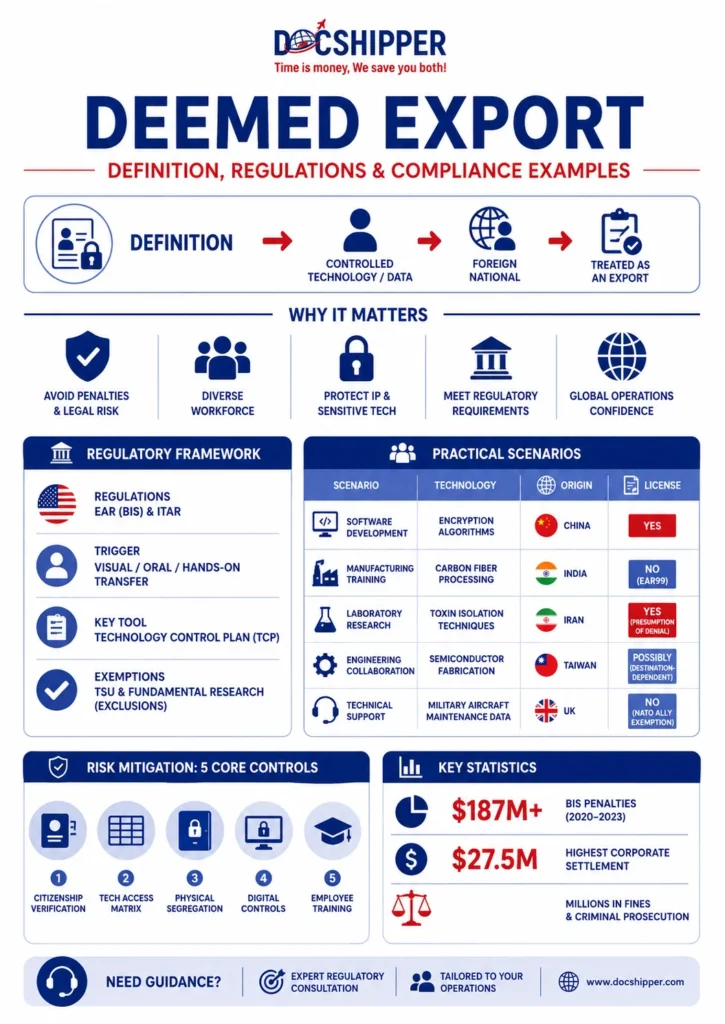
Deemed export refers to the transfer of controlled technology or technical data to a foreign national within the same country, treated by export control laws as an actual export requiring authorization. This occurs when restricted information is shared with non-U.S. persons domestically, triggering the same regulatory requirements as physical international shipments.
Introduction
Many companies unknowingly violate export controls by sharing technical drawings, software source code, or manufacturing specifications with foreign employees on domestic soil. This common oversight stems from a critical misconception: export compliance only applies to physical shipments crossing borders. In reality, deemed export regulations extend controls to knowledge transfer within your own facility.
This concept emerged during the Cold War when governments realized technology leakage occurred not only through shipping containers but through hiring foreign engineers who gained access to sensitive information. Today, deemed export controls affect manufacturing plants, research laboratories, universities, and technology firms across multiple jurisdictions.
Understanding deemed export is essential for:
- Compliance officers managing multinational teams with diverse citizenship profiles
- HR departments screening candidates for positions involving controlled technology
- Research institutions collaborating with international scholars on dual-use projects
- Manufacturers providing technical training to foreign nationals on production floors
- IT departments granting system access containing export-controlled software or data
Regulatory Framework & Compliance Requirements
Deemed export rules operate under multiple regulatory regimes depending on the technology type and destination country. In the United States, the Export Administration Regulations (EAR) administered by the Bureau of Industry and Security and the International Traffic in Arms Regulations (ITAR) enforced by the Department of State govern these transactions.
The trigger mechanism is straightforward yet frequently misunderstood. A deemed export occurs when a foreign national gains visual inspection, oral communication, or hands-on application of controlled technology. The foreign person’s country of citizenship determines licensing requirements, not their physical location or visa status. This means a Chinese engineer working in California receives the same regulatory treatment as shipping blueprints directly to Beijing.
The Technology Control Plan (TCP) serves as the cornerstone compliance tool for organizations managing deemed exports. This documented system identifies controlled technology within the organization, restricts access based on citizenship screening, and implements safeguards preventing unauthorized disclosure. Companies failing to establish adequate TCPs face civil penalties reaching millions of dollars plus criminal prosecution for willful violations.
Licensing exemptions exist under specific conditions. The License Exception TSU permits technology release to certain employees of U.S. companies for internal development or production purposes. The Fundamental Research Exclusion protects academic institutions when research results remain unrestricted and intended for publication. However, these exceptions contain numerous limitations requiring careful legal analysis before application.
At DocShipper, we conduct thorough pre-employment citizenship screening and technology access audits to ensure our clients maintain continuous deemed export compliance while building diverse international teams. Our compliance specialists coordinate with Bureau of Industry and Security guidelines to structure proper authorization frameworks before technology transfer occurs.
Practical Scenarios & Risk Assessment
Real-world deemed export violations frequently occur in seemingly innocuous situations. Consider an aerospace manufacturer hiring a Russian national as a quality control inspector. During factory tours, the inspector observes composite material layup techniques classified under ITAR as defense articles. Without prior State Department authorization, this visual access constitutes an illegal deemed export to Russia, triggering severe enforcement consequences.
| Scenario Type | Technology Involved | Foreign National Origin | License Required |
|---|---|---|---|
| Software Development | Encryption algorithms (ECCN 5D002) | China | Yes – BIS License |
| Manufacturing Training | Carbon fiber composite processing | India | No – EAR99 commodity |
| Laboratory Research | Toxin isolation techniques | Iran | Yes – Presumption of Denial |
| Engineering Collaboration | Semiconductor fabrication methods | Taiwan | Possibly – Destination-dependent |
| Technical Support | Military aircraft maintenance data | UK | No – NATO ally exemption |
University research presents particularly complex deemed export challenges. A graduate student from Pakistan working on hypersonic propulsion research triggers ITAR controls even when the university claims fundamental research protections. The critical distinction lies in publication restrictions: if the sponsoring agency requires prepublication review or classification, the fundamental research exclusion evaporates and deemed export licenses become mandatory.
Statistical enforcement data reveals the financial stakes. Between 2020 and 2023, BIS imposed over $187 million in penalties for deemed export violations, with individual corporate settlements reaching $27.5 million. These figures exclude ITAR enforcement actions prosecuted separately by the State Department’s Directorate of Defense Trade Controls.
Risk mitigation requires implementing five core control mechanisms:
- Citizenship verification through passport review and documentary evidence before facility access
- Technology access matrices mapping controlled items against authorized personnel by nationality
- Physical segregation of restricted areas with badge-controlled entry and visitor logs
- Digital rights management preventing foreign nationals from accessing controlled files on shared networks
- Training programs educating employees on recognition and reporting of potential violations
DocShipper assists clients in establishing these control frameworks through comprehensive technology audits and customized compliance protocols. Our international logistics expertise extends beyond cargo handling to encompass the intangible knowledge transfers that increasingly define modern supply chain compliance challenges.
Conclusion
Deemed export regulations transform domestic hiring and knowledge sharing into complex international transactions requiring the same rigorous authorization processes as physical cargo shipments. Companies operating in technology-intensive sectors must implement robust screening and access control systems to avoid substantial civil penalties and criminal liability.
Need guidance navigating deemed export compliance for your international workforce? Contact DocShipper for expert regulatory consultation tailored to your operational requirements.
📚 Quiz
Test Your Knowledge: Deemed Export
1. What defines a "deemed export" under U.S. export control regulations?
2. Which factor determines deemed export licensing requirements?
3. A U.S. aerospace company hires a Chinese engineer who visually observes composite material manufacturing techniques classified under ITAR during a factory tour, without prior State Department authorization. What has occurred?
🎯 Your Result
📞 Free Custom Quote in 24hFAQ | Deemed Export: Definition, Regulations & Compliance Examples
No. U.S. export regulations treat lawful permanent residents (green card holders) as U.S. persons exempt from deemed export controls. The exemption applies regardless of their original country of citizenship. However, this status must be verified through documentation, and dual nationals may trigger additional scrutiny depending on their secondary citizenship in countries of concern.
Technology release encompasses any transmission of technical data, software source code, or know-how that enables the development, production, or use of controlled items. This includes visual inspection of controlled articles, oral briefings containing technical specifications, hands-on training with restricted equipment, or providing access to technical documents or computer systems containing controlled information. Simply being present in a facility does not automatically constitute release unless the foreign national gains actual knowledge of controlled technology.
Visa classification has no bearing on deemed export licensing requirements. An H-1B specialty occupation worker, L-1 intracompany transferee, or any other temporary visa holder remains a foreign national subject to deemed export controls based on their country of citizenship. The visa merely authorizes legal employment in the United States but does not override export control obligations. Companies must obtain appropriate licenses before granting technology access regardless of valid work authorization.
Partial exemptions exist but vary significantly by regulation type. ITAR provides exemptions for certain defense articles released to nationals of NATO countries, Australia, Japan, and Sweden under specific conditions outlined in ITAR §126.5. However, EAR-controlled dual-use technology receives no blanket exemptions based on allied status. Even for ITAR exemptions, companies must maintain detailed records and ensure the foreign national does not originate from an embargoed country or appear on denied parties lists.
Unintentional violations still trigger substantial civil penalties. BIS can impose administrative fines up to the greater of $300,000 per violation or twice the transaction value. ITAR violations carry civil penalties up to $500,000 per occurrence. Criminal prosecution for willful violations includes imprisonment up to 20 years and corporate fines reaching $1 million. Voluntary self-disclosure reduces penalties significantly, often by 50% or more, making proactive compliance auditing financially prudent.
Effective risk assessment begins with technology classification determining which items fall under export control jurisdiction. Companies then inventory all positions with potential access to controlled technology and identify the citizenship profile of current and prospective employees. This crosswalk reveals gaps where foreign nationals hold or seek positions requiring restricted technology access. The assessment culminates in documented risk mitigation strategies including license applications, technology segregation, or position restructuring to eliminate controlled technology exposure.
Yes. Companies may apply for comprehensive deemed export licenses covering multiple foreign nationals from the same destination country accessing the same controlled technology. These consolidated licenses streamline compliance for organizations with numerous employees of similar citizenship profiles. However, each individual must still undergo screening, and the license conditions must be strictly observed regarding technology scope, authorized personnel lists, and reporting requirements.
Robust documentation includes citizenship verification records (passport copies, naturalization certificates), signed technology access acknowledgments, training completion certificates, facility access logs segregating restricted areas, technology transfer agreements specifying authorized individuals, export license copies with conditions, and periodic compliance audit reports. These records must be maintained for five years minimum and produced upon government request during compliance reviews or enforcement investigations.
Universities must carefully evaluate whether projects qualify for the fundamental research exclusion, which requires unrestricted publication and absence of access controls based on citizenship. Corporate sponsorship agreements often contain prepublication review clauses that negate this exclusion, converting the research into controlled technology requiring deemed export licenses for foreign students and researchers. Many universities now maintain export control offices specifically to navigate these complexities and ensure faculty compliance.
When foreign nationals acquire U.S. citizenship through naturalization, they immediately become U.S. persons exempt from deemed export restrictions. Companies should update technology access authorizations and personnel records accordingly. Conversely, if a U.S. citizen acquires foreign citizenship creating dual national status with a country of concern, additional scrutiny may apply depending on the specific export control classification of accessed technology. HR departments must implement status change notification procedures.
Remote access creates dual compliance obligations. If a foreign national employee physically located abroad accesses controlled technology through network connections, both deemed export and physical export regulations may apply simultaneously. The location of the server hosting controlled data becomes critical, as does the employee's citizenship and physical location. Cloud computing architectures with distributed data storage across multiple jurisdictions further complicate compliance, often requiring geographic access restrictions based on user profiles.
Processing timelines vary dramatically by technology classification and destination country. Standard BIS license applications average 45-60 days but may extend to six months for sensitive technologies or countries of concern. ITAR Technical Assistance Agreements supporting deemed exports typically require 60-90 days minimum, with complex cases exceeding one year. Expedited processing exists for limited circumstances but requires demonstrated urgency and complete application packages. Strategic workforce planning must account for these substantial lead times before hiring foreign nationals for controlled technology positions.
Need Help with
Logistics or Sourcing ?
First, we secure the right products from the right suppliers at the right price by managing the sourcing process from start to finish. Then, we simplify your shipping experience - from pickup to final delivery - ensuring any product, anywhere, is delivered at highly competitive prices.


Fill the Form
Prefer email? Send us your inquiry, and we’ll get back to you as soon as possible.
Contact us




