


In short ⚡
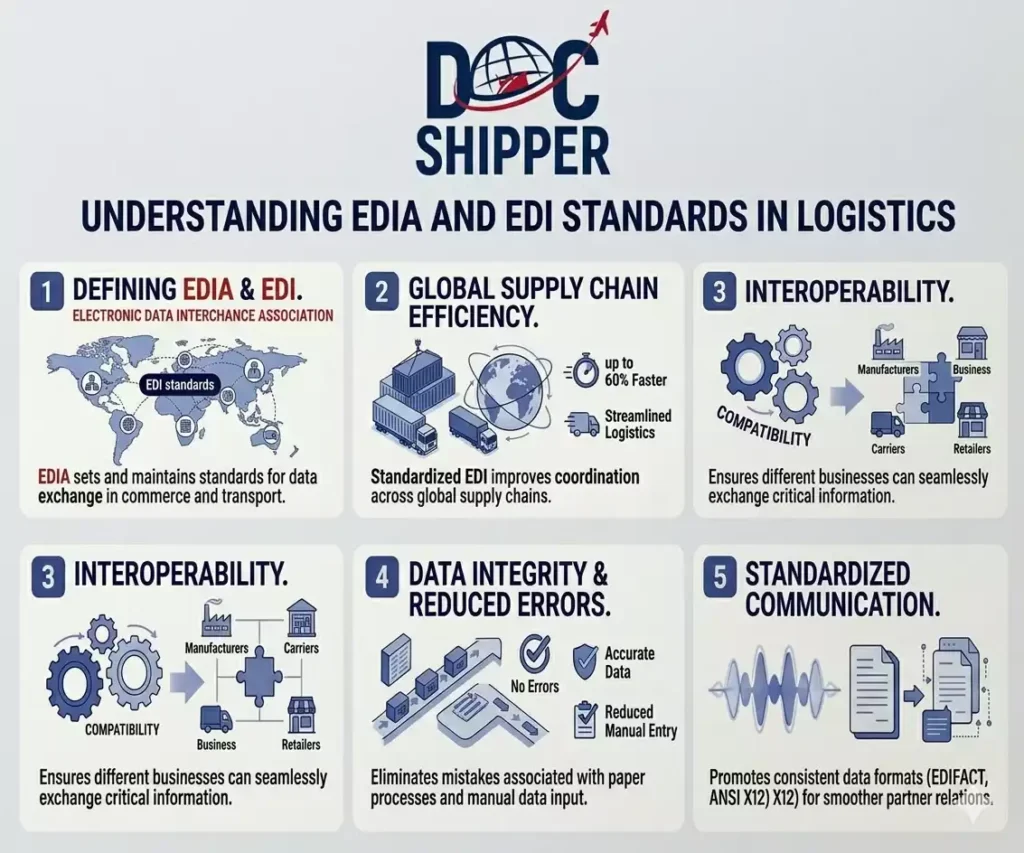
EDIA (Electronic Data Interchange Association) is a professional organization dedicated to promoting and standardizing Electronic Data Interchange (EDI) practices across industries. Founded to facilitate seamless digital communication between trading partners, EDIA develops guidelines, provides training, and advocates for interoperable standards that enable automated business document exchange in international logistics and supply chain management.
Introduction
In modern international trade, paper-based documentation creates bottlenecks that delay shipments, increase costs, and introduce errors. Companies struggle with incompatible systems when exchanging purchase orders, invoices, and customs declarations with global partners.
EDIA emerged as the industry answer to this fragmentation. By establishing common protocols and advocating for unified EDI standards, the association ensures that manufacturers, freight forwarders, customs brokers, and carriers can communicate seamlessly regardless of their internal software systems.
Key characteristics of EDIA’s mission include:
- Standards Development: Creating and maintaining EDI message formats compatible with UN/EDIFACT and ANSI X12
- Industry Advocacy: Representing members’ interests in regulatory discussions with customs authorities and trade bodies
- Education Programs: Offering certification courses for EDI specialists and supply chain professionals
- Interoperability Testing: Providing sandbox environments where companies validate system integrations before production deployment
- Best Practice Documentation: Publishing guidelines for secure data transmission and compliance with data protection regulations
EDIA Standards & Governance Framework
EDIA operates through a multi-stakeholder governance model where industry representatives, technology vendors, and regulatory advisors collaborate on standard development. The association coordinates with international bodies like GS1 and the UN/CEFACT to ensure global alignment.
The technical committees within EDIA focus on sector-specific needs. The Customs & Border Management Committee develops message formats for automated customs clearance systems. The Transport & Logistics Committee standardizes booking confirmations, bills of lading, and cargo manifests that carriers exchange with shippers.
EDIA’s certification program validates that software solutions comply with published standards. Vendors submit their platforms for conformance testing, ensuring their EDI translators correctly interpret message segments. This certification reduces integration risks when companies onboard new trading partners.
The association maintains a public repository of message implementation guidelines, complete with data element dictionaries and sample transactions. Companies can download templates for common scenarios like purchase order acknowledgments or advanced shipping notices, accelerating their EDI deployment timelines.
At DocShipper, we leverage EDIA-compliant systems to connect our clients with customs authorities and carriers worldwide. This standardization eliminates manual data re-entry, reducing clearance times by up to 60% compared to paper-based processes.
Industry Impact & Case Studies
EDIA’s standardization efforts have delivered measurable benefits across supply chains. Research indicates that companies adopting EDIA-endorsed EDI standards experience 30-40% reductions in document processing costs and 75% fewer data entry errors compared to manual workflows.
Case Study: Automotive Sector Integration
A European automotive manufacturer implemented EDIA’s recommended EDI framework to coordinate with 200+ suppliers across Asia and North America. By standardizing purchase order formats (ORDERS message) and delivery schedules (DELFOR message), the company reduced order cycle times from 72 hours to 4 hours. Inventory holding costs dropped by €3.2 million annually as just-in-time delivery accuracy improved to 98.7%.
Customs Modernization Program
When several African nations digitized their customs systems, EDIA partnered with government agencies to develop localized implementations of the CUSDEC (Customs Declaration) message. This collaboration enabled 95% of import declarations to process automatically, freeing customs officers to focus on high-risk shipments requiring physical inspection.
| Industry Sector | Key EDIA Standard | Measured Impact |
|---|---|---|
| Retail | DESADV (Despatch Advice) | Inventory accuracy +22%, stockouts -35% |
| Pharmaceuticals | IFTMIN (Forwarding Instructions) | Regulatory compliance time -50% |
| Maritime Shipping | IFTMBC (Booking Confirmation) | Container utilization +18% |
| Aerospace | INVOIC (Commercial Invoice) | Payment cycle time -40% |
Recent EDIA initiatives focus on blockchain integration for enhanced data immutability and API-based EDI that allows smaller businesses to participate without expensive infrastructure investments. The association’s RESTful API specifications enable companies to exchange structured data using modern web protocols while maintaining backward compatibility with legacy EDI systems.
Conclusion
EDIA’s work in standardizing electronic data exchange has fundamentally transformed how global supply chains operate. By providing frameworks that enable automated, error-free communication between disparate systems, the association reduces friction in international trade while improving transparency and compliance.
Need expert guidance on implementing EDI standards for your logistics operations? Contact DocShipper to discuss how EDIA-compliant solutions can streamline your supply chain workflows.
📚 Quiz
Test Your Knowledge: EDIA (Electronic Data Interchange Association)
1. What is the primary mission of EDIA in international trade?
2. A small business owner believes EDIA standards are legally mandatory for all international trade transactions. Is this interpretation correct?
3. An automotive manufacturer needs to reduce order cycle times with 200+ global suppliers. Which EDIA-compliant approach would be most appropriate?
🎯 Your Result
📞 Free Quote in 24hFAQ | EDIA (Electronic Data Interchange Association): Definition, Role & Impact on Global Trade
EDIA membership is open to manufacturers, logistics providers, software vendors, customs brokers, and any entity involved in electronic data exchange for trade. Individual memberships are available for consultants and technology specialists. Membership tiers accommodate both multinational corporations and small-to-medium enterprises, with scaled benefits including access to technical documentation, voting rights on standards development, and discounted training programs.
While GS1 focuses primarily on product identification through barcodes and GTIN numbers, EDIA specializes in the structure and transmission protocols for business documents exchanged between companies. EDIA works collaboratively with GS1, ensuring that identification standards integrate seamlessly with EDI message formats. The organizations complement each other—GS1 defines what to identify, EDIA defines how to communicate that information electronically.
EDIA standards are not legally mandatory, but many customs authorities and major trading partners require EDI compliance as a practical necessity for doing business. For instance, the EU's Union Customs Code mandates electronic declarations, which typically use EDIA-endorsed message formats. Similarly, large retailers and manufacturers often specify EDIA-compliant EDI as a prerequisite in supplier agreements to ensure system compatibility.
Implementation costs vary based on company size and existing infrastructure. Small businesses using cloud-based EDI services may spend $500-2,000 monthly for managed solutions. Mid-sized companies integrating EDI with ERP systems typically invest $50,000-150,000 in software and consulting. Large enterprises with custom integrations may spend $500,000+, but achieve ROI within 12-18 months through reduced labor costs and error corrections. EDIA provides cost calculators and vendor comparison tools to help organizations budget appropriately.
EDIA publishes security guidelines covering encryption protocols, authentication methods, and audit trail requirements. The association recommends AS2 (Applicability Statement 2) for secure internet-based EDI, which uses digital certificates and message signing to verify sender identity and data integrity. EDIA's security working group continuously updates recommendations to address emerging threats, including ransomware targeting supply chain communications and man-in-the-middle attacks on transaction data.
Yes, EDIA has developed hybrid architectures where traditional EDI messages trigger blockchain transactions for added transparency. For example, a shipping instruction (IFTMIN) can simultaneously update a distributed ledger, creating an immutable record of cargo handoffs between parties. This combination leverages EDI's structured data formats with blockchain's verification capabilities, particularly valuable for high-value goods requiring enhanced traceability like pharmaceuticals or luxury items.
EDIA provides tiered certification programs: Certified EDI Professional (foundational knowledge of message structures), Advanced EDI Specialist (focus on integration architecture), and EDI Systems Auditor (for compliance and security assessment). Courses are available online and through regional workshops, covering topics from basic EDIFACT syntax to complex mapping scenarios involving multiple standards. Many universities recognize EDIA certifications for continuing education credits in logistics and IT programs.
EDIA partners with value-added network (VAN) providers that offer simplified EDI solutions requiring minimal technical expertise. These turnkey services include web portals where users manually enter transaction data, which the VAN converts to proper EDI format for transmission. EDIA also maintains a directory of pre-certified software specifically designed for small businesses, often available as low-cost SaaS subscriptions. Regional EDIA chapters frequently host free introductory workshops to demystify EDI adoption.
EDIA collaborates with World Customs Organization (WCO) on digital transformation projects, particularly implementing the WCO Data Model through EDI messages. The association provides technical expertise during pilot programs where customs authorities transition from paper declarations to electronic systems. EDIA's involvement ensures that new customs platforms remain compatible with commercial systems already used by importers and freight forwarders, preventing costly rework and integration delays.
Major standard revisions occur every 3-5 years, with minor updates released annually to address identified issues or incorporate new business requirements. EDIA maintains a public change request system where members can propose modifications. Critical security patches or regulatory compliance updates may trigger emergency revisions outside the normal cycle. The association provides migration guides and grace periods (typically 18-24 months) when releasing backward-incompatible changes to existing message formats.
EDIA's latest specifications include provisions for IoT data integration, where sensor readings from temperature monitors, GPS trackers, or RFID tags can populate EDI message fields. For instance, a DESADV (Despatch Advice) can automatically include real-time temperature data from refrigerated containers, creating auditable records for cold chain compliance. This convergence of EDI and IoT enables predictive analytics, where sensor data patterns trigger automated reorder messages before stock depletion occurs.
EDIA offers mediation services when disputes arise over message interpretation or standard compliance. The association's technical advisory board can issue binding rulings on whether a party's implementation adheres to published specifications. For contractual disputes between trading partners regarding EDI performance obligations, EDIA provides neutral expert witnesses who can testify about industry-standard practices. These services help avoid costly litigation while maintaining business relationships critical to supply chain continuity.
Need Help with
Logistics or Sourcing ?
First, we secure the right products from the right suppliers at the right price by managing the sourcing process from start to finish. Then, we simplify your shipping experience - from pickup to final delivery - ensuring any product, anywhere, is delivered at highly competitive prices.


Fill the Form
Prefer email? Send us your inquiry, and we’ll get back to you as soon as possible.
Contact us




:%20Definition,%20Role%20&%20Impact%20on%20Global%20Trade)