


In short ⚡
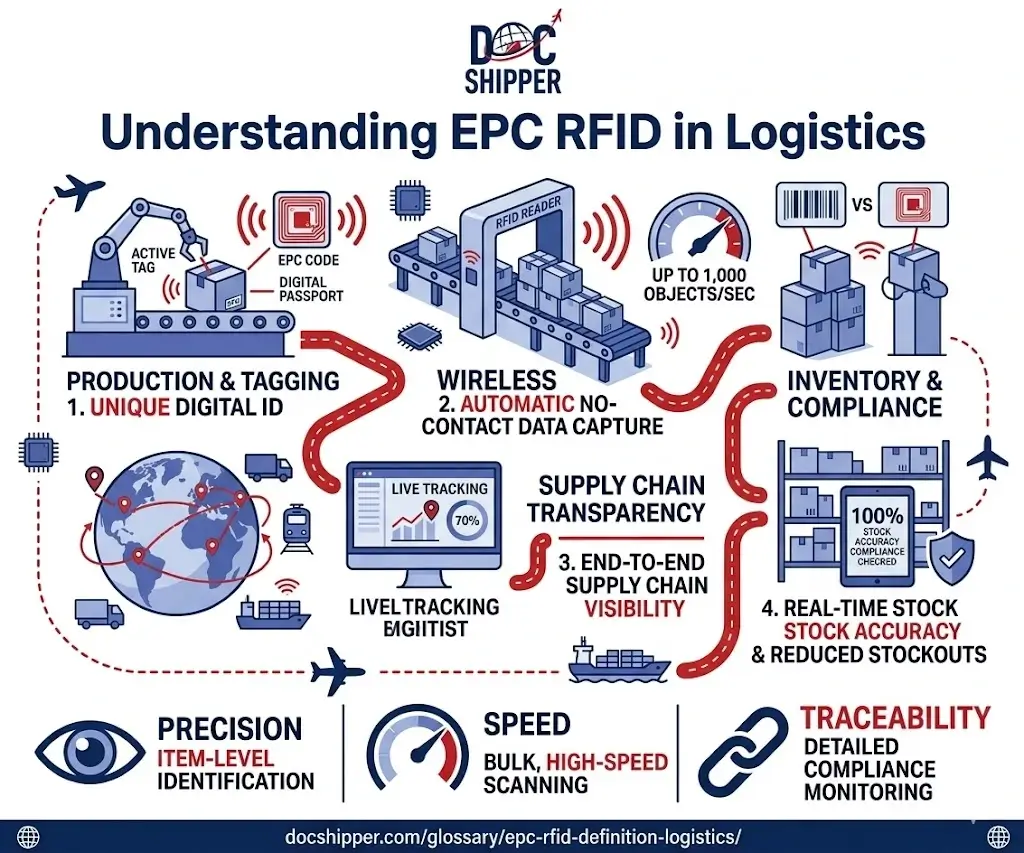
The Electronic Product Code (EPC) is a standardized electronic identifier used in RFID systems to uniquely track products throughout the global supply chain. Unlike traditional barcodes, EPC enables real-time, automated inventory management and traceability, storing detailed information about item origin, manufacturing date, and logistics status across international trade operations.
Introduction
In international logistics, confusing product identification methods often leads to costly errors. Misidentified shipments, lost containers, and inventory discrepancies plague importers and exporters daily. Traditional barcodes require line-of-sight scanning and provide limited data capacity.
The Electronic Product Code revolutionizes supply chain visibility by embedding comprehensive tracking data in radio-frequency tags. This technology has become essential for companies managing complex import/export operations across multiple countries and warehouses.
Key characteristics of EPC systems include:
- Unique identification: Each item receives a distinct digital signature traceable across borders
- RFID integration: Works with passive or active radio-frequency identification tags
- EPCglobal standards: Globally accepted protocols managed by GS1 organization
- Real-time tracking: Enables instant location updates without manual scanning
- Supply chain transparency: Links manufacturers, logistics providers, customs, and retailers in one data ecosystem
Technical Structure & Implementation
The EPC architecture comprises several standardized formats designed for different logistics applications. The most common structure follows the SGTIN (Serialized Global Trade Item Number) format, which extends the traditional GTIN barcode with serialization capabilities.
An EPC code typically contains four essential components:
- Header: Defines the EPC version and format type (8 bits)
- Manager Number: Identifies the company or brand owner (28 bits)
- Object Class: Specifies the product category or SKU (24 bits)
- Serial Number: Provides unique item-level identification (36 bits)
The technology operates through EPC Information Services (EPCIS), a standardized protocol enabling different systems to share event data. When goods cross borders, customs authorities and logistics partners access this shared database to verify authenticity and track movement history.
Legal compliance becomes critical in international trade. The GS1 EPCglobal standards ensure interoperability across countries with different regulatory frameworks. These standards define data formats, communication protocols, and security requirements for cross-border supply chains.
Implementation challenges often arise from infrastructure requirements. Warehouses need RFID readers at entry/exit points, loading docks, and storage areas. Integration with existing warehouse management systems (WMS) and enterprise resource planning (ERP) platforms requires careful planning.
At DocShipper, we implement EPC tracking systems for clients managing high-volume imports, ensuring seamless integration with customs clearance procedures and warehouse operations across Asia, Europe, and North America.
The security dimension cannot be overlooked. EPC tags can be encrypted to prevent counterfeiting and unauthorized tracking. For pharmaceutical shipments and luxury goods, this authentication layer proves essential for customs verification and brand protection.
Concrete Examples & Industry Data
Real-world implementation of EPC technology demonstrates measurable improvements in logistics efficiency. Consider these industry benchmarks:
| Industry Sector | Inventory Accuracy Improvement | Processing Time Reduction | ROI Timeline |
|---|---|---|---|
| Apparel & Retail | 96-99% (from 65%) | 40-50% faster receiving | 18-24 months |
| Pharmaceuticals | 99.8% accuracy | 65% reduction in recalls | 12-18 months |
| Electronics Manufacturing | 98% traceability | 30% faster shipping | 15-20 months |
| Automotive Parts | 99.5% accuracy | 55% labor reduction | 20-28 months |
Use Case: European Fashion Importer
A French clothing retailer importing 500,000 units annually from Bangladesh implemented EPC tagging at the factory level. Previously, manual barcode scanning required 6 staff members working 8 hours to process each container arrival.
After EPC implementation:
- Container processing time dropped to 45 minutes with 2 staff members
- Inventory discrepancies reduced from 8% to 0.3%
- Customs clearance accelerated by 40% due to instant data verification
- Annual labor cost savings: €180,000
- Stockout incidents decreased by 72%
The technology particularly shines in cross-border e-commerce. Chinese exporters using EPC tags report 28% faster fulfillment for European orders because warehouse automation systems instantly locate items without manual searching.
For cold chain logistics, EPC sensors combined with temperature monitoring provide real-time alerts. A pharmaceutical distributor reduced spoilage losses from $2.4M to $340K annually by detecting temperature deviations during ocean freight.
Conclusion
The Electronic Product Code transforms international logistics from reactive to predictive operations. Companies adopting this technology gain competitive advantages through precision tracking and automated compliance.
Need expert guidance implementing EPC systems in your supply chain? Contact DocShipper for customized logistics solutions across global markets.
📚 Quiz
Test Your Knowledge: Electronic Product Code (EPC)
What is the primary function of an Electronic Product Code in international logistics?
Which statement correctly describes a key advantage of EPC over traditional barcodes?
A pharmaceutical importer experiences frequent temperature-related spoilage during ocean freight. How can EPC technology address this challenge?
🎯 Your Result
📞 Free Quote in 24hFAQ | EPC (Electronic Product Code): Definition, Structure & Concrete Examples
EPC uses radio-frequency identification enabling bulk scanning without line-of-sight requirements, while barcodes need individual optical scanning. EPC stores significantly more data (up to 512 bits) compared to barcode limitations. Additionally, EPC tags can be read through packaging materials and at distances up to 12 meters, dramatically increasing warehouse efficiency for international shipments.
Entry-level EPC systems start around $15,000-$30,000 for basic RFID readers and software integration. Per-tag costs range from $0.05 to $0.25 for passive tags, depending on volume. Small importers handling 50,000+ units annually typically achieve ROI within 18-24 months through labor savings and inventory accuracy improvements. Cloud-based solutions reduce upfront infrastructure costs significantly.
Industrial-grade EPC tags withstand temperatures from -40°C to +85°C, humidity up to 95%, and physical impacts during container handling. Marine-resistant tags survive ocean freight salt exposure. For harsh environments, ruggedized tags with protective enclosures ensure functionality throughout multi-modal transport across continents. Tag durability testing follows ISO 18000-6C standards for global logistics applications.
Currently, no countries mandate EPC for all imports, but specific sectors face requirements. The EU Falsified Medicines Directive requires serialization (often EPC-based) for pharmaceuticals. China's drug traceability system increasingly relies on EPC standards. Australia and Brazil have pilot programs for agricultural imports. Voluntary adoption dominates most markets, driven by retailer requirements rather than customs regulations.
EPC enables instant data transmission to customs authorities before physical arrival, allowing pre-clearance processing. Automated systems verify product declarations against actual tagged inventory without manual inspection. This reduces clearance time by 30-50% for compliant shipments. Integration with customs single-window systems allows real-time duty calculation and risk assessment based on EPC data fields.
Standard EPC tags store manufacturer identification, product category, unique serial numbers, production date, and batch information. Extended EPC formats include expiration dates, country of origin, weight, dimensions, and handling instructions. Advanced implementations link to cloud databases containing complete product histories, quality certifications, and supply chain event records accessible throughout international logistics networks.
Modern EPC platforms offer APIs and middleware connecting to major WMS providers like SAP, Oracle, Manhattan Associates, and Blue Yonder. Integration typically requires 2-6 weeks for configuration and testing. Open-source solutions like Fosstrak enable custom integrations for proprietary systems. Most implementations use EPCIS (EPC Information Services) standard for seamless data exchange between partners globally.
Passive EPC tags typically serve single-use applications due to low cost and disposal convenience. Active tags with batteries (costing $25-$100) are designed for reuse across multiple shipments, lasting 3-7 years. Reusable tags make economic sense for high-value containers, pallets, and reusable packaging systems in closed-loop supply chains between regular trading partners.
EPC tags incorporate cryptographic authentication preventing cloning and unauthorized duplication. Each tag contains unique identifiers verified against manufacturer databases during customs inspection and retail delivery. Advanced implementations use blockchain integration for immutable transaction records. Luxury goods and pharmaceuticals increasingly rely on EPC authentication to combat the $1.7 trillion annual counterfeit trade problem.
Consumer privacy advocates worry about post-sale tracking through embedded tags. Best practices include kill commands deactivating tags at point-of-sale, encryption preventing unauthorized reading, and clear labeling indicating RFID presence. European GDPR regulations require transparency about data collection. Commercial EPC systems focus on supply chain visibility rather than consumer tracking, with data access restricted to authorized supply chain partners.
Freight forwarders using EPC systems reduce manual documentation by 60-70% through automated cargo manifest generation. Real-time visibility enables proactive exception management for delayed shipments. Container-level EPC tracking improves yard management at consolidation warehouses. Integration with carrier systems allows seamless handoffs between transport modes. Leading forwarders report 35% improvement in on-time delivery performance after EPC adoption.
Basic EPC operations require 4-8 hours of training covering reader operation, exception handling, and system interface navigation. Advanced training for supervisors includes data analysis, system troubleshooting, and reporting functions, typically 2-3 days. Most systems feature intuitive interfaces reducing learning curves. Ongoing support and refresher sessions every 6 months maintain operational proficiency across multi-shift warehouse environments handling international cargo.
Need Help with
Logistics or Sourcing ?
First, we secure the right products from the right suppliers at the right price by managing the sourcing process from start to finish. Then, we simplify your shipping experience - from pickup to final delivery - ensuring any product, anywhere, is delivered at highly competitive prices.


Fill the Form
Prefer email? Send us your inquiry, and we’ll get back to you as soon as possible.
Contact us




:%20Definition,%20Structure%20&%20Concrete%20Examples)