


In short ⚡
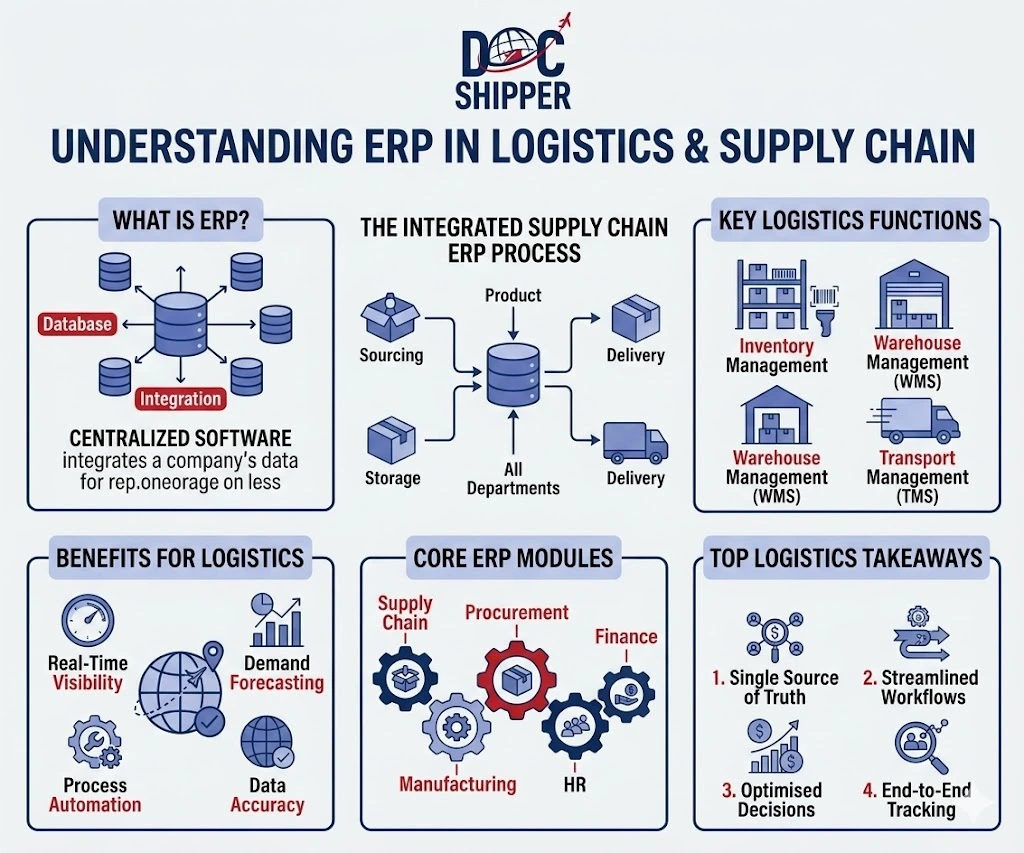
Enterprise Resource Planning (ERP) is an integrated software system that centralizes and automates core business processes across departments—including finance, inventory, procurement, production, and logistics—into a unified database. By consolidating real-time data from multiple functions, ERP systems enable companies to improve operational efficiency, enhance decision-making, and ensure regulatory compliance throughout the supply chain.
Introduction
Many import-export businesses struggle with fragmented data spread across spreadsheets, disconnected software, and manual workflows. This siloed approach leads to inventory discrepancies, delayed shipments, compliance errors, and lost revenue. In today’s fast-paced global trade environment, these inefficiencies can make or break your competitive edge.
An ERP system solves this challenge by integrating all operational data into a single platform. From purchase orders to customs documentation, every transaction is tracked in real time. This visibility is critical for logistics providers, freight forwarders, and manufacturers who must coordinate complex international shipments while staying compliant with ever-changing regulations.
Key characteristics of modern ERP solutions include:
- Unified Database: One central repository eliminates redundant data entry and ensures consistency across departments.
- Real-Time Visibility: Instant access to inventory levels, order status, and financial data accelerates decision-making.
- Automation: Reduces manual tasks like invoicing, procurement approvals, and report generation.
- Scalability: Adapts to business growth, new markets, and additional product lines without requiring complete system overhauls.
- Compliance Tools: Built-in features for customs declarations, HS code management, and audit trails ensure regulatory adherence.
In-Depth Analysis & Expertise
At its core, an ERP system operates on a modular architecture. Each module—such as Warehouse Management, Financial Accounting, or Customer Relationship Management—connects to the central database. When a sales order is entered, the system automatically updates inventory, triggers procurement if stock is low, schedules production, and generates shipping documents. This seamless flow eliminates bottlenecks and human error.
For international logistics, ERP functionality extends to customs compliance. Advanced platforms integrate with HS code databases and automatically calculate duties, taxes, and trade agreements. This automation is vital when handling hundreds of SKUs across multiple countries, each with unique import regulations.
Implementation typically follows a phased approach. Companies start by mapping existing workflows, then configure the ERP to mirror—and optimize—those processes. Data migration is a critical phase: historical records, customer profiles, and supplier information must be cleansed and transferred accurately. At DocShipper, we assist clients in preparing logistics data for ERP integration, ensuring zero disruption during cutover.
Cloud-based ERP solutions have revolutionized accessibility. Teams can access the platform from anywhere, essential for freight forwarders coordinating shipments across time zones. Mobile apps allow warehouse staff to scan barcodes, update inventory, and confirm deliveries in real time. This mobility reduces paperwork and accelerates fulfillment cycles.
Security is paramount. Modern ERPs employ role-based access controls, encrypting sensitive financial and customer data. Audit trails log every transaction, a requirement for ISO certification and regulatory audits. These features protect against fraud while providing transparency for stakeholders and tax authorities.
Concrete Examples & Data
Consider a mid-sized electronics importer processing 3,000 shipments annually from Asia to Europe. Before ERP adoption, the company relied on Excel for inventory tracking and separate software for accounting. Order errors occurred in 12% of shipments, resulting in costly delays and customer complaints.
After implementing an ERP with integrated logistics modules, the business achieved measurable improvements:
- Order Accuracy: Error rate dropped to 2% thanks to automated order validation and real-time inventory checks.
- Lead Time Reduction: Average processing time fell from 6 days to 3 days, improving cash flow and customer satisfaction.
- Customs Compliance: Zero penalties or shipment holds in the first year, compared to four incidents previously.
- Cost Savings: Administrative overhead decreased by 22% through automation of invoicing, reporting, and document generation.
Below is a comparison of key metrics before and after ERP implementation:
| Metric | Before ERP | After ERP | Improvement |
|---|---|---|---|
| Order Error Rate | 12% | 2% | -83% |
| Processing Time (days) | 6 | 3 | -50% |
| Customs Penalties | 4 incidents/year | 0 | -100% |
| Admin Cost Reduction | Baseline | -22% | Significant |
| Inventory Accuracy | 78% | 96% | +23% |
Another example: a garment manufacturer coordinating production across three countries. The ERP’s bill-of-materials module tracks fabric inventory, calculates reorder points, and schedules production runs. When raw material prices fluctuate, the system alerts procurement teams, enabling proactive negotiation with suppliers. This responsiveness reduced material costs by 8% annually.
In freight forwarding, DocShipper leverages ERP integrations to synchronize client shipment data with carrier schedules. When a container is delayed, the system automatically recalculates delivery dates and notifies all stakeholders. This transparency builds trust and reduces the 30+ emails typically exchanged per shipment.
Conclusion
Enterprise Resource Planning systems are no longer a luxury—they are essential infrastructure for businesses navigating the complexities of global trade. By centralizing data, automating workflows, and ensuring compliance, ERPs transform logistics operations from reactive firefighting into strategic, data-driven management.
Need guidance on ERP selection or data preparation for your logistics operations? Contact DocShipper to discuss how we can streamline your supply chain integration.
📚 Quiz
Test Your Knowledge: ERP (Enterprise Resource Planning)
What is the core function of an ERP system in logistics operations?
Which statement correctly describes ERP's role in customs compliance?
A mid-sized electronics importer processes 3,000 annual shipments and experiences 12% order errors using spreadsheets. What realistic improvement can they expect after ERP implementation?
🎯 Your Result
📞 Free Personalized QuoteFAQ | ERP (Enterprise Resource Planning): Definition, Features & Concrete Examples
The primary benefit is real-time visibility across the entire supply chain. An ERP consolidates inventory, order status, shipping documents, and financial data into one platform, eliminating manual tracking and reducing errors. This transparency enables faster decision-making, improved customer service, and better compliance with customs regulations.
Implementation timelines vary based on company size and complexity. Small businesses with straightforward workflows may complete deployment in 3 to 6 months. Mid-sized enterprises with multiple locations often require 9 to 18 months. Large corporations with legacy systems and extensive customization needs can take 2 to 3 years. Phased rollouts reduce risk and allow for incremental adjustments.
Yes, modern ERPs offer API connections and pre-built integrations with common logistics platforms, e-commerce systems, and accounting tools. Middleware solutions facilitate data exchange between the ERP and specialized applications like warehouse management systems (WMS) or transportation management systems (TMS). This flexibility preserves investments in existing technology while gaining ERP benefits.
An ERP manages enterprise-wide processes—finance, procurement, production, and sales—while a Warehouse Management System (WMS) focuses specifically on warehouse operations like receiving, putaway, picking, and shipping. Many ERPs include basic WMS modules, but high-volume distributors often deploy specialized WMS software that integrates with the ERP for granular inventory control.
Cloud ERPs employ bank-level encryption, multi-factor authentication, and regular security audits. Reputable providers comply with ISO 27001 and GDPR standards. Data is backed up across geographically distributed servers, offering better disaster recovery than on-premise systems. However, companies must enforce strong password policies and role-based access controls to maximize security.
ERP systems store HS codes, country-of-origin data, and trade agreement rules in the central database. When creating export documentation, the software automatically applies correct tariffs, validates licenses, and flags restricted goods. Audit trails document every transaction, simplifying customs inspections. This automation reduces the 90% error rate common with manual spreadsheet processes.
Most companies achieve positive ROI within 18 to 36 months. Cost savings come from reduced labor, fewer errors, lower inventory carrying costs, and improved cash flow. A study by Panorama Consulting found that 67% of organizations recoup implementation costs through operational efficiencies within three years. Faster adoption occurs when leadership commits to training and process optimization.
Small businesses benefit from entry-level ERP solutions designed for 10 to 50 users. These platforms offer essential features—inventory tracking, invoicing, and reporting—at affordable subscription rates. As order volumes grow, the ERP scales without requiring a complete system replacement. Even startups handling 100+ shipments monthly gain efficiency from centralized data versus manual spreadsheets.
Key challenges include data migration errors, insufficient user training, and resistance to process changes. Poor planning leads to budget overruns and extended timelines. To mitigate risks, companies should conduct thorough needs assessments, allocate 15-20% of the budget for training, and appoint experienced project managers. Engaging employees early in the process fosters buy-in and smoother adoption.
Yes, enterprise-grade ERPs support unlimited currencies and multiple languages within a single instance. The system automatically converts financial transactions at real-time exchange rates and generates reports in the user's preferred language. This capability is critical for importers and exporters managing subsidiaries across continents. Tax calculations adjust based on jurisdiction, ensuring compliance with local regulations.
ERP systems analyze historical sales data, seasonal trends, and market conditions to predict future demand. Machine learning algorithms improve accuracy over time. Procurement teams use these forecasts to optimize inventory levels, reducing stockouts and excess inventory. For perishable goods or fast-fashion items, accurate forecasting prevents $50,000+ losses from unsold inventory or missed sales opportunities.
Cloud ERPs handle software updates and security patches automatically, reducing IT burden. On-premise systems require dedicated staff for server maintenance, backups, and upgrades. All ERPs need periodic database optimization, user permission reviews, and custom report adjustments. Budget 10-15% of initial implementation costs annually for support contracts, training refreshers, and minor customizations as business needs evolve.
Need Help with
Logistics or Sourcing ?
First, we secure the right products from the right suppliers at the right price by managing the sourcing process from start to finish. Then, we simplify your shipping experience - from pickup to final delivery - ensuring any product, anywhere, is delivered at highly competitive prices.


Fill the Form
Prefer email? Send us your inquiry, and we’ll get back to you as soon as possible.
Contact us




:%20Definition,%20Features%20&%20Concrete%20Examples)