


In short ⚡
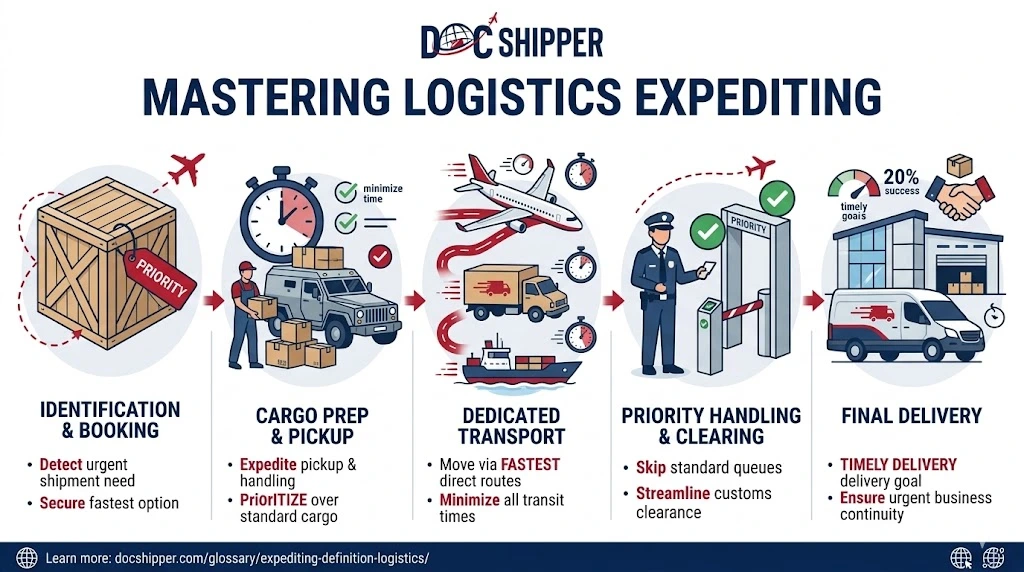
Expediting is a proactive supply chain management practice that involves accelerating production, shipping, or delivery processes to meet tight deadlines. This technique ensures critical shipments arrive on time by actively monitoring supplier performance, identifying bottlenecks, and implementing corrective actions throughout the logistics chain.
Introduction
Delayed shipments cost businesses an estimated $75 billion annually in lost productivity and missed opportunities. Many importers discover production delays too late, leaving insufficient time for corrective action. Expediting transforms reactive crisis management into proactive risk mitigation.
In international trade, where lead times span weeks or months, expediting serves as an early warning system that protects delivery schedules. This practice becomes essential when managing time-sensitive projects, seasonal inventory, or just-in-time manufacturing requirements.
- Continuous monitoring: Regular supplier communication to track production milestones and identify deviations early
- Bottleneck resolution: Swift intervention when delays occur, including alternative supplier coordination or expedited shipping arrangements
- Documentation acceleration: Priority processing of certificates, customs documents, and quality inspections to prevent administrative delays
- Logistics optimization: Rerouting shipments, upgrading transport modes, or consolidating partial deliveries to maintain timelines
- Stakeholder coordination: Aligning manufacturers, freight forwarders, customs brokers, and final recipients around shared deadline objectives
In-Depth Analysis & Expert Mechanisms
Effective expediting operates through structured intervention protocols rather than ad-hoc problem solving. Professional expeditors establish clear communication schedules with suppliers—typically weekly during production and daily during critical phases. These touchpoints verify raw material availability, production progress percentages, quality control checkpoints, and estimated completion dates.
The practice distinguishes itself through predictive delay identification. Experienced expeditors recognize warning signs weeks before official delays materialize: supplier communication becoming less responsive, vague progress updates, or repeated requests to reschedule inspection visits. Early detection enables corrective action while options remain flexible and cost-effective.
Escalation frameworks form the backbone of professional expediting. When suppliers miss agreed milestones, expeditors implement graduated responses: initial courtesy reminders, formal delay notifications to purchasing teams, management-level escalation calls, and ultimately contingency supplier activation. At DocShipper, we maintain pre-qualified alternative suppliers for critical components, enabling rapid production transfers when primary sources fail to deliver.
International expediting requires understanding regulatory acceleration mechanisms. Many customs authorities offer expedited clearance programs for established importers with strong compliance records. The U.S. Customs-Trade Partnership Against Terrorism (C-TPAT) provides faster processing for certified members, while the EU’s Authorized Economic Operator (AEO) status delivers similar benefits across European borders.
Transportation mode flexibility represents another expediting cornerstone. When ocean freight threatens deadline compliance, expeditors evaluate partial air shipment economics—often flying critical components while shipping bulk items by sea. This hybrid approach balances urgency against budget constraints, calculating whether expediting costs justify avoiding stockout penalties or production line shutdowns.
Modern expediting increasingly leverages digital tracking technologies. IoT sensors provide real-time container location data, temperature monitoring for sensitive goods, and automated delay alerts. These systems reduce manual follow-up requirements while increasing intervention speed. DocShipper’s platform integrates supplier production dashboards with shipment tracking, creating unified visibility across the entire supply chain timeline.
Practical Cases & Performance Data
Consider an automotive manufacturer facing a three-week production delay on custom engine components from a Chinese supplier. Standard response involves accepting the delay and adjusting assembly schedules. Professional expediting offers alternatives: relocating production to the supplier’s secondary factory with available capacity, arranging partial air freight for completed units while production continues, or coordinating with the supplier’s raw material vendor to accelerate steel delivery.
The electronics sector demonstrates expediting’s financial impact. When a smartphone manufacturer discovered display panel shortages would delay a product launch by six weeks, expeditors negotiated a production priority upgrade by committing to increased order volumes. The supplier reallocated production capacity from lower-priority clients, reducing delay to nine days. The $180,000 expediting cost prevented an estimated $8.7 million revenue loss from missing the holiday sales window.
| Scenario | Standard Approach | Expediting Intervention | Time Saved |
|---|---|---|---|
| Production Delay | Accept revised timeline | Daily supplier calls + management escalation | 14 days |
| Customs Hold | Submit additional documents | Customs broker direct contact + pre-cleared alternatives | 5 days |
| Port Congestion | Wait in queue | Reroute to alternative port + expedited inland transport | 8 days |
| Quality Failure | Restart production cycle | Parallel backup supplier activation | 21 days |
| Documentation Error | Correct and resubmit | Pre-clearance document verification + expedited corrections | 3 days |
A European fashion retailer provides another instructive case. Seasonal collections require precise delivery timing—arriving too early increases warehousing costs, while late delivery misses peak sales periods. Their expediting strategy includes:
- Milestone-based payments: Supplier compensation tied to production phase completion rather than final delivery, incentivizing schedule adherence
- Backup logistics capacity: Pre-negotiated air freight contracts activated when ocean shipments face delays, with costs shared between supplier and retailer
- Quality gate expediting: On-site inspectors at manufacturing facilities who approve production batches immediately rather than awaiting remote reviews
- Partial shipment authorization: Completed items ship immediately while production continues, reducing all-or-nothing delivery risk
Industry data reveals expediting’s effectiveness: companies employing dedicated expediting functions report 34% fewer delivery delays compared to reactive management approaches. The practice proves particularly valuable for high-value, low-volume shipments where delay costs significantly exceed expediting investment. Pharmaceutical cold chain shipments, aerospace components, and event-specific merchandise represent ideal expediting candidates.
Cost structures vary considerably. Simple production monitoring services range from $200-500 weekly, while comprehensive expediting including backup supplier coordination and logistics rerouting may reach 3-5% of shipment value. Companies typically break even when expediting prevents delays costing twice the service fee—a threshold met in approximately 68% of interventions according to supply chain benchmarking data.
Conclusion
Expediting transforms supply chain uncertainty into manageable risk through proactive monitoring, structured intervention protocols, and flexible logistics alternatives. Companies that treat expediting as strategic investment rather than emergency expense maintain competitive advantage through reliable delivery performance.
Need expert support managing time-critical shipments? Contact DocShipper for comprehensive expediting services tailored to your supply chain requirements.
📚 Quiz
Test Your Knowledge: Expediting
What is the primary focus of expediting in supply chain management?
A company believes expediting and express shipping are the same thing. Is this interpretation correct?
An automotive manufacturer discovers their Chinese supplier will miss delivery deadlines by three weeks. Which response represents proper expediting application?
🎯 Your Results
📞 Free Personalized QuoteFAQ | Expediting: Definition, Process & Practical Applications in Logistics
Express shipping refers to faster transportation modes (air freight vs. ocean), while expediting encompasses broader supply chain acceleration including production monitoring, documentation prioritization, and bottleneck resolution. Expediting may utilize express shipping as one tool among many interventions. The practice focuses on preventing delays rather than merely reacting with faster transport once problems occur.
Expediting justifies investment when delay costs exceed service fees—typically for time-sensitive projects, seasonal merchandise, just-in-time manufacturing inputs, or penalty-clause contracts. Companies importing high-value goods, managing complex supplier networks, or operating with minimal safety stock benefit most. First-time imports from unproven suppliers also warrant expediting to establish performance baselines.
Professional expeditors leverage multiple influence mechanisms: regular communication establishing accountability, management-level escalation when delays occur, order volume commitments in exchange for priority scheduling, quality inspection expediting to prevent approval delays, and contractual penalties for missed milestones. Relationships with alternative suppliers provide credible backup threats that motivate primary sources.
No practice eliminates all delays—natural disasters, strikes, or force majeure events exceed expediting control. However, professional expediting reduces delay frequency by 30-40% and minimizes delay duration through rapid intervention. The value lies in converting unmanaged uncertainty into calculated risk with contingency responses prepared in advance.
Effective expediting needs detailed production schedules with milestone dates, raw material procurement timelines, quality inspection plans, current work-in-progress quantities, and contact information for production managers. Suppliers should provide weekly progress updates including percentage completion, photos of work progress, and immediate notification of any issues affecting schedules.
Ocean freight expediting focuses on documentation accuracy (preventing customs delays), booking priority during capacity constraints, container prioritization at terminals, and real-time tracking to identify delays early. When vessels face significant delays, expeditors evaluate partial air shipment economics or rerouting through alternative ports with better congestion profiles.
Purchase agreements should include specific delivery milestones with financial penalties, supplier authorization for third-party expeditor communication, right to inspect production facilities, and provisions for backup supplier activation. Incoterms selection affects expediting leverage—DDP terms provide importers greater control than EXW arrangements. Force majeure clauses should define acceptable delays versus supplier-caused issues.
Reputable expeditors guarantee maximum effort and structured intervention processes but cannot guarantee delivery outcomes dependent on supplier cooperation and external factors. Service agreements typically specify response times for identified issues, communication frequency, and escalation protocols rather than absolute delivery date guarantees. Performance metrics focus on delay reduction percentages and issue resolution speed.
Modern expediting platforms integrate supplier production tracking, shipment GPS monitoring, automated delay alerts, document management systems, and supplier communication logs into unified dashboards. AI algorithms identify delay patterns and recommend interventions. IoT sensors provide real-time cargo condition monitoring for temperature-sensitive goods. These technologies reduce manual follow-up while accelerating problem identification.
Automotive (just-in-time parts), electronics (product launch deadlines), fashion (seasonal collections), pharmaceuticals (shelf-life constraints), aerospace (flight schedule dependencies), and construction (project milestones) represent primary expediting beneficiaries. Any industry where delay costs significantly exceed inventory carrying costs finds expediting economically justified.
Expediting scales to shipment value and complexity. Basic production monitoring services start at minimal monthly fees, while comprehensive programs cost 2-5% of shipment value. Small importers often utilize expediting for critical shipments while managing routine orders through standard processes. The practice proves most cost-effective for shipments where one-week delays justify several hundred dollars in preventive monitoring.
Professional expeditors work alongside freight forwarders rather than replacing them. Expeditors focus on production and supply-side acceleration, while forwarders handle transport execution. Coordination involves sharing shipment readiness information, evaluating transport mode alternatives when delays occur, prioritizing customs clearance for time-sensitive cargo, and managing documentation flows between suppliers and logistics providers.
Need Help with
Logistics or Sourcing ?
First, we secure the right products from the right suppliers at the right price by managing the sourcing process from start to finish. Then, we simplify your shipping experience - from pickup to final delivery - ensuring any product, anywhere, is delivered at highly competitive prices.


Fill the Form
Prefer email? Send us your inquiry, and we’ll get back to you as soon as possible.
Contact us




