


In short ⚡
Express shipping is a premium logistics service that guarantees accelerated delivery of goods, typically within 24 to 72 hours, with priority handling, real-time tracking, and door-to-door service. Widely used in international trade, it ensures time-sensitive shipments reach their destination quickly and securely, making it essential for urgent business operations and high-value cargo.Introduction
In today’s global marketplace, delays can cost businesses thousands of dollars in lost sales and damaged reputations. Many companies struggle to differentiate between standard freight and express services, often choosing the wrong option for their critical shipments. This confusion leads to missed deadlines, dissatisfied customers, and unnecessary expenses.
Express shipping plays a crucial role in modern supply chains, particularly for companies engaged in international trade. It bridges the gap between urgent business needs and logistical realities, enabling e-commerce operations, just-in-time manufacturing, and emergency replenishment scenarios. Understanding this service is essential for importers and exporters who prioritize speed and reliability.
Key characteristics of express shipping include:
- Speed priority: Dedicated transportation networks with minimal handling points
- Guaranteed delivery windows: Contractual commitments to specific timeframes
- Enhanced tracking: Real-time visibility throughout the entire journey
- Customs facilitation: Expedited clearance procedures and documentation support
- Premium pricing: Higher costs reflecting the specialized infrastructure and priority handling
Express Shipping Mechanisms & Expertise
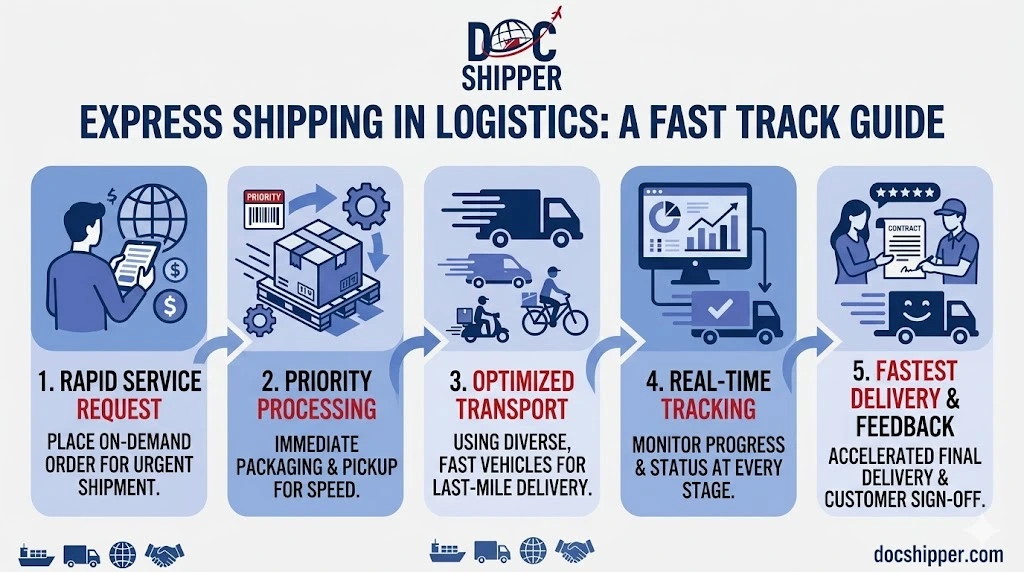
Express services operate through dedicated transportation networks that bypass standard consolidation points. Major carriers like DHL, FedEx, and UPS maintain their own aircraft fleets and ground networks, ensuring shipments move continuously without waiting for container consolidation or scheduled departures.
The customs clearance advantage distinguishes express from standard freight. Express carriers typically hold Authorized Economic Operator (AEO) status and maintain direct electronic connections with customs authorities worldwide. This enables pre-clearance procedures, where documentation is processed before the shipment physically arrives, reducing border delays to mere hours rather than days.
From a regulatory perspective, express shipments often benefit from simplified customs procedures. The World Customs Organization’s Revised Kyoto Convention recognizes express consignments as requiring expedited treatment. The WCO guidelines establish frameworks that member countries implement to facilitate rapid clearance of these shipments.
Service Level Agreements (SLAs) form the contractual backbone of express shipping. These legally binding commitments specify exact delivery timeframes, compensation for delays, and performance guarantees. Unlike standard freight where delivery estimates are approximate, express SLAs create enforceable obligations that protect shippers.
At DocShipper, we leverage our partnerships with leading express carriers to secure preferential rates and priority handling for our clients. Our team verifies all documentation requirements upfront and coordinates customs clearance to ensure your urgent shipments move without delays or unexpected costs.
The insurance and liability framework also differs significantly. Express carriers typically include higher automatic coverage limits and offer streamlined claims processes. Standard freight may require separate insurance arrangements, while express services integrate protection as part of their premium offering, reflecting the higher-value cargo they typically handle.
Practical Examples & Data
Understanding express shipping becomes clearer through real-world applications and comparative analysis. The following examples illustrate how businesses utilize this service across different scenarios and industries.
Comparative Analysis: Express vs. Standard Freight
| Criteria | Express Shipping | Standard Air Freight |
|---|---|---|
| Transit Time (US-EU) | 24-48 hours | 5-7 days |
| Cost per kg | $15-$35 | $5-$12 |
| Tracking Updates | Real-time (every scan point) | Daily milestones |
| Delivery Guarantee | Money-back SLA | Best-effort estimate |
| Customs Clearance | Pre-clearance, 2-4 hours | Standard process, 1-3 days |
Use Case: E-commerce Electronics Retailer
A European electronics retailer needed to replenish stock of a popular smartphone model before a weekend sale. Standard air freight would take 6 days, risking €50,000 in lost revenue. They chose express shipping from China to Germany:
- Shipment details: 200kg of smartphones (value: €120,000)
- Express cost: €5,400 vs. standard freight €1,800
- Transit time: 36 hours door-to-door
- Outcome: Stock arrived Thursday morning, sale proceeded, generating €85,000 in weekend revenue
- ROI calculation: Additional €3,600 expense saved €50,000 in opportunity costs
Industry Statistics
According to recent market analysis, the global express shipping market demonstrates significant growth patterns:
- Market value reached $362 billion in 2023, with projected CAGR of 7.2% through 2030
- E-commerce drives approximately 65% of express shipment volume globally
- Average express shipment weight: 2.5kg (compared to 150kg for standard air freight)
- Time-definite services account for 78% of express cargo value despite representing only 15% of total air freight tonnage
- Cross-border express shipments increased by 23% in 2022-2023, reflecting global e-commerce expansion
These data points underscore express shipping’s critical role in modern commerce, particularly as businesses prioritize speed-to-market and customer satisfaction over pure cost minimization.
Conclusion
Express shipping represents a strategic logistics solution that trades higher costs for speed, reliability, and peace of mind in time-critical situations. Understanding when to deploy this service—and how to optimize its use—separates successful international traders from those who struggle with supply chain disruptions.
Need expert guidance on express shipping options for your specific requirements? Contact DocShipper for personalized logistics solutions that balance speed, cost, and reliability for your international shipments.
📚 Quiz
Test Your Knowledge: Express Shipping
1. What is the primary defining characteristic of express shipping?
2. How does express shipping achieve faster customs clearance compared to standard freight?
3. A European electronics retailer needs to replenish 200kg of smartphones from China before a weekend sale. Standard air freight takes 6 days and costs €1,800, while express shipping takes 36 hours and costs €5,400. Which option represents the correct business decision?
🎯 Your Result
📞 Free Quote in 24hFAQ | Express Shipping: Definition, Features & Practical Examples
Most express carriers accept shipments up to 70kg per piece, with total shipment weights reaching several hundred kilograms. However, optimal express shipping typically handles parcels under 30kg. Heavier cargo often becomes more cost-effective through standard air freight, though some carriers offer heavyweight express services for urgent shipments up to 500kg with specialized pricing structures.
Express carriers typically offer two models: DDP (Delivered Duty Paid) where all fees are prepaid, or DDU (Delivered Duty Unpaid) where the recipient pays upon delivery. Many services include customs brokerage as part of their fee, managing documentation and duty calculations. This differs from standard freight where customs clearance is often arranged separately by the importer or their customs broker.
Express carriers accept certain dangerous goods under strict IATA regulations, including lithium batteries, dry ice, and some medical specimens. However, restrictions are more stringent than standard cargo due to passenger aircraft limitations. Prohibited items include most flammable liquids, explosives, and toxic substances. Shippers must complete specialized dangerous goods declarations and packaging requirements before acceptance.
Essential documents include a commercial invoice (minimum three copies), shipping label with tracking number, and customs declaration forms. Depending on the destination and goods type, additional paperwork may include certificates of origin, product safety certifications, or import licenses. Express carriers provide electronic systems to generate these documents, streamlining the process compared to traditional freight forwarding.
Major carriers achieve on-time delivery rates exceeding 95% for domestic express services and 90-93% for international routes. Service guarantees typically offer refunds or credits for late deliveries, though force majeure events (weather, strikes, customs delays) may void guarantees. Reading SLA terms carefully reveals specific conditions and exclusions that affect reliability commitments.
Next-day express guarantees delivery by the following business day, typically before 10:30 AM or end-of-day depending on service tier. Same-day express, available in major cities, delivers within hours of pickup, usually within 4-6 hours for metropolitan areas. Same-day costs 2-3 times more than next-day and operates within limited geographic zones, while next-day covers broader international networks.
Express carriers apply dimensional weight (volumetric weight) calculations when package volume exceeds actual weight relative to density standards. The formula divides package dimensions (L×W×H in cm) by a divisor (typically 5000 for express). If dimensional weight exceeds actual weight, the higher figure determines pricing. This prevents oversized, lightweight packages from occupying disproportionate aircraft space at below-cost rates.
Yes, express carriers provide real-time tracking through web portals and mobile apps, updating at each scan point throughout the journey. Modern systems offer GPS tracking for ground transportation segments and predictive delivery estimates. Notifications alert senders and recipients of key milestones including pickup, customs clearance, and out-for-delivery status, providing transparency that standard freight rarely matches.
Carriers typically investigate delays immediately and provide status updates within 24 hours. For guaranteed services missing delivery windows, automatic refunds or credits apply per SLA terms. Lost shipments trigger formal claims processes where declared value determines compensation, usually up to carrier liability limits ($100-$500 automatic coverage). Additional insurance purchased at shipping time provides higher reimbursement for valuable cargo.
Express shipping's carbon footprint per shipment is higher than consolidated freight due to dedicated flights and vehicles operating with partial loads. However, major carriers increasingly invest in carbon offset programs, alternative fuel vehicles, and route optimization to reduce environmental impact. Some offer carbon-neutral shipping options where fees fund renewable energy projects. Businesses balancing speed needs with sustainability goals should consider these programs.
Key factors include destination coverage strength (some carriers excel in specific regions), pricing for your typical shipment profile, customs clearance reputation, tracking system quality, and customer service responsiveness. Request quotes from multiple carriers, examine their SLA terms, and test their services with smaller shipments before committing to high-value cargo. At DocShipper, we maintain partnerships with top carriers and can recommend optimal choices based on your specific route and requirements.
Specialized express services offer temperature-controlled transportation using insulated packaging and monitoring systems. These services maintain specific temperature ranges (2-8°C for vaccines, -20°C for frozen specimens) throughout transit. However, not all express lanes support cold chain logistics, and costs significantly exceed standard express rates. Shippers must validate lane availability, provide specialized packaging, and include temperature data loggers for compliance documentation.
Need Help with
Logistics or Sourcing ?
First, we secure the right products from the right suppliers at the right price by managing the sourcing process from start to finish. Then, we simplify your shipping experience - from pickup to final delivery - ensuring any product, anywhere, is delivered at highly competitive prices.


Fill the Form
Prefer email? Send us your inquiry, and we’ll get back to you as soon as possible.
Contact us




