


In short ⚡
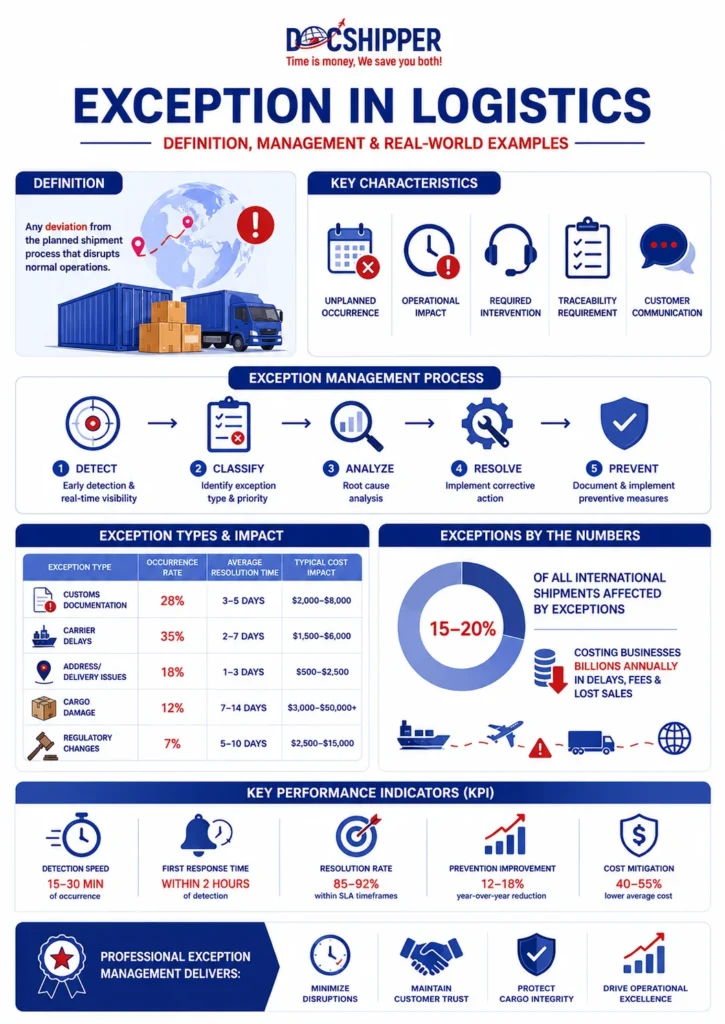
An exception in logistics refers to any deviation from the planned shipment process that disrupts normal operations. These irregularities—ranging from customs delays to damaged cargo—require immediate attention and corrective action to minimize supply chain disruptions and maintain customer satisfaction.
Introduction
Every logistics professional has faced that dreaded notification: “Shipment exception detected.” This simple alert signals that your carefully orchestrated supply chain has encountered an unexpected obstacle. In international trade, where timing and precision are critical, exceptions can transform routine shipments into costly nightmares.
Understanding and managing logistics exceptions is fundamental to operational excellence. These disruptions affect approximately 15-20% of all international shipments, costing businesses billions annually in delays, storage fees, and lost sales opportunities.
Key characteristics of logistics exceptions include:
- Unplanned occurrence: Deviations from the original shipment schedule or routing
- Operational impact: Potential delays, additional costs, or cargo damage
- Required intervention: Manual actions needed to resolve the situation
- Traceability requirement: Documentation of cause, resolution, and preventive measures
- Customer communication: Proactive notification to maintain transparency and trust
Exception Management: Expertise & Best Practices
Effective exception management requires a systematic approach combining technology, expertise, and rapid response protocols. The first critical element is early detection—identifying issues before they escalate into major disruptions. Modern tracking systems provide real-time visibility, allowing logistics teams to spot anomalies within minutes of occurrence.
Classification systems form the backbone of professional exception management. Industry leaders categorize exceptions into predictable groups: customs-related issues, carrier delays, documentation errors, cargo damage, and force majeure events. Each category demands specific resolution protocols and escalation procedures.
The root cause analysis process separates exceptional logistics providers from average ones. Simply resolving an exception is insufficient—understanding why it occurred prevents recurrence. At DocShipper, we systematically document every exception, analyzing patterns to implement preventive measures that reduce future disruptions for our clients.
Communication protocols determine customer perception during exceptions. Transparency trumps perfection—clients appreciate honest, timely updates about delays more than silence followed by excuses. Established SLAs should specify notification timeframes, typically within 2-4 hours of exception detection.
The resolution framework must balance speed with accuracy. Rush decisions often create secondary problems. Professional logistics partners maintain contingency plans including alternative routing options, backup carriers, and expedited customs clearance procedures. According to World Trade Organization guidelines, proper exception management can reduce average resolution time by 40-60%.
Finally, technology integration amplifies human expertise. AI-powered predictive analytics can forecast potential exceptions based on historical data, weather patterns, and geopolitical factors. Machine learning algorithms identify recurring issues, enabling preemptive interventions before exceptions materialize.
Real-World Cases & Statistical Data
Understanding exceptions through concrete examples clarifies their real-world impact and resolution strategies. Consider these documented scenarios from international logistics operations:
Case 1: Customs Documentation Exception
A European electronics importer ordered 500 smartphones valued at €250,000 from China. Upon arrival at Rotterdam port, customs flagged the shipment due to incomplete CE certification documentation. The exception created a 7-day delay, generating €3,500 in storage fees. Resolution required expedited document correction and legal compliance verification. DocShipper’s pre-shipment document audit service prevents 94% of such customs-related exceptions for our clients.
Case 2: Weather-Related Carrier Delay
A pharmaceutical shipment from India to the United States encountered severe monsoon conditions, delaying the vessel by 96 hours. The temperature-sensitive cargo required specialized monitoring throughout the extended journey. The carrier issued an exception notice, triggering contingency cold-chain protocols. Total additional cost: $8,200, but cargo integrity remained intact through proactive temperature management.
| Exception Type | Occurrence Rate | Average Resolution Time | Typical Cost Impact |
|---|---|---|---|
| Customs Documentation | 28% | 3-5 days | $2,000-$8,000 |
| Carrier Delays | 35% | 2-7 days | $1,500-$6,000 |
| Address/Delivery Issues | 18% | 1-3 days | $500-$2,500 |
| Cargo Damage | 12% | 7-14 days | $3,000-$50,000+ |
| Regulatory Changes | 7% | 5-10 days | $2,500-$15,000 |
Key Performance Indicators for Exception Management:
- Detection Speed: Leading providers identify exceptions within 15-30 minutes of occurrence
- First Response Time: Customer notification should occur within 2 hours
- Resolution Rate: Professional freight forwarders resolve 85-92% of exceptions within SLA timeframes
- Prevention Improvement: Year-over-year exception reduction of 12-18% indicates effective learning systems
- Cost Mitigation: Expert management reduces average exception cost by 40-55% compared to reactive approaches
These statistics demonstrate that while exceptions are inevitable in complex international logistics, their impact can be dramatically reduced through professional management, proactive monitoring, and systematic prevention strategies.
Conclusion
Logistics exceptions represent critical moments where professional expertise separates exceptional service from mediocrity. While no supply chain operates without occasional disruptions, systematic exception management transforms potential crises into manageable incidents with minimal business impact.
Need professional support managing your supply chain exceptions? Contact DocShipper for expert logistics solutions that minimize disruptions and maximize reliability.
📚 Quiz
Test Your Knowledge: Logistics Exceptions
What defines a logistics exception according to industry standards?
Which statement correctly describes customs exceptions versus carrier exceptions?
Your shipment notification shows "Exception: Documentation hold at customs." What immediate action demonstrates professional exception management?
🎯 Your Result
📞 Free Quote in 24hFAQ | Exception in Logistics: Definition, Management & Real-World Examples
Exception notifications are automatically generated when tracking systems detect deviations from planned transit schedules, route changes, customs holds, delivery failures, or documentation issues. Modern TMS platforms use algorithmic thresholds—typically delays exceeding 24 hours or unexpected location scans—to flag exceptions requiring human intervention and customer communication.
Customs exceptions involve regulatory compliance issues—missing documents, incorrect classifications, or import restrictions—requiring legal or administrative resolution. Carrier exceptions relate to transportation problems like mechanical failures, capacity issues, or weather delays. Customs exceptions typically take longer to resolve (3-7 days) and often incur storage fees, while carrier exceptions may be resolved through rerouting or alternative transportation within 1-3 days.
Advanced logistics platforms use predictive analytics to forecast potential exceptions with 65-75% accuracy. AI systems analyze historical patterns, weather forecasts, geopolitical events, carrier performance data, and seasonal trends. While not all exceptions are preventable, predictive technology enables proactive mitigation strategies—such as alternative routing or accelerated processing—reducing both frequency and impact of disruptions.
Liability depends on the exception cause and contractual terms. Carrier-caused delays (mechanical failures, scheduling errors) typically fall under carrier liability, subject to Incoterms and bill of lading conditions. Shipper documentation errors are shipper responsibility. Force majeure events (natural disasters, strikes) generally exempt all parties. Professional freight forwarders negotiate liability terms and maintain insurance to protect client interests regardless of fault determination.
Professional exception notifications include: specific issue description, current cargo location, estimated delay duration, root cause analysis, proposed resolution actions, revised delivery timeline, additional cost implications, and direct contact information for the handling team. Transparency and detail enable customers to make informed business decisions and communicate accurately with their own stakeholders.
Industry best practices mandate customer notification within 2-4 hours of exception detection. Initial response should acknowledge the issue and provide preliminary information. Detailed action plans typically follow within 8-12 hours. Response speed directly correlates with customer satisfaction—immediate communication, even without complete solutions, demonstrates professionalism and reduces client anxiety about shipment status.
Documentation requirements vary by exception type but typically include: original shipping documents, exception incident reports, photographic evidence (for damage claims), corrected or supplemental paperwork, carrier delay confirmations, customs correspondence, resolution action logs, and revised delivery confirmations. Comprehensive documentation supports insurance claims, liability determinations, and continuous improvement analysis.
No—minor delays within normal operational variance don't constitute exceptions. Industry standards typically define exceptions as deviations exceeding 24 hours from planned schedules or any event requiring manual intervention. A 2-hour delay due to port congestion may not trigger exception status, while a customs hold or missed delivery attempt would. Exception thresholds should be clearly defined in service level agreements.
Systematic reduction strategies include: thorough pre-shipment document verification, carrier performance analysis and selection, appropriate packaging for cargo protection, accurate commodity classification, compliance training for internal teams, buffer time in critical schedules, diversified routing options, and partnership with experienced freight forwarders. Companies implementing comprehensive prevention programs typically reduce exception rates by 30-45% within 12 months.
Modern exception management relies on: real-time GPS and IoT tracking devices, automated alert systems, AI-powered predictive analytics, cloud-based TMS platforms with exception workflows, mobile communication apps for instant updates, blockchain for document verification, and integrated dashboards providing stakeholder visibility. Technology investment typically generates 3:1 ROI through reduced exception costs and improved customer retention.
Cost allocation depends on contractual terms and exception causation. Shipper-caused exceptions (documentation errors, incorrect addresses) may justify cost transfer. Carrier or freight forwarder errors typically shouldn't burden customers. Many professional logistics providers absorb minor exception costs as service investments, passing along only substantial third-party charges. Transparent cost communication maintains trust even when charges are necessary.
Air freight exceptions typically involve tighter timeframes—resolution within 24-48 hours is critical given higher time sensitivity and costs. Ocean freight allows more flexibility but involves longer resolution periods and higher storage fees during extended delays. Air exceptions often relate to documentation and capacity issues, while ocean exceptions frequently involve weather, port congestion, and equipment availability. Both modes require proactive communication, but air freight demands more aggressive intervention timelines.
Need Help with
Logistics or Sourcing ?
First, we secure the right products from the right suppliers at the right price by managing the sourcing process from start to finish. Then, we simplify your shipping experience - from pickup to final delivery - ensuring any product, anywhere, is delivered at highly competitive prices.


Fill the Form
Prefer email? Send us your inquiry, and we’ll get back to you as soon as possible.
Contact us




