


In short ⚡
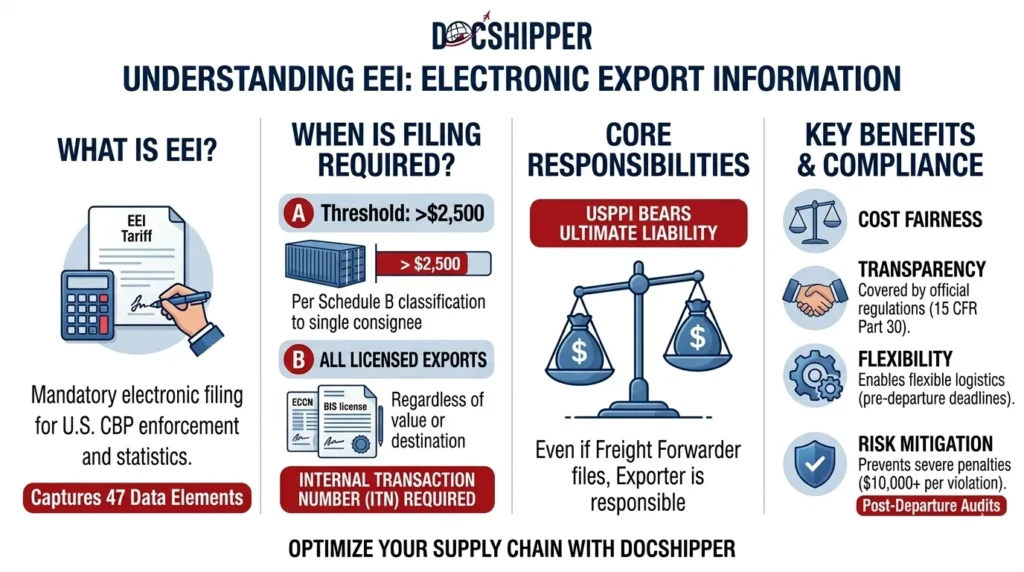
Electronic Export Information (EEI) is the mandatory electronic filing submitted to U.S. Customs and Border Protection via the Automated Export System (AES) for exports valued over $2,500, controlled commodities, or those requiring licenses. This digital declaration replaces the former paper-based SED (Shipper's Export Declaration) and serves as the primary export compliance documentation for regulatory enforcement and trade statistics.
Introduction
U.S. exporters frequently face confusion about when and how to file export documentation. Misunderstanding EEI requirements leads to shipment delays, penalties up to $10,000 per violation, and potential export privilege suspension. This declaration forms the backbone of export control enforcement.
The EEI captures critical data points used by federal agencies for trade policy, enforcement investigations, and economic analysis. Accurate filing protects your business from regulatory violations while ensuring smooth cargo movement.
Key characteristics include:
- Mandatory filing threshold: Shipments exceeding $2,500 per Schedule B classification to single consignee
- License requirement trigger: All exports requiring BIS, DDTC, or other agency authorizations regardless of value
- Filing deadline: Pre-departure filing required; no shipment movement without Internal Transaction Number (ITN)
- Responsible parties: U.S. Principal Party in Interest (USPPI) or authorized forwarding agent
- Validation system: Real-time AES acceptance generates ITN for customs clearance
Regulatory Framework & Compliance Requirements
The Foreign Trade Regulations (15 CFR Part 30) govern EEI filing obligations. These regulations designate the USPPI—typically the seller, manufacturer, or order party—as ultimately responsible for accurate submission. Even when delegating filing authority to freight forwarders, the USPPI retains legal liability.
The Electronic Export Information must capture 47 data elements, including Schedule B commodity codes, destination countries, ECCN (Export Control Classification Numbers) for dual-use items, and license information. At DocShipper, we implement automated validation protocols that cross-reference your product classifications against export control lists before AES submission.
Critical filing exemptions exist under Section 30.37. Shipments to Canada (excluding controlled items), items valued under $2,500 (with specific exceptions), and certain temporary exports qualify for exemption. However, shippers must annotate commercial documents with appropriate exemption citations—failure constitutes a violation.
The Internal Transaction Number (ITN) serves as proof of filing. This 14-character alphanumeric identifier must appear on all transportation documents. Carriers cannot legally accept cargo without valid ITN or exemption legend, creating enforcement checkpoints throughout the supply chain.
Enforcement agencies conduct post-departure audits examining filing accuracy. Common violations include misclassification, incorrect valuation methods (free alongside ship vs. cost and freight), and destination control statement omissions. The U.S. Census Bureau publishes comprehensive filing guidelines updated for regulatory changes.
Filing Scenarios & Practical Examples
Understanding when EEI applies prevents costly errors. Consider a machinery exporter shipping $75,000 CNC equipment to Germany. The USPPI must file complete EEI including ECCN 2B001 classification, license exception STA citation, and end-user information. The generated ITN accompanies the commercial invoice and air waybill.
Contrast this with low-value consumer goods: shipping $1,800 worth of promotional t-shirts to Canada requires no EEI, provided products aren’t controlled. The commercial invoice must state “NO EEI 30.37(a)” to document the exemption claim.
The table below compares filing requirements across common scenarios:
| Scenario | Value/Type | EEI Required? | Documentation |
|---|---|---|---|
| Commercial shipment to UK | $3,200 electronics | Yes | Full AES filing, ITN required |
| Sample shipment to Canada | $800 textiles | No | Exemption legend 30.37(a) |
| Defense article to NATO ally | $500 ITAR components | Yes | DDTC license, full AES |
| Temporary export (repair) | $15,000 machinery | Conditional | 30.37(b) if returning within 1 year |
| Humanitarian donation | $0 (no charge) | Yes if >$2,500 value | Fair market value determines filing |
The routed export transaction presents unique complexity. When a foreign buyer arranges transportation, the U.S. freight forwarder becomes the filing agent. Written authorization must transfer responsibility, specifying which party completes AES submission. At DocShipper, we manage these delegation agreements to ensure clear compliance chains.
Real-world impact: A 2022 BIS enforcement action penalized an electronics exporter $180,000 for repeatedly filing incorrect ECCNs. The company classified consumer-grade microprocessors under general EAR99 categories while shipping dual-use chips requiring 3A001 classification and licensing. Post-departure reconciliation audits detected the pattern, resulting in severe penalties.
Key filing best practices:
- Pre-classify products: Determine Schedule B and ECCN before customer orders
- Validate end-users: Screen against denied parties lists during quoting phase
- Document exemptions: Maintain written justification for non-filed shipments
- Retain records: AES submissions must be preserved for five years from export date
- Conduct internal audits: Quarterly reviews identify systemic classification errors before enforcement discovers them
Conclusion
Electronic Export Information filing represents the foundational compliance requirement for U.S. exporters. Accurate EEI submission prevents enforcement actions, ensures data integrity for government agencies, and facilitates seamless international shipments. The system’s complexity demands ongoing training and validation protocols.
Need assistance navigating AES filing requirements or export compliance audits? Contact DocShipper for comprehensive export documentation support.
📚 Quiz
Test Your Knowledge: Electronic Export Information (EEI)
What is the primary purpose of Electronic Export Information (EEI) filing?
A freight forwarder files EEI on behalf of a U.S. exporter. Who bears ultimate legal responsibility for filing accuracy?
You're exporting $1,200 worth of consumer electronics to Canada. Which statement is correct?
🎯 Your Result
📞 Free Quote in 24hFAQ | EEI (Electronic Export Information): Definition, Filing Requirements & Practical Examples
The U.S. Principal Party in Interest (USPPI), typically the seller or manufacturer, holds ultimate legal responsibility. While USPPIs may authorize freight forwarders to file on their behalf through written power of attorney, liability for inaccurate information remains with the USPPI. Enforcement actions target the principal party regardless of who physically submitted the filing.
Carriers are prohibited from accepting cargo without a valid ITN or exemption legend. If the shipment somehow departs, penalties include fines up to $10,000 per violation, shipment holds at foreign ports, and potential suspension of export privileges. Repeated violations may result in criminal prosecution under export control laws.
No. AES regulations mandate pre-departure filing. The system generates the ITN before cargo movement, which carriers verify at acceptance. Post-departure filing constitutes a violation requiring voluntary self-disclosure to regulatory authorities. Late filings may reduce penalty amounts but don't eliminate liability.
Shipments to Puerto Rico, U.S. Virgin Islands, and other territories are considered domestic movements, not exports. No EEI filing is required regardless of value or product type. However, movements to freely associated states (Palau, Marshall Islands, Micronesia) constitute exports requiring standard compliance procedures.
Schedule B numbers align with Harmonized System codes. Use the Census Bureau's Schedule B Search Tool or consult the Harmonized Tariff Schedule. For technical products, engineering specifications drive classification. Misclassification represents the most common EEI violation—invest in professional classification services for complex goods to ensure accuracy.
Export Control Classification Numbers (ECCN) identify dual-use items on the Commerce Control List. All products fall under either a specific ECCN or the general EAR99 category. EEI filings must include the applicable designation. Items classified under 600-series ECCNs or USML categories require additional license documentation in the AES submission.
Value determines filing obligation, not transaction type. If warranty replacement parts exceed $2,500 per Schedule B code to one consignee, full EEI applies. No-charge shipments use fair market value for threshold calculations. Controlled items require filing regardless of value or warranty status.
Federal regulations mandate five-year retention from the export date. Records must include the complete EEI submission, ITN confirmation, supporting documents (invoices, packing lists, licenses), and any correspondence with regulatory agencies. Electronic storage is acceptable if records remain accessible and legible throughout the retention period.
No. Each physical shipment requires a separate AES filing and unique ITN. The system links specific cargo to individual export declarations. Splitting one order across multiple containers or consolidations necessitates separate filings, even when consignees and products are identical. Attempting to reuse ITNs constitutes documentation fraud.
Exemption 30.37(a) covers most shipments valued at $2,500 or less per Schedule B classification. However, exemptions don't apply to exports requiring licenses, items on the USML or CCL, rough diamonds, or merchandise destined for countries under comprehensive sanctions. Shippers must annotate commercial documents with the specific exemption citation.
In routed transactions where foreign buyers control transportation, the U.S. freight forwarder typically becomes the filing agent. The USPPI must provide accurate product information and authorize the forwarder in writing. Despite delegation, the USPPI remains liable for filing accuracy. Clear contractual language defining responsibilities prevents compliance gaps.
Correct errors immediately through the AES correction process if shipment hasn't departed. For post-departure errors, file corrections within authorized timeframes and maintain documentation explaining the mistake. Material errors affecting licensing or controlled items may require voluntary self-disclosure to BIS or DDTC to mitigate potential penalties.
Need Help with
Logistics or Sourcing ?
First, we secure the right products from the right suppliers at the right price by managing the sourcing process from start to finish. Then, we simplify your shipping experience - from pickup to final delivery - ensuring any product, anywhere, is delivered at highly competitive prices.


Fill the Form
Prefer email? Send us your inquiry, and we’ll get back to you as soon as possible.
Contact us




:%20Definition,%20Filing%20Requirements%20&%20Practical%20Examples)