



In short ⚡
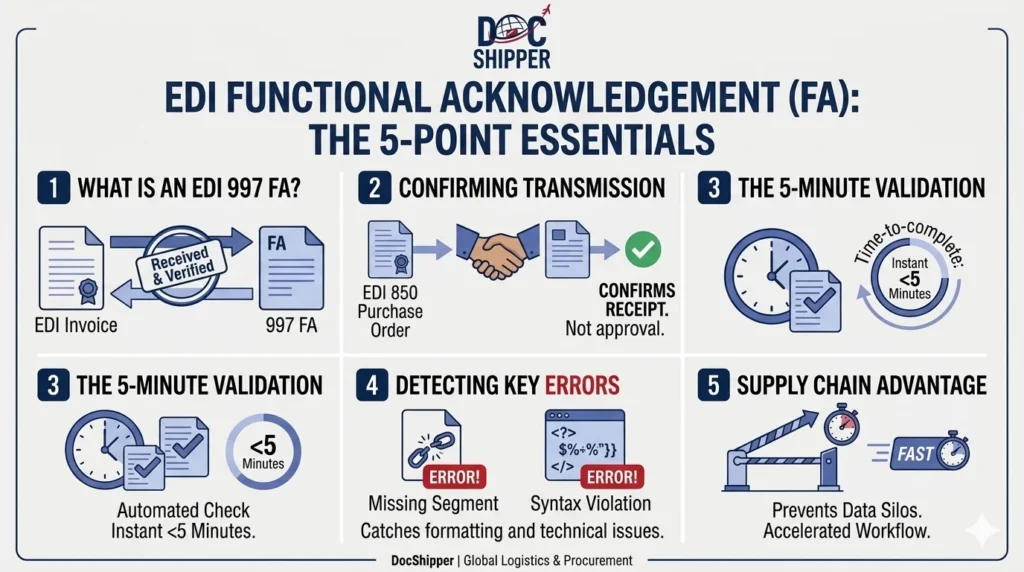
Functional Acknowledgement (FA) is an EDI transaction set (997/CONTRL) that confirms the receipt and validates the structural integrity of electronic documents exchanged between trading partners. This automated response mechanism ensures data transmission reliability, detects errors immediately, and maintains audit trails for compliance in international trade operations.
Introduction
Every day, thousands of shipments fail or get delayed because electronic documents never reach their destination—or worse, arrive corrupted without anyone noticing until customs or warehouse operations grind to a halt. In digital supply chains, assuming successful transmission creates catastrophic blind spots.
The Functional Acknowledgement solves this critical gap by providing machine-readable confirmation that data exchanges completed successfully. Whether shipping automotive parts from Germany or electronics from China, FA messages validate every purchase order, invoice, and shipping notice transmitted through EDI networks.
Key characteristics of Functional Acknowledgements include:
- Automated validation: Instant verification of document structure and syntax
- Error identification: Pinpoints specific segments, elements, or codes causing failures
- Universal standards: Works across X12, EDIFACT, and proprietary EDI formats
- Non-repudiation: Creates legal proof of document receipt and acceptance
- Business continuity: Enables immediate retransmission when errors occur
Technical Implementation & Standards
Functional Acknowledgements operate within standardized EDI frameworks to ensure interoperability across global trading networks. The two dominant formats are the 997 transaction set (ANSI X12) used primarily in North America and the CONTRL message (UN/EDIFACT) prevalent in Europe and Asia.
When an EDI document arrives at a trading partner’s system, the receiving VAN (Value-Added Network) or translation software immediately generates an FA. This response validates five critical layers: envelope integrity (ISA/IEA headers), functional group structure (GS/GE segments), transaction set syntax, data element compliance, and code value accuracy against reference tables.
The acknowledgement contains hierarchical error reporting that specifies exactly where problems occurred. For instance, if a purchase order’s ship-to address uses an invalid country code, the FA returns error code “6” (invalid data element) referencing segment N1, element 04, position 156. This precision allows developers to correct issues within minutes rather than hours.
According to GS1 EDI Standards, implementing mandatory FA policies reduces transmission errors by 78% and eliminates costly manual reconciliation processes. The acknowledgement cycle typically completes within 30 seconds to 5 minutes, depending on network configuration and document complexity.
At DocShipper, we configure FA monitoring systems that automatically alert logistics teams when acknowledgements indicate errors or fail to arrive within expected timeframes. This proactive approach prevents shipment delays by catching data issues before they impact physical operations—a service particularly critical for clients managing time-sensitive pharmaceutical or automotive shipments across multiple continents.
The implementation requires careful attention to acknowledgement policies between partners. Some organizations demand FA responses for every transaction, while others only require acknowledgements for high-value or regulated shipments. The trading partner agreement must specify response timeframes, escalation procedures for unacknowledged documents, and retention periods for audit compliance.
Practical Examples & Business Impact
Consider a European fashion retailer transmitting 850 purchase orders to Asian garment manufacturers. Without Functional Acknowledgements, a corrupted transmission containing 12% invalid style codes might proceed unnoticed until production begins—potentially causing a $340,000 loss from incorrect manufacturing and expedited shipping costs.
With FA implementation, the scenario transforms entirely. The manufacturer’s EDI system receives the purchase orders and immediately returns 997 acknowledgements. Eleven documents receive “A” status (accepted), while one returns “R” (rejected) with error code “5” indicating data element “too short” in segment LIN*02. The retailer’s system automatically flags this error, triggers a corrected retransmission within 4 minutes, and receives successful acknowledgement—all before human intervention becomes necessary.
The business impact becomes measurable through operational efficiency metrics:
| Metric | Without FA | With FA | Improvement |
|---|---|---|---|
| Error Detection Time | 3-7 days (manual discovery) | 30 seconds – 5 minutes | 99.9% faster |
| Document Reconciliation Cost | $18 per transaction | $0.02 automated | $17.98 savings |
| Shipment Delay Rate | 11.2% affected by data errors | 0.8% unresolved issues | 93% reduction |
| Audit Compliance Score | 67% documentation gaps | 99.4% complete trails | 48% improvement |
| Partner Dispute Resolution | 18 days average | 2 hours with FA evidence | 99.5% faster |
Another concrete scenario involves pharmaceutical distribution. A distributor transmits 856 advance ship notices for temperature-controlled vaccines to hospital networks across five countries. Each ASN triggers an FA within 90 seconds. When one acknowledgement returns error code “1” (transaction set not supported), the distributor immediately contacts that hospital’s IT department—discovering they upgraded EDI systems without updating their trading partner profiles. The issue resolves within 30 minutes, preventing a $280,000 vaccine shipment from arriving at a facility unable to process receiving documentation.
The regulatory dimension cannot be overlooked. Customs authorities in EU, US, and APAC regions increasingly require digital audit trails proving document authenticity and transmission integrity. Functional Acknowledgements create immutable timestamps and validation records that satisfy these compliance requirements—particularly critical for controlled substances, dual-use goods, and high-value electronics subject to export licensing.
For small to medium enterprises entering international trade, FA implementation represents a competitive advantage rather than technical burden. Cloud-based EDI providers now include automated acknowledgement processing in standard packages, eliminating the need for expensive in-house infrastructure while providing enterprise-grade reliability for businesses processing 50 to 5,000 transactions monthly.
Conclusion
Functional Acknowledgements transform EDI from a blind data exchange into a verified, auditable communication system essential for modern supply chain operations. The technology prevents costly errors, accelerates dispute resolution, and ensures regulatory compliance across global trade networks.
Need assistance implementing FA protocols or optimizing your EDI infrastructure for international logistics? Contact DocShipper for expert guidance on building reliable digital trade systems.
📚 Quiz
Test Your Knowledge: Functional Acknowledgement (FA)
What is the primary purpose of a Functional Acknowledgement in EDI transactions?
A retailer receives an FA with status "E" (accepted with errors) for a transmitted purchase order. What does this indicate?
A manufacturer's EDI system receives a purchase order with correct formatting but discovers the ordered quantity exceeds production capacity. Which response mechanism addresses this scenario?
🎯 Your Results
📞 Free Quote in 24hFAQ | FA (Functional Acknowledgement): Definition, Implementation & Practical Examples
Functional Acknowledgements (997/CONTRL) validate technical correctness—syntax, structure, and data element compliance. Application Acknowledgements (such as 855 Purchase Order Acknowledgement) confirm business acceptance—whether the receiving organization can fulfill the request. An FA might accept a purchase order's format while an application acknowledgement later rejects it due to out-of-stock inventory. Both serve distinct purposes in complete EDI workflows.
Requirements depend on trading partner agreements and industry regulations. The automotive sector (via AIAG standards) typically mandates FA for all transactions. Retail partnerships often require acknowledgements for orders above $10,000. Healthcare transactions involving patient data usually demand FAs for compliance. Organizations should document acknowledgement policies in their EDI implementation guides and trading partner agreements to prevent disputes.
Standard practice suggests 24-hour windows for non-critical transactions and 30-minute to 2-hour thresholds for time-sensitive shipments. High-volume retailers often configure alerts at 15-minute intervals. The timing depends on network infrastructure, VAN processing speeds, and business criticality. DocShipper recommends establishing tiered escalation protocols: automated retransmission at 1 hour, IT notification at 4 hours, and partner contact at 24 hours for missing acknowledgements.
Technically yes, but this creates operational and legal risks. Without FAs, senders cannot prove document delivery, making dispute resolution nearly impossible. Most modern EDI systems generate acknowledgements automatically, so refusal typically indicates outdated infrastructure. When partners resist FA implementation, consider requiring acknowledgements contractually or switching to EDI-compliant service providers. The marginal cost of generating FAs (typically $0.01-0.05 per transaction) is negligible compared to error resolution expenses.
The sender must immediately correct and retransmit the document. Most EDI translation software provides error logs specifying exact problems—invalid codes, missing mandatory elements, or formatting issues. Critical shipments require escalation protocols: automated alerts to logistics managers, direct communication with trading partners, and manual intervention procedures. For regulated goods (pharmaceuticals, hazardous materials), some organizations maintain backup communication channels (secure email, phone verification) to prevent shipment disruptions while resolving EDI errors.
Most modern SaaS EDI platforms include automatic FA generation and monitoring as standard features. These systems receive inbound documents, validate syntax, generate appropriate acknowledgements, and alert users to errors—all without manual intervention. However, configuration remains important: acknowledgement timing thresholds, error notification recipients, and retransmission policies must align with business requirements. When evaluating cloud EDI providers, verify their acknowledgement processing capabilities and audit trail retention policies meet industry compliance standards.
FAs detect syntax and structural errors but cannot validate business logic or data accuracy. An acknowledgement might confirm a purchase order's format is correct while missing that the ordered quantity exceeds warehouse capacity or that product codes don't match the supplier's catalog. Complete error prevention requires combining FAs with application acknowledgements, master data synchronization, and business rule validation. This layered approach reduces total error rates from typical 8-12% to below 0.5% in mature implementations.
FAs create timestamped proof that export declarations, commercial invoices, and certificates of origin were transmitted and received correctly. Customs authorities conducting post-clearance audits often request evidence that required documents existed at time of shipment. The acknowledgement trail demonstrates compliance with advance filing requirements (such as US ISF or EU ICS2) and proves document authenticity when disputes arise. This audit capability is particularly valuable for AEO (Authorized Economic Operator) certification and similar trusted trader programs.
The primary codes are "A" (accepted), "E" (accepted with errors), "R" (rejected), and "P" (partially accepted). Accepted status means syntax validation passed completely. Errors status indicates non-critical issues that don't prevent processing—such as optional elements containing invalid values. Rejected means critical failures requiring correction and retransmission. Partially accepted applies to batch transmissions where some transaction sets passed and others failed. Each status includes detailed error codes (segment identifiers, element positions, and specific violation descriptions) enabling rapid correction.
Integration typically occurs through EDI middleware or translation software that sits between trading partner networks and internal ERP systems. When an FA arrives, the middleware updates transaction status in the ERP—marking purchase orders as "transmitted successfully" or "transmission failed." Advanced integrations trigger automated workflows: successful FAs release inventory for picking, while rejected FAs create help desk tickets for IT resolution. This real-time status synchronization eliminates manual checking and ensures operational teams work with current document transmission states.
Yes, though implemented differently. While traditional EDI uses standardized 997/CONTRL messages, modern API integrations employ HTTP status codes and JSON response objects serving identical purposes. A successful POST request to a supplier's order API returns status 201 (created) functioning as an acknowledgement, while status 400 (bad request) with error details mirrors a rejected FA. The principle remains constant: automated confirmation that data transmission completed successfully and passed validation rules. Organizations modernizing from EDI to APIs should maintain equivalent acknowledgement capabilities to preserve operational visibility and audit trails.
Most jurisdictions require 5 to 7 years retention for transaction records supporting tax filings and customs declarations. The EU GDPR mandates retaining data only as long as business purposes require, typically 6 years for commercial documents. US FDA regulations demand 7 years for pharmaceutical distribution records. Organizations should archive FAs alongside the original transactions they acknowledge, maintaining the complete audit trail. Cloud EDI providers typically include compliant storage in subscription fees, but verify their retention policies meet your specific regulatory requirements before deleting local copies.
Need Help with
Logistics or Sourcing ?
First, we secure the right products from the right suppliers at the right price by managing the sourcing process from start to finish. Then, we simplify your shipping experience - from pickup to final delivery - ensuring any product, anywhere, is delivered at highly competitive prices.


Fill the Form
Prefer email? Send us your inquiry, and we’ll get back to you as soon as possible.
Contact us




:%20Definition,%20Implementation%20&%20Practical%20Examples)