


In short ⚡
Failure Modes and Effects Analysis (FMEA) is a systematic methodology for identifying potential failures in products, processes, or systems before they occur. Used extensively in international logistics and supply chain management, this risk assessment tool evaluates failure modes, their causes, and effects to prioritize preventive actions based on severity, occurrence, and detection ratings.
Introduction
Supply chain disruptions cost companies millions annually. Yet most failures are predictable and preventable with the right analytical framework.
FMEA provides that framework by transforming reactive problem-solving into proactive risk management. In international logistics, where delays cascade through multiple stakeholders, identifying weak points before shipment proves invaluable.
This methodology applies across three critical domains in global trade:
- Design FMEA (DFMEA): Evaluates product design vulnerabilities affecting transportability, packaging integrity, and customs compliance
- Process FMEA (PFMEA): Analyzes operational procedures including warehousing, loading sequences, and documentation workflows
- System FMEA (SFMEA): Examines interactions between transportation modes, IT systems, and regulatory environments
- Supply Chain FMEA: Assesses vendor reliability, route vulnerabilities, and geopolitical risks impacting delivery timelines
- Service FMEA: Reviews customer-facing processes like freight forwarding accuracy and claims handling efficiency
The standardized approach enables logistics teams to quantify risks numerically, creating objective prioritization for resource allocation.
FMEA Methodology & Risk Assessment Framework
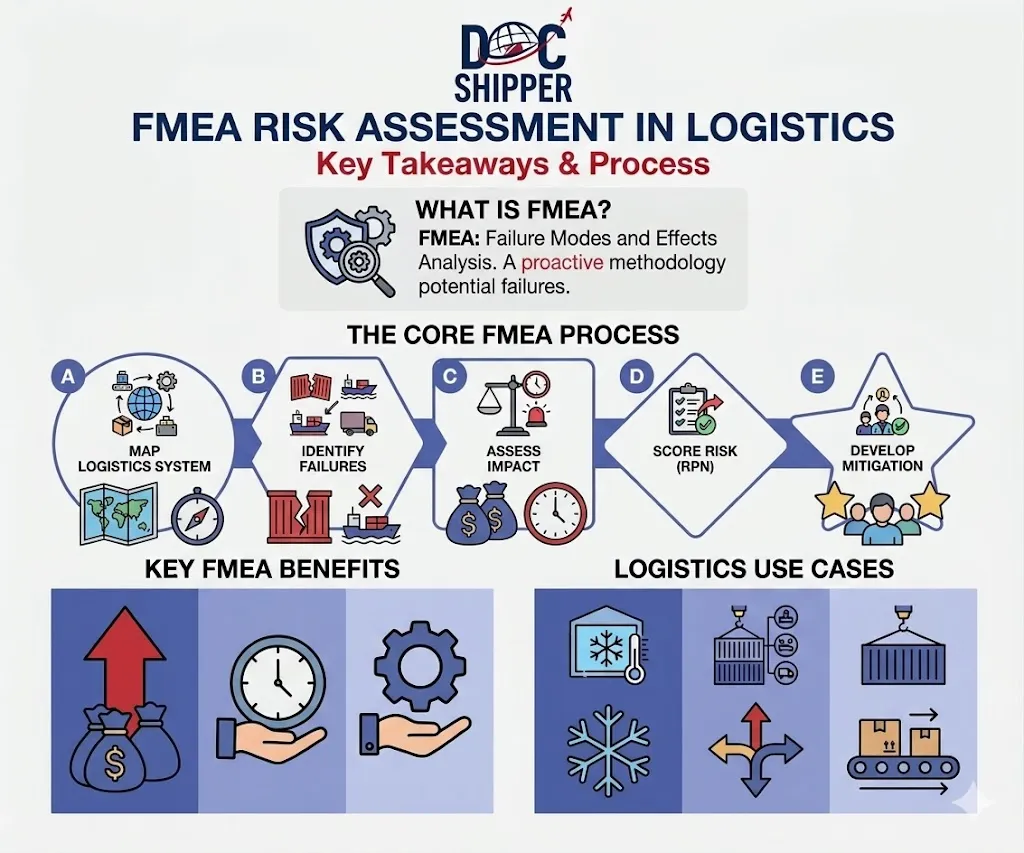
The FMEA process follows a structured five-step methodology that transforms qualitative observations into quantitative action plans.
Step 1: Identify Potential Failure Modes. Teams catalog every conceivable way a process or component could fail. In cargo handling, this includes damaged goods, misrouted shipments, incorrect documentation, temperature excursions for cold chain products, and customs holds.
Step 2: Determine Failure Effects. Each failure mode is analyzed for its impact on the customer and business operations. A damaged pharmaceutical shipment affects regulatory compliance, product efficacy, and brand reputation simultaneously.
Step 3: Assign Severity Ratings. Effects receive numerical scores (1-10) where 10 represents catastrophic consequences. According to the ISO 9001 quality management framework, severity focuses exclusively on the end-user impact, regardless of occurrence frequency.
Step 4: Identify Causes and Assign Occurrence Ratings. Root causes receive probability scores (1-10). A loading procedure routinely skipped receives a higher occurrence rating than rare equipment malfunctions. Historical data from quality management systems provides statistical backing.
Step 5: Evaluate Detection Controls and Calculate RPN. Existing controls are rated on detection capability (1-10, where 10 means no detection method exists). The Risk Priority Number (RPN) multiplies these three factors: RPN = Severity × Occurrence × Detection. Scores range from 1 to 1,000, with higher numbers demanding immediate corrective action.
At DocShipper, we integrate FMEA into our quality assurance protocols, conducting systematic risk assessments for high-value shipments to identify vulnerabilities before goods leave origin facilities. This proactive approach reduces claims by identifying packaging weaknesses and documentation errors during pre-shipment inspections.
The methodology requires cross-functional collaboration. Logistics managers, warehouse staff, customs brokers, and quality engineers contribute domain expertise. Modern implementations utilize digital FMEA software that tracks action items, reassesses risks post-implementation, and maintains historical databases for continuous improvement.
Living Documentation: FMEA documents evolve throughout product lifecycles and operational changes. Quarterly reviews ensure risk assessments reflect current realities like new trade regulations, supplier changes, or transportation route modifications.
Practical Applications & Risk Priority Numbers
Real-world implementation demonstrates FMEA’s tangible value in preventing costly disruptions. Consider these scenarios from international freight operations:
Use Case: Electronics Shipment from China to Germany
A manufacturer exports 10,000 consumer electronics units monthly. The FMEA team identifies “inadequate pallet wrapping” as a failure mode.
| Failure Mode | Severity (S) | Occurrence (O) | Detection (D) | RPN |
|---|---|---|---|---|
| Inadequate pallet wrapping | 7 | 6 | 4 | 168 |
| Incorrect HS code classification | 8 | 3 | 2 | 48 |
| Temperature variation in transit | 9 | 2 | 7 | 126 |
| Documentation arriving late | 6 | 5 | 3 | 90 |
Outcome: The highest RPN (168) triggers immediate corrective action. The team implements automated stretch wrap machines with tension monitoring, reducing occurrence from 6 to 2. The revised RPN drops to 56, falling below the action threshold of 100.
Comparative Analysis: Before and After FMEA Implementation
A mid-sized freight forwarder handling 500 TEUs monthly conducted FMEA analysis across their operations:
- Claim Rate Reduction: Damage claims decreased from 3.2% to 0.9% within six months, saving approximately $180,000 annually
- Customs Clearance Time: Average clearance time improved from 4.5 days to 2.1 days through preemptive documentation reviews
- Delivery Accuracy: On-time delivery rates increased from 87% to 96% by addressing route planning failure modes
- Inspection Failures: Regulatory inspection failures dropped from 12 incidents yearly to 2, reducing penalty costs by $45,000
- Customer Satisfaction: Net Promoter Score improved from 42 to 68 as service reliability increased
Industry data from the American Society for Quality shows that companies using FMEA systematically experience 25-40% fewer quality incidents compared to reactive quality management approaches. The methodology’s structured nature ensures accountability and tracks improvement over time.
At DocShipper, we apply FMEA during supplier audits and pre-production inspections, identifying design flaws that would compromise cargo integrity before manufacturing begins. This upstream intervention prevents downstream logistics failures, particularly for fragile goods and hazardous materials requiring specialized handling protocols.
Conclusion
FMEA transforms logistics risk management from guesswork into data-driven decision-making. By systematically evaluating failure modes, organizations prevent disruptions that erode profit margins and damage customer relationships.
Need assistance implementing FMEA in your supply chain operations? Contact DocShipper for expert guidance on risk assessment and quality assurance across your international logistics network.
📚 Quiz
Test Your Knowledge: FMEA (Failure Modes and Effects Analysis)
1. What is the primary purpose of FMEA in supply chain management?
2. How is the Risk Priority Number (RPN) calculated in FMEA methodology?
3. A pharmaceutical shipment has a failure mode with Severity = 9 (high), Occurrence = 2 (rare), and Detection = 7 (difficult to detect), resulting in RPN = 126. What is the recommended action?
🎯 Your Result
📞 Free Quote in 24hFAQ | FMEA (Failure Modes and Effects Analysis): Definition, Application & Concrete Examples
FMEA is a structured type of risk assessment that quantifies risks using three numerical dimensions: severity, occurrence, and detection. While general risk assessments may identify hazards qualitatively, FMEA provides a standardized scoring system (RPN) that enables objective prioritization. The methodology's documentation requirements and cross-functional approach make it more rigorous than informal risk reviews, particularly valuable for complex logistics operations with multiple failure points.
Best practices recommend quarterly reviews for active operations and immediate updates when process changes occur. Regulatory modifications, new transportation routes, supplier changes, or technology implementations all trigger FMEA revisions. Annual comprehensive reviews ensure the entire system remains aligned with current operational realities. Companies handling high-risk goods like pharmaceuticals or aerospace components often conduct monthly spot-checks on critical failure modes to maintain compliance with quality management standards.
Most organizations set action thresholds between 100-125 for the Risk Priority Number. However, this varies by industry risk tolerance and product criticality. Some companies implement tiered responses: RPN above 200 requires immediate action, 100-200 demands action within 30 days, and below 100 goes into monitoring status. Additionally, any failure mode with a severity rating of 9-10 requires attention regardless of RPN, as catastrophic consequences justify intervention even for rare occurrences.
Absolutely. Process FMEA excels at analyzing customs procedures by identifying documentation errors, classification mistakes, and compliance gaps. Failure modes include incorrect tariff codes, missing certificates of origin, incomplete commercial invoices, and valuation discrepancies. Each receives severity ratings based on potential fines and delay costs, occurrence ratings from historical data, and detection ratings for current verification controls. This approach has proven particularly effective for companies managing complex free trade agreement requirements across multiple jurisdictions.
Leading solutions include Minitab Quality Companion, ReliaSoft XFMEA, and IQS FMEA Manager, which integrate with ERP systems to pull real-time operational data. These platforms automate RPN calculations, track corrective actions, generate compliance reports, and maintain historical databases for trend analysis. Many transportation management systems now incorporate basic FMEA modules. For smaller operations, structured spreadsheet templates following AIAG (Automotive Industry Action Group) standards provide cost-effective alternatives while maintaining methodological rigor.
FMEA is proactive, identifying potential failures before they occur, while root cause analysis is reactive, investigating failures after they happen. FMEA examines multiple failure scenarios simultaneously across entire processes, whereas root cause analysis focuses deeply on one specific incident. The two methodologies complement each other: FMEA prevents predictable failures, and lessons from root cause investigations feed back into FMEA documentation to prevent recurrence. Both are essential components of comprehensive quality management systems in international logistics.
Most organizations see measurable returns within 6-9 months of systematic implementation. Initial costs include staff training, software licensing, and analysis time. However, even preventing one major claim or customs penalty often justifies the investment. A freight forwarder handling $10 million in annual cargo value typically spends $15,000-$25,000 on FMEA setup but saves $40,000-$80,000 annually through reduced damage claims, fewer delays, and improved operational efficiency. The methodology's value compounds over time as teams become proficient and historical data improves prediction accuracy.
Effective FMEA requires cross-functional teams including warehouse managers, customs brokers, quality assurance specialists, transportation coordinators, IT systems administrators, and customer service representatives. Including frontline workers who handle cargo daily provides practical insights that management may overlook. External participants like carriers, freight forwarders, and regulatory consultants contribute valuable perspectives on industry-wide failure patterns. Sessions typically require 4-8 participants and span 2-4 hours per process analyzed, with follow-up meetings to review corrective action effectiveness.
ISO 9001:2015 mandates risk-based thinking throughout quality management systems. FMEA provides documented evidence of systematic risk identification, evaluation, and mitigation—key certification requirements. Auditors specifically look for process maps, risk assessments, and corrective action tracking, all of which FMEA methodology inherently produces. Companies with mature FMEA programs often streamline certification audits because they already maintain the detailed documentation and continuous improvement records that standards require. The methodology directly addresses clauses 6.1 (Risk Actions), 8.5 (Production Control), and 10.2 (Nonconformity Response).
While FMEA cannot forecast specific political events, it can assess supply chain vulnerabilities to various disruption scenarios. Failure modes like "single-source country dependency" or "route unavailability due to regional instability" receive occurrence ratings based on historical patterns and current intelligence. Severity ratings consider business continuity impact, and detection ratings evaluate monitoring systems like geopolitical risk tracking subscriptions. This framework helps companies develop contingency plans and diversification strategies, making operations more resilient to unexpected geopolitical shocks affecting international trade lanes.
FMEA integrates seamlessly into Six Sigma's DMAIC (Define, Measure, Analyze, Improve, Control) framework, typically applied during the Analyze and Improve phases. Six Sigma uses FMEA to identify critical-to-quality characteristics and prioritize process improvements that yield maximum defect reduction. The quantitative nature of both methodologies creates synergy: Six Sigma statistical tools validate FMEA occurrence ratings, while FMEA's structured approach focuses Six Sigma projects on high-impact areas. Many logistics organizations pursuing Six Sigma certification require FMEA training for Green Belt and Black Belt candidates.
These scenarios require special attention despite potentially moderate RPN scores. Even rare catastrophic failures justify preventive investment. Best practice involves implementing robust detection controls and emergency response procedures. For example, a pharmaceutical cold chain failure might occur infrequently (low occurrence) but destroys entire shipment value (high severity). Companies typically establish redundant monitoring systems, backup transportation arrangements, and insurance coverage specifically for these low-probability, high-impact risks rather than waiting for statistical frequency to drive action.
Need Help with
Logistics or Sourcing ?
First, we secure the right products from the right suppliers at the right price by managing the sourcing process from start to finish. Then, we simplify your shipping experience - from pickup to final delivery - ensuring any product, anywhere, is delivered at highly competitive prices.


Fill the Form
Prefer email? Send us your inquiry, and we’ll get back to you as soon as possible.
Contact us




:%20Definition,%20Application%20&%20Concrete%20Examples)