


In short ⚡
Fair Return is a regulatory principle ensuring that logistics providers, customs brokers, and freight forwarders receive reasonable compensation for their services while maintaining market competitiveness. It represents the balance between operational costs, risk exposure, and profit margins in international trade operations, often scrutinized by regulatory authorities to prevent monopolistic pricing or unfair trade practices.
Introduction
In international logistics, pricing disputes frequently arise when clients question whether service charges reflect genuine operational costs or excessive markups. The concept of Fair Return addresses this critical tension by establishing transparent benchmarks for service valuation.
This principle became particularly relevant following WTO Trade Facilitation Agreement implementation, which mandates that customs-related fees must be proportionate to services rendered. Understanding Fair Return protects both service providers from undervaluation and clients from exploitation.
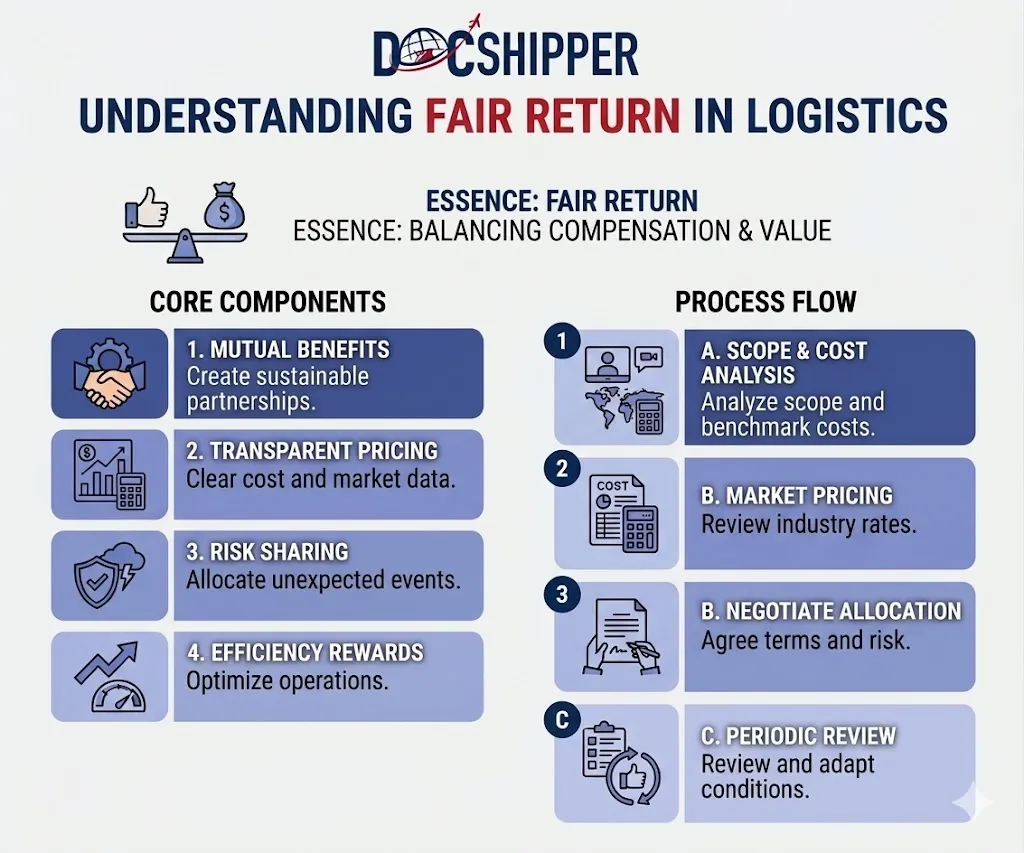
Key characteristics of Fair Return in logistics include:
- Cost-based pricing: Compensation must cover actual operational expenses including labor, technology, compliance, and infrastructure
- Risk-adjusted margins: Services involving higher liability (hazardous goods handling, customs guarantees) justify increased returns
- Market benchmarking: Pricing remains competitive relative to industry standards in comparable markets
- Transparency requirements: Detailed breakdowns of charges must be available upon request
- Regulatory compliance: Returns must align with national and international trade regulations governing service fees
In-Depth Analysis & Regulatory Framework
The Fair Return doctrine originates from utility regulation principles adapted for trade services. Unlike product pricing, service compensation in logistics must account for intangible value creation—expertise, compliance assurance, and risk mitigation.
From a regulatory perspective, several international frameworks govern Fair Return standards. The WTO Trade Facilitation Agreement Article 6.2 explicitly states that fees must be limited to the approximate cost of services rendered. The European Union’s Customs Code further specifies that charges cannot exceed administrative costs plus a reasonable profit margin.
Calculating Fair Return involves three fundamental components. First, direct operational costs include staff salaries, software licenses, warehouse space, and transportation expenses. Second, indirect costs encompass regulatory compliance, insurance, professional development, and quality management systems. Third, opportunity cost considerations account for capital invested in specialized infrastructure that could generate returns elsewhere.
The risk premium factor significantly influences Fair Return calculations. Services involving customs bonding, temporary importation guarantees, or liability for classification errors justify higher margins. A customs broker assuming full liability for duty calculations may legitimately charge 15-25% more than a consultant providing advisory services only.
At DocShipper, we implement transparent pricing matrices aligned with Fair Return principles. Our fee structures are benchmarked quarterly against industry standards across 27 countries, ensuring clients receive competitive rates while maintaining sustainable service quality. We systematically document cost components for each service line, providing detailed justifications when requested.
Industry best practices suggest maintaining profit margins between 8-15% for standard logistics services, with specialized operations (pharmaceutical cold chain, aerospace parts handling) justifying margins up to 22%. These benchmarks vary by market maturity—emerging markets typically support higher returns due to infrastructure challenges and regulatory uncertainty.
Practical Examples & Calculation Methods
Understanding Fair Return becomes clearer through concrete calculation scenarios. Consider a customs brokerage service for a standard commercial shipment from China to the United States with a declared value of $50,000.
| Cost Component | Amount (USD) | Justification |
|---|---|---|
| Broker labor (2.5 hours) | $125 | Licensed specialist at $50/hour |
| Software & systems access | $35 | ACE filing, tariff database subscription |
| Compliance verification | $45 | HS code validation, document review |
| Professional liability insurance | $20 | Proportional coverage for this transaction |
| Administrative overhead | $30 | Management, facilities, utilities |
| Total Operational Cost | $255 | Break-even point |
| Fair Return margin (12%) | $31 | Industry-standard profit |
| Total Fair Service Fee | $286 | Client charge |
This transparent breakdown demonstrates how Fair Return balances operational reality with reasonable profitability. A competitor charging $180 would operate below sustainability thresholds, while pricing exceeding $350 without additional value-added services would constitute excessive markup.
Comparative market analysis reveals significant geographic variations. According to 2024 industry data, customs clearance fees range from $150-$450 for similar shipments depending on market conditions. Port congestion in Los Angeles justifies 15-20% premiums due to extended processing times, while automated clearance in Singapore supports lower fees through operational efficiency.
Another scenario illustrates Fair Return for freight forwarding services. Consider a 20-foot container shipment from Hamburg to Dubai with the following cost structure:
- Ocean freight negotiation: Forwarder secures $1,200 rate; resells at $1,380 (15% markup) reflecting booking management, carrier liaison, and schedule optimization
- Documentation handling: $95 fee covering Bill of Lading issuance, certificate of origin, packing list verification (actual costs: $78)
- Cargo insurance arrangement: 3% commission on $85,000 cargo value = $2,550 (industry-standard broker fee)
- Destination coordination: $120 fee for delivery scheduling, customs notification, consignee communication (actual time investment: 2.5 hours at $48/hour)
The forwarder’s total revenue is $2,145 against $1,398 in direct costs—a 13.2% net margin that falls squarely within Fair Return parameters. This calculation excludes value-added services like cargo tracking platforms or dedicated account management, which justify supplementary fees.
In complex operations involving multimodal transport, Fair Return calculations must account for coordination complexity. A shipment requiring air freight from Vietnam to Germany, then truck distribution to five European warehouses, involves exponentially greater orchestration. Fair Return models for such services typically apply tiered pricing: base coordination fee plus per-segment management charges, ensuring compensation reflects actual value creation at each stage.
Conclusion
Fair Return principles establish the foundation for sustainable client-provider relationships in international logistics. By understanding the legitimate cost components and reasonable profit expectations, importers and exporters can evaluate service proposals effectively while supporting providers who deliver professional, compliant, and reliable operations. The transparency inherent in Fair Return models ultimately benefits the entire supply chain ecosystem.
Need guidance on evaluating logistics service pricing or structuring fair agreements with providers? Contact DocShipper’s advisory team for expert analysis tailored to your specific trade requirements.
📚 Quiz
Test Your Knowledge: Fair Return in International Trade
What is the primary purpose of Fair Return in logistics services?
According to industry best practices, what profit margin range is considered fair for standard logistics services?
A customs broker charges $286 for a standard clearance ($255 operational costs + $31 profit margin). A competitor offers the same service for $180. Which scenario best reflects Fair Return principles?
🎯 Your Results
📞 Get Free Quote in 24hFAQ | Fair Return: Definition, Calculation & Concrete Examples in International Trade
Most jurisdictions allow contract challenge based on unconscionable pricing. The WTO Trade Facilitation Agreement provides formal complaint mechanisms through national enquiry points. Additionally, industry associations like FIATA maintain ethics committees that investigate pricing disputes. Documentation of comparable market rates strengthens claims of excessive charging, potentially leading to fee adjustments or provider sanctions.
Customs brokerage typically operates on lower percentage margins (8-12%) due to regulatory standardization and high transaction volumes. Freight forwarding allows 12-18% margins because services involve greater operational variability, carrier negotiation expertise, and coordination complexity. Specialized brokerage (pharmaceuticals, defense articles) may justify margins approaching forwarding levels due to stringent compliance requirements.
Yes. Automated platforms eliminating manual processes can sustainably operate at 6-9% margins while maintaining service quality. However, extremely low margins (below 5%) often indicate venture capital subsidization rather than genuine operational efficiency, creating unsustainable market distortions. Clients should verify whether discount pricing reflects permanent efficiency gains or temporary market positioning strategies.
Professional providers should furnish itemized invoices separating labor, technology, regulatory, and third-party costs. Upon request, they should provide service level agreements defining deliverables, benchmark comparisons showing market positioning, and explanation of any premiums for specialized handling. Resistance to transparency often signals pricing irregularities.
Higher-value cargo justifies increased fees primarily through liability exposure and insurance costs, not percentage-based markups. A responsible provider charges moderately higher base fees for handling electronics worth $500,000 versus textiles worth $50,000, but the difference should reflect actual risk management costs—typically 0.1-0.3% of cargo value—rather than arbitrary percentage multipliers.
Even in lightly regulated markets, Fair Return concepts apply through contract law principles prohibiting unjust enrichment. International arbitration mechanisms (ICC, LCIA) recognize fair pricing standards in dispute resolution. Additionally, multinational corporations increasingly require supply chain partners to adhere to ethical pricing frameworks regardless of local regulatory environments.
Significant technology expenditure (customs software, track-and-trace systems, AI classification tools) legitimately increases Fair Return expectations by 2-4 percentage points. However, providers must demonstrate that these investments deliver tangible client benefits—faster processing, reduced errors, enhanced visibility—rather than merely improving internal efficiency while maintaining standard pricing.
Focus on total landed cost rather than isolated fee components. A provider charging $320 for customs clearance but securing 8% lower duty rates through expert classification delivers superior value than one charging $250 but accepting manufacturer's classification. Request detailed service scope descriptions and calculate total transactional cost including potential error-related expenses.
Emergency services justify premium pricing—typically 50-150% above standard rates—reflecting genuine urgency costs: after-hours labor, accelerated carrier bookings, priority processing fees. However, providers cannot arbitrarily declare routine shipments as emergencies. Fair Return in expedited scenarios requires documented justification of extraordinary resource deployment and opportunity costs.
Properly structured agreements include adjustment clauses tied to objective indices (fuel costs, labor rates, regulatory changes) while maintaining core margin structures. Fixed-rate contracts without adjustment mechanisms either incorporate risk premiums (increasing initial costs) or create unsustainable provider obligations. Hybrid models with capped adjustments balance predictability and fairness most effectively.
Consolidation services typically operate on lower per-shipment margins (7-10%) compensated by higher transaction volumes. However, per-kilogram rates should remain competitive with direct shipping when scaled appropriately. Clients shipping sufficient volume to fill dedicated containers should not pay consolidation premiums, as Fair Return calculations must reflect actual service complexity and resource allocation.
Hidden fee practices violate trade facilitation principles and contract law doctrines of good faith. Clients should demand comprehensive quotations including all foreseeable charges. Post-contract fee additions require documented justification of unforeseen circumstances (regulatory changes, exceptional handling requirements). Repeated supplementary billing patterns indicate systematic underquoting incompatible with Fair Return principles.
Need Help with
Logistics or Sourcing ?
First, we secure the right products from the right suppliers at the right price by managing the sourcing process from start to finish. Then, we simplify your shipping experience - from pickup to final delivery - ensuring any product, anywhere, is delivered at highly competitive prices.


Fill the Form
Prefer email? Send us your inquiry, and we’ll get back to you as soon as possible.
Contact us




