


In short ⚡
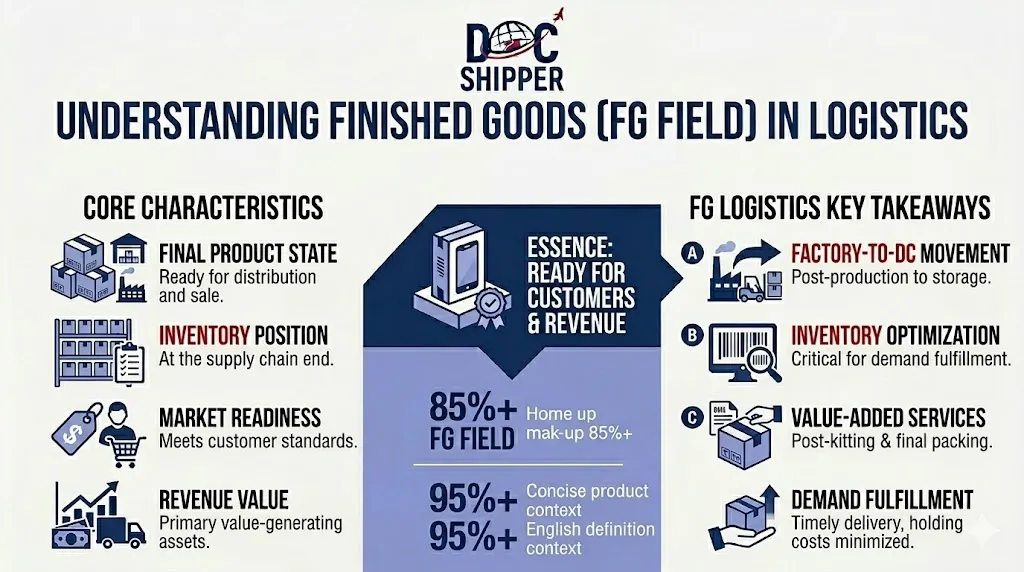
Field Finished Goods (FG) are manufactured products that have completed the production process and are ready for sale or distribution. These goods represent the final stage in a company's inventory cycle, located in warehouses, distribution centers, or retail outlets, awaiting customer delivery or consumption.Introduction
Many companies struggle to differentiate between work-in-progress inventory and finished goods ready for market. This distinction is critical for accurate financial reporting, efficient warehouse operations, and smooth international logistics.
Field Finished Goods represent the culmination of manufacturing efforts. They directly impact cash flow, customer satisfaction, and supply chain velocity. For import/export operations, proper FG classification ensures correct customs documentation and tariff application.
- Inventory accounting: FG appears as a current asset on balance sheets, affecting financial metrics
- Storage requirements: Demands specific warehouse conditions based on product characteristics
- Customs classification: Requires accurate HS codes for international shipments
- Quality control: Must meet specifications before customer release
- Logistics coordination: Triggers distribution and order fulfillment processes
FG Management & Supply Chain Integration
Effective Field Finished Goods management requires understanding several interconnected systems. The transition from production to FG status triggers multiple business processes across departments.
Inventory valuation methods significantly impact how FG is recorded. Companies typically use FIFO (First-In-First-Out), LIFO (Last-In-First-Out), or weighted average cost methods. Each approach affects profit margins differently during price fluctuations.
ERP integration automates FG tracking from production completion through shipment. Modern systems generate automatic alerts when inventory reaches reorder points or exceeds optimal storage duration. At DocShipper, we integrate with major ERP platforms to ensure real-time visibility across international supply chains.
Quality assurance protocols determine FG release eligibility. Products must pass final inspections verifying compliance with technical specifications, safety standards, and regulatory requirements. The ISO 9001 standard provides frameworks for systematic quality verification.
Storage optimization balances accessibility with cost efficiency. FG with high turnover rates requires prime warehouse locations, while slower-moving products can occupy less accessible areas. Temperature-controlled environments may be necessary for pharmaceuticals, food products, or electronics.
Customs documentation accuracy prevents clearance delays. FG shipments require commercial invoices, packing lists, and certificates of origin. DocShipper systematically verifies these documents against actual inventory to avoid customs holds that disrupt delivery schedules.
Practical Examples & Real-World Data
Understanding FG through concrete scenarios clarifies its operational impact. These examples demonstrate how proper management reduces costs and improves customer satisfaction.
Comparative Inventory Categories
| Category | Value Addition | Ready for Sale | Customs Status |
|---|---|---|---|
| Raw Materials | 0% | No | Separate HS code |
| Work-in-Progress | 25-75% | No | Complex valuation |
| Field Finished Goods | 100% | Yes | Final product HS code |
Case Study: Electronics Manufacturer
A consumer electronics company maintains €8.2 million in FG inventory across three distribution centers. Their analysis revealed:
- Turnover rate: FG moves within 18 days on average, versus 45 days for industry standard
- Storage costs: €12 per pallet monthly, with climate control adding 35% premium
- Obsolescence risk: Technology products lose 2.5% value monthly after production
- Customs efficiency: Pre-classification reduced clearance time by 40%
- Working capital impact: Optimizing FG levels freed €1.8 million for reinvestment
Pharmaceutical FG Scenario
A pharmaceutical exporter ships temperature-sensitive FG to 15 countries. Their compliance requirements include:
GDP (Good Distribution Practice) certification ensures product integrity from warehouse to delivery. Specialized packaging maintains 2-8°C temperature ranges during transit. Each batch requires documentation tracing production date, expiry, and storage conditions.
Regulatory submissions to authorities like the European Medicines Agency verify FG quality before market release. DocShipper coordinates with cold chain logistics providers to maintain unbroken temperature control across international routes.
Conclusion
Field Finished Goods management directly impacts profitability, customer satisfaction, and regulatory compliance in international trade. Proper classification, documentation, and storage protocols ensure smooth operations.
Need assistance optimizing your FG logistics or navigating international shipping requirements? Contact DocShipper for expert guidance tailored to your supply chain needs.
📚 Quiz
Test Your Knowledge: Field Finished Goods (FG)
Question 1: What is the defining characteristic of Field Finished Goods?
Question 2: Which statement about FG customs classification is correct?
Question 3: A pharmaceutical company needs to ship temperature-sensitive FG internationally. Which approach is appropriate?
🎯 Your Result
📞 Free Personalized QuoteFAQ | FG (Field Finished Goods): Definition, Management & Practical Examples
Field Finished Goods have completed all manufacturing processes and quality checks, making them immediately saleable. Semi-finished goods require additional processing, assembly, or customization before reaching customers. This distinction affects inventory valuation, warehouse allocation, and customs classification.
Optimal levels balance holding costs against stockout risks. The Economic Order Quantity (EOQ) formula considers annual demand, ordering costs, and storage expenses. Companies typically maintain 30-90 days of FG inventory depending on production lead times, demand variability, and product shelf life. Advanced analytics incorporate seasonal patterns and promotional activity.
FG requires classification under the Harmonized System based on material composition, intended use, and processing degree. Correct HS codes determine applicable tariffs, import restrictions, and documentation requirements. Misclassification can result in customs penalties, delayed shipments, or duty overpayment. Regular code verification against WCO updates ensures ongoing compliance.
FG appears as a current asset on balance sheets at production cost or net realizable value, whichever is lower. It impacts cash flow by tying up working capital until sold. Income statements reflect FG movement through cost of goods sold when products ship. High FG levels may indicate overproduction, weak demand, or distribution inefficiencies requiring management attention.
Standard property insurance covers FG against fire, theft, and natural disasters. Marine cargo insurance protects goods during international transit. Specialized coverage addresses temperature-sensitive products, high-value electronics, or hazardous materials. Policy limits should reflect actual inventory values, including manufacturing costs and potential profit margins on unsold stock.
Perishable FG requires FEFO (First-Expired-First-Out) inventory rotation to minimize waste. Warehouse systems track batch numbers and expiration dates automatically. Products approaching expiry may qualify for discount sales or donation programs. Regulatory requirements mandate destruction documentation for expired pharmaceuticals, food products, or cosmetics beyond safe use periods.
Blockchain creates immutable records tracking FG from production through delivery. Each transaction—quality inspection, warehouse transfer, customs clearance—generates cryptographic verification. This transparency benefits industries requiring provenance documentation like luxury goods, pharmaceuticals, or organic products. Smart contracts automate compliance verification and payment release upon delivery confirmation.
Free trade zones allow FG storage without immediate customs duty payment. Companies can repackage, label, or perform light assembly operations. Duties apply only when goods enter domestic commerce, improving cash flow. These zones facilitate international distribution by enabling rapid shipment to multiple countries without repeated customs procedures.
Key metrics include inventory turnover ratio (cost of goods sold divided by average FG value), days inventory outstanding (365 divided by turnover ratio), fill rate percentage (orders shipped complete versus total orders), obsolescence rate (expired or unsold inventory percentage), and carrying cost per unit (storage, insurance, depreciation combined). Industry benchmarks vary significantly by sector.
E-commerce requires FG positioning near major population centers for rapid delivery. Fulfillment centers stock high-velocity items while slower-moving products ship from central warehouses. Real-time inventory synchronization prevents overselling across multiple sales channels. Returns processing creates reverse logistics challenges requiring dedicated FG inspection and restocking procedures.
Environmental regulations increasingly mandate recyclable or biodegradable FG packaging. Extended producer responsibility programs require manufacturers to fund packaging disposal or recycling. Lightweighting reduces material usage and transportation emissions. Some jurisdictions restrict single-use plastics or require minimum recycled content percentages. Compliance documentation accompanies international FG shipments to verify packaging standards.
Trade tensions prompt companies to maintain FG inventory in multiple regions, reducing tariff exposure and supply chain disruption risks. Nearshoring strategies position FG closer to end markets despite higher production costs. Political instability may require sudden FG relocation to safer jurisdictions. Sanctions compliance systems verify FG destinations against restricted party lists before shipment authorization.
Need Help with
Logistics or Sourcing ?
First, we secure the right products from the right suppliers at the right price by managing the sourcing process from start to finish. Then, we simplify your shipping experience - from pickup to final delivery - ensuring any product, anywhere, is delivered at highly competitive prices.


Fill the Form
Prefer email? Send us your inquiry, and we’ll get back to you as soon as possible.
Contact us




:%20Definition,%20Management%20&%20Practical%20Examples)