


In short ⚡
Final Destination refers to the ultimate endpoint where goods are delivered to the consignee or end-user after completing all transportation stages. This location determines customs procedures, duties, documentation requirements, and carrier responsibilities throughout the international shipping process.
Introduction
Confusion between place of delivery, port of discharge, and final destination causes countless delays in international trade. Shipments may pass through multiple transit points, yet only one location qualifies as the final destination—the address where goods legally and physically conclude their journey.
Understanding this concept prevents documentation errors that lead to customs holds, demurrage charges, and regulatory penalties. The final destination appears on commercial invoices, bills of lading, and customs declarations. Misidentifying it creates mismatches that trigger inspections.
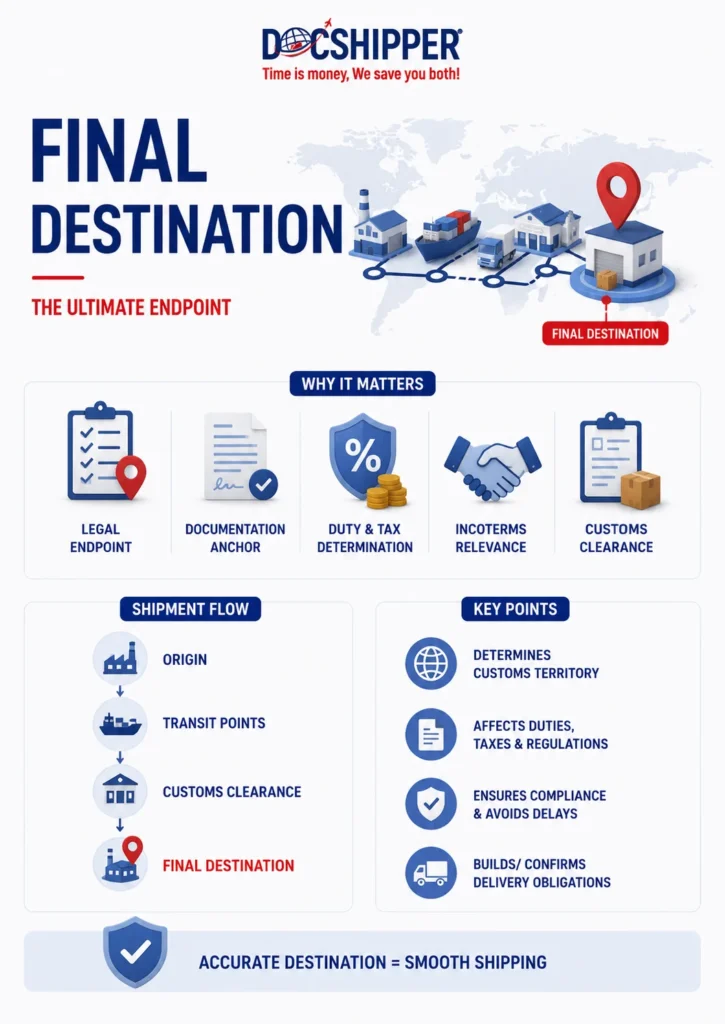
Key characteristics include:
- Legal endpoint: Where customs clearance for consumption occurs
- Consignee location: The verified business or individual receiving goods
- Documentation anchor: Referenced across all shipping documents
- Duty determination: Influences applicable tariffs and tax calculations
- Incoterms relevance: Defines seller/buyer responsibility transitions
In-Depth Understanding & Legal Framework
The final destination establishes jurisdiction for customs authorities and determines which country’s import regulations apply. When goods move from Shanghai to a warehouse in Berlin via Rotterdam, the final destination remains Berlin—not the transshipment port.
This distinction matters because customs duties calculate based on the destination country’s tariff schedule. The Harmonized System codes apply according to the final destination’s customs territory. Goods destined for Switzerland face different procedures than those clearing in EU member states, even when using the same ports.
Legal frameworks govern accuracy requirements. The Revised Kyoto Convention mandates precise destination information for customs risk assessment. Incorrect declarations constitute a customs offense in most jurisdictions.
The bill of lading must specify the final destination to validate freight charges and insurance coverage. Carriers calculate rates based on the complete journey to this endpoint. Ambiguous destinations void certain liability clauses and complicate claims processing.
Free trade agreements require proof of final destination for preferential tariff treatment. A certificate of origin becomes invalid if goods reroute to a non-qualifying country. At DocShipper, we systematically verify destination details against trade agreement criteria to maximize duty savings for our clients.
Freight forwarders distinguish between place of delivery and final destination when multiple parties handle inland transport. The contractual delivery point may differ from where goods ultimately arrive. This separation clarifies when risk and cost responsibilities transfer between commercial parties.
Practical Examples & Data
Consider automotive parts manufactured in Japan destined for an assembly plant in Slovakia. The shipment routes through Hamburg for customs clearance before trucking to Bratislava. The final destination remains the Slovak facility address—Hamburg serves as a transit point only.
| Scenario | Stated Destination | Customs Territory | Duty Calculation |
|---|---|---|---|
| Direct import | Warehouse in Lyon, France | EU customs union | EU common external tariff |
| Transshipment case | Dubai via Singapore | UAE territory | UAE import duties (if applicable) |
| FTZ storage | Free zone warehouse (Dubai) | FTZ regulations apply | Suspended until domestic entry |
| Multi-country delivery | Multiple EU addresses | First point of entry clears | Single customs clearance |
Industry data shows 23% of customs delays stem from destination mismatches between commercial invoices and transport documents. When the bill of lading lists Rotterdam but the invoice shows Amsterdam, customs systems flag discrepancies automatically.
Use Case: An electronics importer orders goods CIF New York but maintains distribution centers in Texas and California. The commercial contract specifies FOB terms transfer at the port, but the final destination for customs purposes remains the Texas facility where goods clear through CBP.
Key operational points:
- Bonded transport: Goods moving under customs seal to inland clearance maintain the inland location as final destination
- E-commerce shipments: Individual consumer addresses qualify as final destinations for duty de minimis calculations
- Project cargo: Construction sites or installation locations serve as final destinations for specialized equipment
- Return scenarios: RMA procedures require specifying the return destination for reverse logistics customs processing
- Diplomatic cargo: Embassy or consulate addresses bypass normal customs but still require destination documentation
Conclusion
Accurate final destination information forms the foundation of compliant international shipping. This single data point influences duty calculations, carrier routing, insurance coverage, and regulatory compliance across multiple jurisdictions.
Need expert guidance on destination documentation for your shipments? Contact DocShipper for professional freight forwarding services tailored to your logistics requirements.
📚 Quiz
Test Your Knowledge: Final Destination
What does "final destination" represent in international shipping?
A shipment routes through Hamburg for customs clearance before trucking to a factory in Slovakia. Which location is the final destination?
Your commercial invoice lists Amsterdam as destination, but the bill of lading shows Rotterdam. What is the likely consequence?
🎯 Your Result
📞 Free Quote in 24hFAQ | Final Destination: Definition, Process & Practical Examples
The port of discharge is where cargo unloads from the ocean vessel, while final destination refers to the ultimate delivery address. Goods may discharge in Hamburg but have Munich as the final destination, requiring inland transport after port operations complete.
Customs authorities at the final destination country calculate duties based on their national tariff schedules and trade agreements. The destination determines which preferential rates apply and which regulatory standards govern product compliance requirements.
Changing final destination mid-transit requires amending bills of lading, customs declarations, and potentially rerouting cargo. This process incurs additional fees and may void existing insurance coverage or free trade agreement benefits depending on contract terms.
The buyer typically specifies the final destination in purchase orders, as they control where goods ultimately arrive. Sellers must accurately reflect this information on shipping documents, even when freight forwarders arrange transport logistics.
Commercial invoices, packing lists, bills of lading, air waybills, customs declarations, and certificates of origin all require accurate final destination information. Discrepancies between documents trigger customs examinations and delay clearance procedures.
Goods entering free trade zones list the FTZ facility as an interim destination. The final destination becomes relevant only when goods exit the zone for domestic consumption, triggering duty payment and standard customs clearance processes.
Insurance policies calculate premiums based on complete journey risk to the final destination. Coverage terms specify maximum liability limits depending on destination country security ratings and transportation infrastructure quality assessments.
Incorrect destination information results in rejected customs entries, shipment holds, examination fees, and potential penalties. Correcting errors requires formal amendments, which delay clearance and may incur demurrage charges at ports or terminals.
Express carriers use recipient addresses as final destinations for customs clearance. They pre-clear shipments electronically using consignee information, applying simplified procedures for low-value goods under de minimis thresholds specific to destination countries.
Yes, distribution centers, fulfillment warehouses, and storage facilities qualify as final destinations when they represent the location where imported goods conclude their international journey and clear customs for domestic commerce or future distribution.
Incoterms define cost and risk transfer points but final destination remains constant. Under DDP terms, sellers deliver to the named final destination, while FOB terms transfer risk at origin—yet customs authorities always require the ultimate endpoint for clearance purposes.
E-commerce platforms validate destination addresses through postal code verification systems and carrier address databases. They transmit accurate final destination data to customs authorities via electronic manifests, enabling automated clearance for qualifying consumer shipments.
Need Help with
Logistics or Sourcing ?
First, we secure the right products from the right suppliers at the right price by managing the sourcing process from start to finish. Then, we simplify your shipping experience - from pickup to final delivery - ensuring any product, anywhere, is delivered at highly competitive prices.


Fill the Form
Prefer email? Send us your inquiry, and we’ll get back to you as soon as possible.
Contact us




