


In short ⚡
Financial responsibility in logistics refers to the legal and contractual obligation of a party to cover costs, damages, or losses occurring during international transportation. It determines who bears financial risk when goods are damaged, lost, or delayed, and is typically defined by Incoterms®, insurance policies, and freight agreements in import/export operations.
Introduction
Who pays when a container falls overboard? What happens if customs destroys non-compliant goods? Financial responsibility often becomes clear only when problems arise—and by then, it’s too late for preventive action.
In international trade, understanding who assumes financial risk at each stage of the supply chain prevents costly disputes. Misunderstanding responsibility allocation leads to 72% of litigation in maritime transport, according to ICC data.
Key elements defining financial responsibility include:
- Incoterms® allocation: FOB, CIF, DDP determine transfer points of financial risk
- Insurance coverage: Cargo insurance scope and exclusions specify reimbursable losses
- Carrier liability limits: International conventions cap compensation per kilogram or package
- Force majeure clauses: Exemptions for unavoidable external events
- Documentary evidence: Bills of lading and packing lists establish proof of condition
Understanding Financial Responsibility Mechanisms
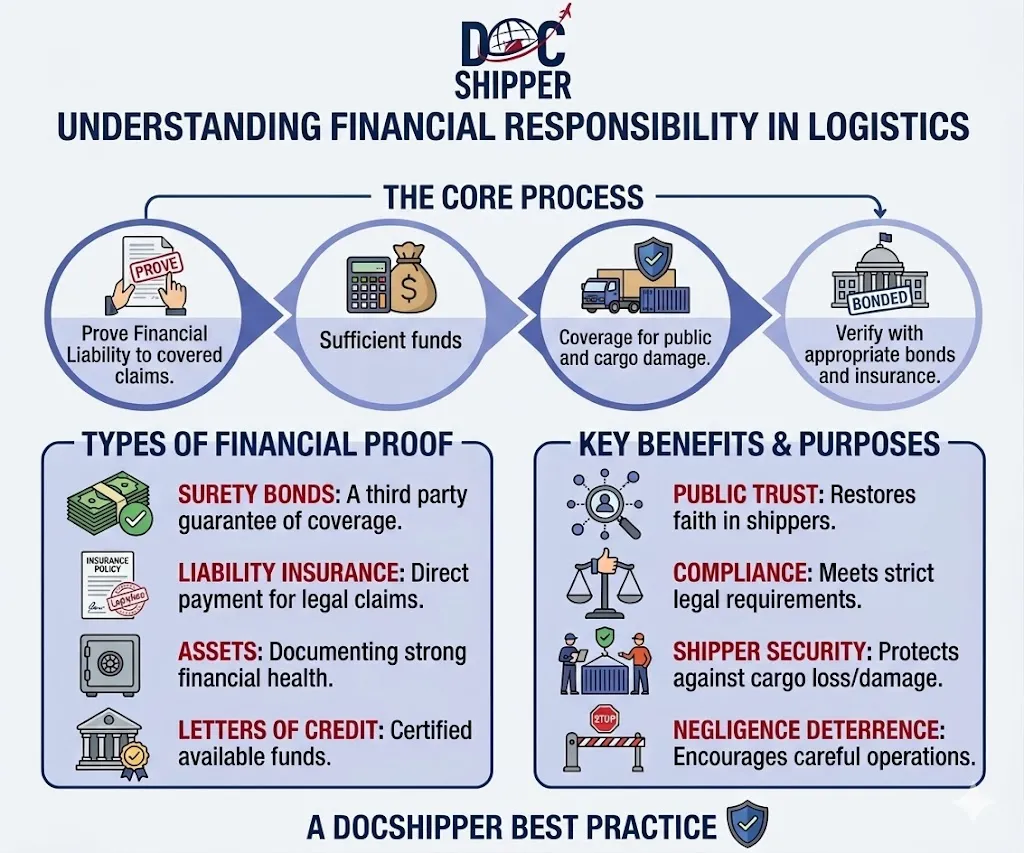
Financial responsibility operates through three interconnected layers: contractual allocation, statutory liability, and insurance indemnification. Each layer applies different rules depending on the transport mode and jurisdictions involved.
Incoterms® 2020 form the foundation of contractual responsibility. Under EXW terms, the buyer assumes all risks from the seller’s warehouse. Under DDP, the seller bears responsibility until final delivery. The critical distinction lies in understanding that Incoterms define risk transfer points, not necessarily cost allocation. A buyer under FOB terms pays freight but transfers risk once goods cross the ship’s rail.
Carrier liability frameworks impose statutory limits regardless of contracts. The Hague-Visby Rules cap maritime carrier responsibility at 666.67 SDR per package or 2 SDR per kilogram, whichever is higher. The Montreal Convention limits air carrier liability to 22 SDR per kilogram. These limits apply unless the shipper declares higher value and pays surcharges.
Insurance gaps create the most dangerous exposure. Standard cargo insurance excludes inherent vice, improper packaging, war, and strikes. The Institute Cargo Clauses (A, B, C) define coverage breadth—Clause A provides “all risks” coverage with specific exclusions, while Clause C covers only enumerated perils. At DocShipper, we systematically review insurance certificates against actual cargo risks to identify coverage gaps before shipment.
Documentary proof requirements shift burden of proof. A clean bill of lading creates a presumption that goods were received in good condition. The party claiming damage must prove it occurred during the carrier’s custody. Time limits apply: maritime claims must be filed within 3 days for visible damage, 15 days for concealed damage. Missing these deadlines forfeits financial claims entirely.
Jurisdictional complexity multiplies when multiple carriers handle goods. The Rotterdam Rules attempt harmonization but remain unratified by major trading nations. Practical result: shippers face different liability regimes for each leg of multimodal transport.
Practical Examples & Data
Financial responsibility scenarios vary dramatically based on term selection and insurance quality. Consider these comparative cases:
| Scenario | Incoterm | Loss Event | Financial Bearer | Maximum Recovery |
|---|---|---|---|---|
| Electronics shipment China-USA | FOB Shanghai | Container theft at LA port | Buyer | $7,333 (11 packages × 666.67 SDR) |
| Textile shipment Bangladesh-Germany | CIF Hamburg | Water damage during voyage | Seller’s insurance | 110% CIF value (ICC-A) |
| Pharmaceutical air shipment | DDP Paris | Temperature excursion ruins cargo | Seller | $88,000 (4,000kg × 22 SDR) |
| Machinery shipment Germany-Brazil | EXW Munich | Customs seizure for non-compliance | Buyer | Zero (no carrier liability) |
Use Case: Electronics Importer Catastrophe
A UK importer ordered $450,000 worth of smartphones from Shenzhen under FOB terms. The buyer arranged ocean freight but purchased only basic carrier liability, not supplementary insurance. The container was stolen during port handling in Felixstowe.
Financial outcome: The carrier’s liability was capped at $8,000 (12 packages × 666.67 SDR × 1.20 USD exchange rate). The importer absorbed a $442,000 loss. Had they purchased all-risks cargo insurance for 0.35% premium ($1,575), they would have recovered $495,000 (110% coverage).
Key lessons from claim data:
- Underinsurance penalty: 43% of shippers carry insufficient coverage, applying average clauses that reduce payouts proportionally
- Documentation failures: 28% of valid claims are denied due to missed notification deadlines or incomplete surveys
- Mismatched Incoterms: 17% of disputes arise from buyers assuming sellers purchased insurance under FOB/FCA terms
- Exclusion blindspots: Temperature-controlled shipments require specialized coverage; standard policies exclude refrigeration failure
- Subrogation complications: When insurers pay claims, they pursue carriers—but carrier liability limits still apply, leaving insurers to absorb losses
At DocShipper, we conduct pre-shipment financial risk audits comparing Incoterm allocation against insurance coverage and carrier liability. This prevents the common scenario where parties assume complementary protections that actually leave critical gaps.
Conclusion
Financial responsibility in logistics demands proactive structuring, not reactive damage control. Aligning Incoterms, carrier contracts, and insurance coverage eliminates the exposure gaps that turn minor incidents into catastrophic losses.
Need expert guidance on optimizing your financial risk allocation? Contact DocShipper for a comprehensive supply chain risk assessment.
📚 Quiz
Test Your Knowledge: Financial Responsibility
1. Financial responsibility in international logistics primarily refers to:
2. Under FOB (Free On Board) Incoterms, when goods are stolen at the destination port:
3. A $450,000 electronics shipment is damaged during ocean transport. The carrier's liability under Hague-Visby Rules is capped at $8,000. What would have prevented this massive financial loss?
🎯 Your Result
📞 Free Personalized QuoteFAQ | Financial Responsibility: Definition, Calculation & Concrete Examples
Financial responsibility refers to the contractual obligation to bear costs or losses, determined by agreement between parties (primarily through Incoterms). Legal liability refers to statutory obligations imposed by international conventions like Hague-Visby Rules, which apply regardless of contracts. A seller may have financial responsibility under DDP terms while the carrier has legal liability for negligence—these can overlap or diverge depending on circumstances.
Only CIF and CIP Incoterms require the seller to purchase insurance. However, this insurance is minimal—covering only 110% of invoice value under Institute Cargo Clauses C (CIP) or A (CIF). All other Incoterms leave insurance decisions to individual parties. The common mistake is assuming FOB or CFR includes insurance protection when it does not.
Each transport leg applies its own liability regime. Sea leg follows Hague-Visby (666.67 SDR/package or 2 SDR/kg). Air leg follows Montreal Convention (22 SDR/kg). Road leg follows CMR Convention (8.33 SDR/kg). The multimodal operator's liability is limited to the regime of the leg where loss occurred—if identifiable. When the loss location is unknown, the lowest applicable limit typically governs, creating significant exposure.
Both parties rely solely on carrier liability limits, which are dramatically lower than cargo values. For a $200,000 machinery shipment weighing 5,000kg, maximum carrier recovery would be $13,333 (666.67 SDR × 10 packages) or $12,200 (2 SDR × 5,000kg)—leaving $187,000+ unrecoverable. This scenario is more common than expected, occurring in approximately 31% of commercial shipments according to TT Club data.
Contractual responsibility can theoretically transfer through document negotiation (transferable bills of lading), but this requires explicit agreement and creates legal complexity. Insurance policies typically prohibit assignment without underwriter consent. Practical result: responsibility structure should be finalized before shipment. Post-shipment transfers invite disputes over which party's insurance applies and when risk actually transferred.
General average occurs when cargo is intentionally sacrificed to save the voyage (jettisoning containers in storms). All cargo interests must contribute proportionally to losses. Particular average refers to partial losses affecting only specific cargo. Average clauses in underinsurance situations reduce claim payments proportionally—insuring $80,000 of $100,000 cargo means recovering only 80% of any loss, not full amount up to $80,000.
Declaring higher cargo value to carriers increases their liability limit but requires paying ad valorem surcharges (typically 0.5-1.5% of declared value). Shippers face a trade-off: accept low statutory limits or pay surcharges approaching insurance premiums. Most logistics professionals recommend purchasing comprehensive cargo insurance rather than relying on declared value, which still contains numerous exclusions and provides narrower coverage than dedicated policies.
Customs seizures, destructions, or penalties typically fall outside carrier and insurance coverage. The party responsible depends on Incoterms: under DDP, the seller bears customs compliance responsibility and related costs. Under DAP or earlier terms, the buyer assumes these risks. Specialized customs bond insurance exists but excludes fines for intentional misclassification. Customs-related financial exposure represents one of the most underestimated risks in cross-border trade.
Force majeure exempts carriers from liability for losses caused by unforeseeable events beyond their control—wars, strikes, natural disasters. However, force majeure interpretation varies by jurisdiction and contract language. The COVID-19 pandemic revealed that many carriers claimed force majeure for delays while insurers disputed its applicability. Financial responsibility during force majeure events often depends on insurance policy wording rather than transport contracts, creating gray zones neither party anticipated.
Joint responsibility occurs in scenarios like FCA with buyer-arranged pre-carriage or FOB with buyer-provided containers. Each party bears responsibility for their contracted segment, but establishing where damage occurred becomes critical and contentious. Container pre-shipment surveys and intermediate condition reports become essential evidence. The practical challenge: if damage discovery occurs at destination, apportioning responsibility between seller's packing, carrier's handling, and buyer's container often requires expensive litigation.
Beyond citing Incoterms, contracts should explicitly state: (1) which party purchases cargo insurance and minimum coverage level, (2) claims notification procedures and deadlines, (3) responsibility for customs duties and taxes, (4) liability for demurrage and detention charges, (5) force majeure definitions and consequences. Ambiguous contracts create disputes costing more than the original shipment. Standard industry contracts from organizations like BIMCO provide tested frameworks that allocate responsibilities clearly.
Small shipments under $5,000 face disproportionate insurance costs (minimum premiums often exceed proportional rates). Options include: (1) open cargo policies providing blanket coverage at reduced rates, (2) freight forwarder liability insurance (typically capped at $50,000-100,000), (3) credit card shipping insurance for qualifying purchases, (4) relying on carrier liability with realistic loss expectations. The key is matching protection level to actual financial exposure rather than over-insuring low-value goods or catastrophically under-insuring high-value items.
Need Help with
Logistics or Sourcing ?
First, we secure the right products from the right suppliers at the right price by managing the sourcing process from start to finish. Then, we simplify your shipping experience - from pickup to final delivery - ensuring any product, anywhere, is delivered at highly competitive prices.


Fill the Form
Prefer email? Send us your inquiry, and we’ll get back to you as soon as possible.
Contact us




