


In short ⚡
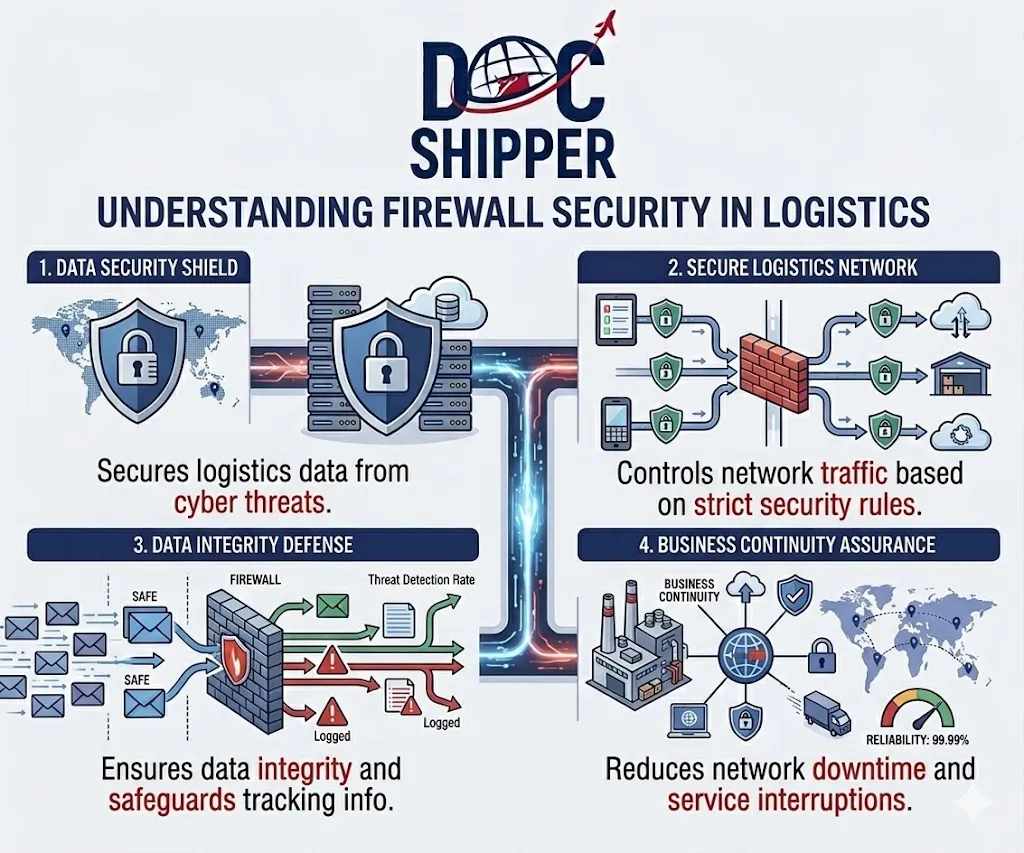
A firewall is a network security system that monitors and controls incoming and outgoing network traffic based on predetermined security rules. It acts as a barrier between trusted internal networks and untrusted external networks, protecting digital supply chain infrastructure from unauthorized access, cyberattacks, and data breaches in international trade operations.
Introduction
In international logistics, a single security breach can expose sensitive shipment data, customs documentation, and client information to cybercriminals. With 68% of logistics companies reporting cyberattacks in 2023, firewall protection has become non-negotiable.
Freight forwarders, customs brokers, and warehouse management systems handle thousands of daily transactions. Each connection point represents a potential vulnerability. A robust firewall strategy protects this digital infrastructure while maintaining operational efficiency.
Key characteristics of firewalls in logistics operations:
- Traffic filtering: Blocks malicious connections while allowing legitimate business communications
- Multi-layer protection: Combines hardware and software solutions for comprehensive security
- Real-time monitoring: Detects suspicious activity across shipping platforms and EDI systems
- Access control: Restricts network entry based on user authentication and authorization levels
- Compliance enforcement: Ensures adherence to GDPR, C-TPAT, and AEO security standards
Firewall Architecture & Security Protocols
Firewalls operate through multiple security layers, each addressing specific threat vectors. Understanding these mechanisms enables logistics companies to implement appropriate protection measures for their operational needs.
Packet filtering firewalls examine data packets against predefined rules, inspecting source IP addresses, destination ports, and protocol types. This stateless approach provides fast processing but limited context awareness. Most modern logistics systems combine packet filtering with stateful inspection for enhanced security.
Stateful inspection firewalls track active connections and analyze traffic context, not just individual packets. When a customs broker submits electronic declarations, the firewall maintains session state, verifying that response packets match legitimate requests. This prevents session hijacking attacks targeting shipment tracking systems.
Application-layer firewalls (proxy firewalls) inspect traffic at the application level, understanding protocols like HTTP, FTP, and SMTP. They decrypt SSL/TLS connections to detect malware hidden in encrypted traffic—critical when third parties access warehouse management systems or transportation platforms.
Next-generation firewalls (NGFW) integrate intrusion prevention systems, deep packet inspection, and application awareness. These advanced solutions identify threats based on behavioral patterns, not just signatures. For logistics operations managing IoT devices in smart warehouses, NGFWs provide essential visibility and control.
According to ENISA (European Union Agency for Cybersecurity), properly configured firewalls reduce successful breach attempts by up to 80% in supply chain environments. At DocShipper, we implement firewall protocols across all client communication channels to safeguard sensitive commercial invoices and customs documentation throughout the shipping process.
Implementation Examples & Data Protection
Practical firewall deployment varies based on company size, infrastructure complexity, and regulatory requirements. Here’s how different logistics scenarios benefit from specific firewall configurations:
Comparative Firewall Solutions
| Solution Type | Best For | Protection Level | Typical Cost |
|---|---|---|---|
| Hardware Firewall | Warehouses, Distribution Centers | High throughput, network-wide | $2,000-$10,000 |
| Software Firewall | Individual Workstations | Host-level protection | $50-$300/device |
| Cloud Firewall | Remote Teams, Multi-location | Scalable, centralized management | $100-$500/month |
| NGFW Solution | Enterprise Logistics Operations | Advanced threat detection | $5,000-$50,000 |
Use Case: Port Terminal Security
A container terminal handling 15,000 TEUs weekly implemented a next-generation firewall to secure its Terminal Operating System (TOS). The configuration includes:
- Geo-blocking: Restricts connections to approved shipping line countries, blocking 94% of automated attacks
- Application whitelisting: Only authorized EDI software can transmit cargo manifests and bills of lading
- Intrusion prevention: Detects and blocks SQL injection attempts targeting vessel scheduling databases
- VPN integration: Encrypted tunnels for remote customs inspectors accessing classification systems
- Segmentation rules: Isolates operational technology (crane controls) from IT networks
This implementation reduced security incidents by 73% within six months while maintaining sub-second response times for customs clearance queries. The firewall logs provided forensic evidence for C-TPAT audit compliance, demonstrating continuous monitoring of supply chain security.
For small and medium freight forwarders, cloud-based firewall services offer enterprise-grade protection without capital expenditure. These solutions scale automatically during peak shipping seasons, protecting customer portals where clients track international shipments in real-time.
Conclusion
Firewalls represent the foundational layer of cybersecurity in modern logistics operations. As supply chains digitize and cyber threats evolve, properly configured firewall systems protect the data integrity and operational continuity that international trade depends upon.
Need expert guidance on securing your logistics infrastructure? Contact DocShipper for a comprehensive security assessment tailored to your shipping operations.
📚 Quiz
Test Your Knowledge: Firewall
What is the primary function of a firewall in logistics operations?
A freight forwarder receives advice that "firewalls prevent all security threats." What is the correct interpretation?
A customs broker with 15 remote employees needs firewall protection. Which solution best fits this scenario?
🎯 Your Result
📞 Free Quote in 24hFAQ | Firewall: Definition, Types & Practical Implementation in Logistics
A firewall controls network traffic flow, blocking unauthorized connections before they reach your systems. Antivirus software scans files and programs already on your device to detect and remove malware. In logistics environments, you need both—firewalls prevent external threats from entering, while antivirus protects against threats introduced via email attachments or infected USB drives.
Properly configured firewalls add negligible latency (typically 1-5 milliseconds). Modern stateful inspection firewalls process legitimate traffic efficiently. Performance issues usually indicate misconfigured rules or undersized hardware. For high-volume logistics operations processing thousands of tracking queries hourly, hardware firewalls with dedicated processing units maintain optimal speed while inspecting all traffic.
Review firewall rules quarterly at minimum, with immediate updates when adding new logistics software, shipping partners, or warehouse locations. Automated rule management systems can adjust policies dynamically based on threat intelligence feeds. Emergency patches should be applied within 24 hours of vendor notification to address critical vulnerabilities.
Yes, cloud firewalls offer significant advantages for freight forwarders with multiple offices or remote staff. They provide centralized policy management, automatic updates, and protection for employees accessing customs systems from various locations. Leading solutions integrate with existing logistics software via APIs, offering visibility across all international shipping operations without requiring on-site hardware maintenance.
Customs brokers require application-layer inspection to protect client classification data, SSL/TLS decryption for encrypted customs portal connections, multi-factor authentication enforcement, activity logging for audit trails, and geo-filtering to limit access to specific customs authority regions. These features ensure compliance with data protection regulations while securing sensitive tariff information and import licenses.
Next-generation firewalls segment IoT networks, isolating smart sensors, automated guided vehicles (AGVs), and inventory scanners from corporate systems. They enforce device authentication, monitor for abnormal behavior patterns, and block command-and-control communications from compromised devices. This prevents attackers from using a vulnerable temperature sensor as an entry point to access warehouse management systems containing shipment data.
Firewalls are a critical defense layer but not a complete solution. They block known malicious IP addresses and prevent lateral movement once ransomware infiltrates a network. Combined with email filtering, endpoint protection, and regular backups, firewalls reduce ransomware risk by approximately 85%. Logistics companies should implement defense-in-depth strategies rather than relying solely on perimeter security.
A Demilitarized Zone (DMZ) is a network segment positioned between internal systems and external networks, protected by dual firewalls. Logistics companies place customer-facing shipment tracking portals and EDI servers in the DMZ, allowing external access without exposing internal warehouse systems or financial databases. If attackers compromise a DMZ server, they still face internal firewall barriers preventing deeper network penetration.
Firewall logs document all network connection attempts, creating an audit trail for security compliance frameworks like ISO 27001, C-TPAT, and AEO certifications. Logs prove continuous monitoring, demonstrate incident response capabilities, and identify policy violations. For customs brokers handling controlled goods, firewall logs verify that only authorized personnel accessed restricted classification databases during specific time periods.
Medium to large freight forwarders benefit from hardware firewalls protecting entire office networks, supplemented by software firewalls on individual laptops used for remote customs clearance. Small operations with under 20 employees can start with commercial-grade software firewalls on each device plus a secure router. The key is matching protection level to operational complexity and data sensitivity.
Essential maintenance includes weekly log reviews for unusual access patterns, monthly firmware updates to patch security vulnerabilities, quarterly rule audits to remove outdated permissions, annual security assessments by external auditors, and continuous monitoring of threat intelligence feeds. Automated management tools reduce manual workload while maintaining security posture across distributed logistics networks.
Modern firewalls support API connections to transportation management systems (TMS), allowing dynamic rule adjustments based on shipment status. They can whitelist temporary carrier portals during active shipments, enforce encryption for rate negotiations, and log all third-party logistics provider connections. This integration maintains security without disrupting the rapid communication exchanges required for international freight coordination.
Need Help with
Logistics or Sourcing ?
First, we secure the right products from the right suppliers at the right price by managing the sourcing process from start to finish. Then, we simplify your shipping experience - from pickup to final delivery - ensuring any product, anywhere, is delivered at highly competitive prices.


Fill the Form
Prefer email? Send us your inquiry, and we’ll get back to you as soon as possible.
Contact us




