



In short ⚡
A Firm Planned Order (FPO) is a fixed production or procurement directive in supply chain planning systems that cannot be automatically modified by the system's algorithms. Unlike standard planned orders, FPOs lock quantities, dates, and sources, giving planners manual control over critical logistics decisions while preventing automatic rescheduling during MRP runs.
Introduction
Supply chain disruptions often occur when automated planning systems reschedule critical orders without human oversight. A Firm Planned Order solves this by giving logistics managers the authority to lock essential production or procurement plans.
In international trade, where lead times span weeks and supplier commitments are contractual, FPOs prevent costly misalignments. They act as anchors in volatile demand environments, ensuring strategic shipments remain prioritized.
Key characteristics include:
- Manual override capability: System cannot auto-adjust quantity or timing
- Fixed supplier allocation: Locks source even during capacity constraints
- Date protection: Prevents automatic rescheduling during MRP regeneration
- Visibility flag: Clearly marked in ERP systems to alert planners
- Exception management: Requires manual intervention for modifications
Technical Mechanics & Planning Authority
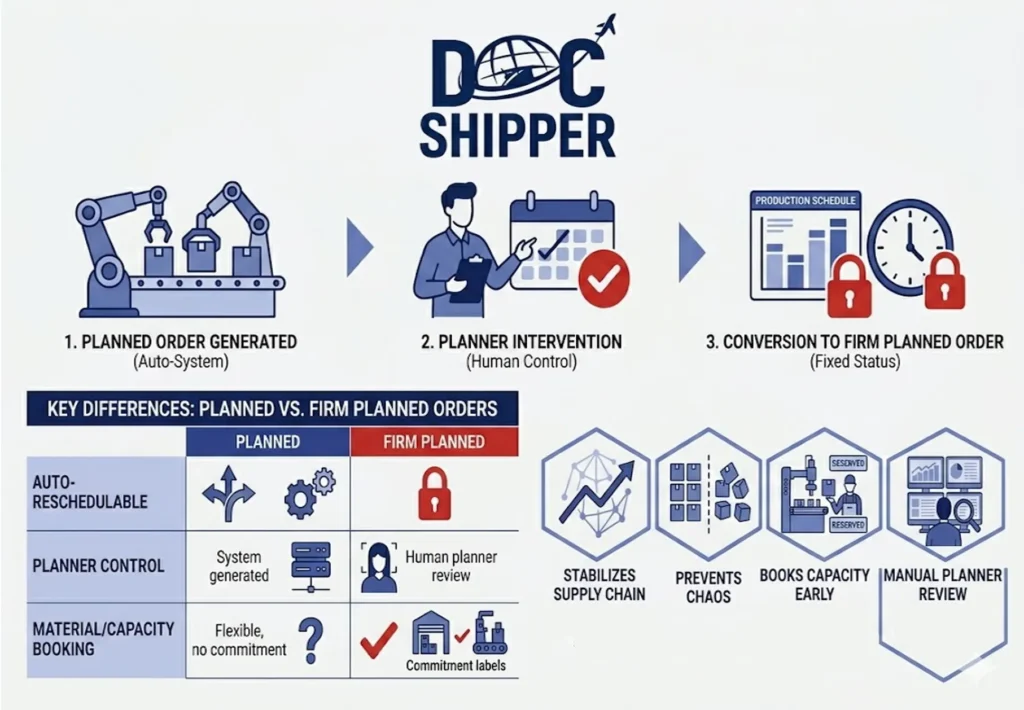
The Material Requirements Planning (MRP) engine calculates demand based on forecasts, existing inventory, and open orders. Standard planned orders remain flexible—the system adjusts them during each planning cycle based on new data inputs.
A Firm Planned Order introduces planning hierarchy control. When an order is firmed, the MRP system treats it as a constraint rather than a variable. The planner essentially tells the algorithm: “This decision is non-negotiable.”
This becomes critical in scenarios involving:
- Contractual commitments: When purchase orders are already issued to suppliers
- Production line reservations: Manufacturing capacity booked weeks in advance
- Customs clearance timelines: Shipments timed to meet regulatory windows
- Promotional campaigns: Inventory must arrive before marketing launch dates
- Cross-docking operations: Inbound and outbound schedules synchronized
The distinction between FPOs and Purchase Orders is crucial. A purchase order is an external commitment to a vendor. An FPO is an internal planning directive that may or may not have been converted to a PO yet. At DocShipper, we coordinate with ERP systems to ensure FPOs align with actual shipment capabilities before they become binding commitments.
From a technical standpoint, ERP systems like SAP use specific transaction codes (MD04, MD16) to convert planned orders into firm status. Oracle SCM employs supply chain orchestration rules that respect FPO constraints during optimization runs.
The APICS Supply Chain Operations Reference (SCOR) model classifies FPOs under “Plan Source” activities, emphasizing their role in balancing automation with human judgment.
Practical Applications & Comparison
Understanding FPOs requires seeing them in operational contexts. Consider an electronics importer preparing for Black Friday. Standard MRP might suggest delaying a container shipment by two weeks to consolidate orders. However, the planner firms that order because:
- The booking confirmation with the ocean carrier is already locked
- Warehouse labor has been scheduled for that specific arrival date
- Retail distribution centers expect inventory by contractual deadlines
- Delaying would miss the promotional window entirely
Here’s a comparative breakdown of order types in logistics planning:
| Order Type | System Flexibility | Typical Use Case | Modification Authority |
|---|---|---|---|
| Planned Order | Fully automatic adjustment | Forecast-based replenishment | System algorithms |
| Firm Planned Order | Locked until manual release | Critical shipments, contractual commitments | Human planner only |
| Purchase Order | Fixed external commitment | Supplier-confirmed procurement | Requires vendor agreement |
| Production Order | Fixed manufacturing directive | Shop floor execution | Manufacturing supervisor |
Use Case: Pharmaceutical Cold Chain
A biotech company importing temperature-controlled vaccines uses FPOs to lock airfreight schedules. Standard planning might suggest switching to ocean freight to reduce costs by 68%. However, the planner firms the air cargo order because:
- Vaccines expire in 45 days—ocean transit takes 32 days
- Cold storage at destination is pre-booked for specific arrival times
- Regulatory approvals are time-stamped to shipment dates
- Any delay risks $2.3 million in product write-offs
At DocShipper, we work with planners to convert FPOs into actionable freight bookings, ensuring that locked planning decisions translate into executed shipments. Our freight forwarding services respect the urgency embedded in firmed orders.
Another scenario involves promotional inventory. A fashion retailer launching a limited-edition line firms orders 90 days before the event. Even if demand forecasts drop by 22%, the FPO remains intact because:
- Marketing campaigns are already published with specific dates
- Influencer contracts reference the product availability window
- Stockouts would damage brand reputation more than excess inventory
Conclusion
Firm Planned Orders represent the intersection of algorithmic efficiency and human judgment in supply chain management. They protect strategic logistics decisions from being overridden by automated systems during volatile periods.
Need expertise in aligning production planning with international shipping realities? Contact DocShipper to ensure your firmed orders translate into successful deliveries.
📚 Quiz
Test Your Knowledge: Firm Planned Order (FPO)
What is the primary defining characteristic of a Firm Planned Order in supply chain systems?
A planner receives a system suggestion to delay a container shipment by two weeks to consolidate orders and reduce costs. When would firming the original order be the CORRECT decision?
How does a Firm Planned Order differ from a Purchase Order in supply chain planning?
🎯 Your Result
📞 Free Quote in 24hFAQ | Firm Planned Order (FPO): Definition, Calculation & Practical Examples
Planners typically firm orders when external commitments have been made (supplier contracts, production line bookings), when timing is critical (promotional launches), or when system-generated suggestions conflict with operational realities. The decision often follows risk assessment—firming protects against automatic changes that could disrupt carefully coordinated logistics.
Yes, but only through manual intervention by an authorized planner. The system will not auto-adjust quantities, dates, or sources. Modifications require reviewing dependent activities (warehouse schedules, carrier bookings) and may involve coordination with suppliers. In ERP systems, this typically requires special transaction codes or workflow approvals.
A frozen planning horizon locks all orders within a time window, while an FPO targets specific orders regardless of timing. Freezing is a blanket policy (e.g., "no changes within 30 days"), whereas firming is selective—locking critical orders while allowing flexibility elsewhere. FPOs offer surgical control; horizon freezing is a broader constraint.
They can, if demand decreases after an order is firmed. However, the cost must be weighed against risks like stockouts, missed promotional windows, or contract penalties. In volatile markets, the insurance value of guaranteed supply often outweighs carrying cost increases. Advanced planning systems now calculate this trade-off using financial impact models.
FPOs sit above safety stock logic. While safety stock is a buffer calculated by the system, FPOs represent committed orders that bypass standard replenishment algorithms. In practice, planners may firm orders to compensate for insufficient safety stock during high-risk periods (supplier instability, peak seasons), creating a manual override layer.
The system will flag the conflict but won't auto-resolve it. Planners must intervene—either unfirming the order, securing additional capacity (overtime shifts, alternate suppliers), or delaying lower-priority work. In manufacturing, this might mean expediting raw material purchases; in logistics, it could require premium freight upgrades.
Less commonly, because JIT relies on flow synchronization rather than locked orders. However, hybrid models use FPOs for critical components while maintaining JIT for commodities. Automotive manufacturers, for example, might firm orders for custom electronics while letting standard fasteners remain flexible. The approach balances responsiveness with control.
Regulatory timelines often force planners to firm orders. If a shipment requires pre-clearance documentation that takes 10 days, and the supplier lead time is 40 days, the order must be firmed 50 days before need date—leaving no room for system rescheduling. Import quotas, licensing windows, and inspection requirements all create scenarios where flexibility becomes a liability.
Advanced planning systems now support conditional firming—automatically locking orders that meet criteria like "value exceeds $100,000" or "delivery date within 14 days." However, this requires careful rule design. Over-automation defeats the purpose of manual control; under-automation leaves planners overwhelmed. Best practice involves tiered thresholds with escalation workflows.
Key indicators include: high percentage of total orders firmed (above 40% suggests over-reliance), frequent emergency unfirming actions, excess inventory accumulation, and low forecast accuracy despite planning efforts. Healthy FPO usage typically represents 10-20% of total orders—enough to protect critical paths without rigidifying the entire supply chain.
Freight forwarders receive firmed orders as non-negotiable shipping requirements. At DocShipper, we prioritize FPO-related shipments in capacity allocation, ensure booking confirmations align with locked dates, and flag any logistical conflicts immediately. Our role is translating planning rigidity into operational execution—matching the planner's intent with carrier capabilities and customs realities.
Effective FPO management requires understanding MRP logic, risk assessment, and cross-functional impacts. Training should cover: when to firm versus when to trust the system, how to evaluate trade-offs (cost vs. risk), ERP system mechanics, and communication protocols with procurement and logistics teams. Many organizations require certification in supply chain planning (APICS CPIM/CSCP) before granting FPO authority.
Need Help with
Logistics or Sourcing ?
First, we secure the right products from the right suppliers at the right price by managing the sourcing process from start to finish. Then, we simplify your shipping experience - from pickup to final delivery - ensuring any product, anywhere, is delivered at highly competitive prices.


Fill the Form
Prefer email? Send us your inquiry, and we’ll get back to you as soon as possible.
Contact us




:%20Definition,%20Calculation%20&%20Practical%20Examples)