


In short ⚡
First Mover Advantage is a competitive benefit gained by companies that enter a new market or introduce innovative products/services before competitors. In international logistics and supply chain management, this advantage enables businesses to establish distribution networks, secure preferential supplier relationships, and capture market share before rivals, creating significant barriers to entry through operational infrastructure and customer loyalty.
Introduction
Why do some logistics providers dominate emerging trade corridors while others struggle to gain traction? The answer often lies in timing and strategic entry. In global trade, being first to establish operations in new markets or adopt transformative technologies can determine long-term profitability.
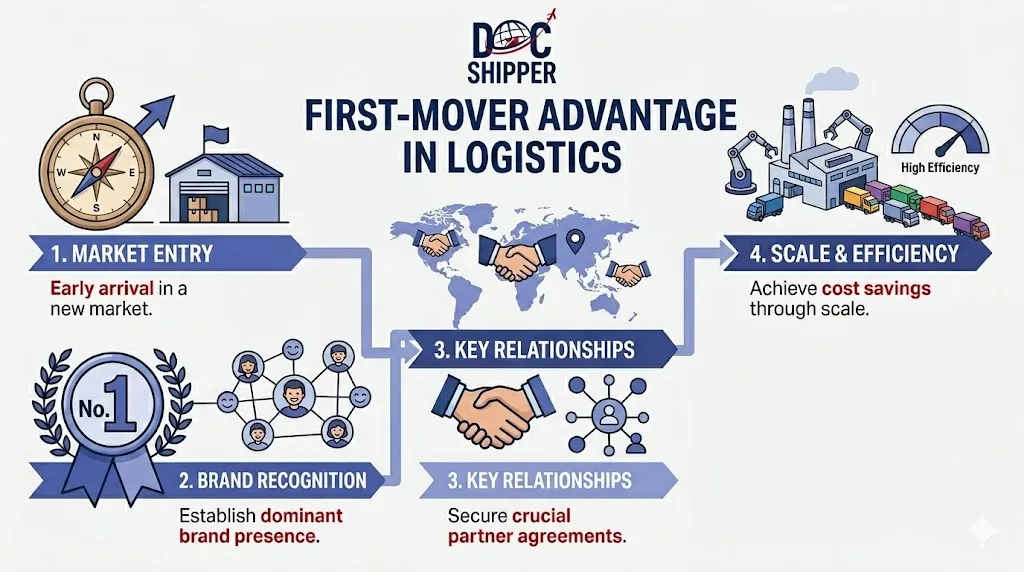
First mover advantage fundamentally shapes competitive positioning in international commerce. Companies entering markets early secure critical resources—warehouses, customs partnerships, carrier contracts—that later entrants find scarce or expensive.
This strategic concept matters particularly in logistics because:
- Network effects multiply value as infrastructure expands and partnerships deepen
- Regulatory relationships develop through early engagement with customs authorities and trade bodies
- Brand recognition establishes trust with importers/exporters in unfamiliar markets
- Cost advantages emerge from learning curves and economies of scale
- Customer lock-in occurs through integrated systems and service dependencies
Strategic Mechanisms & Competitive Dynamics
First mover advantage operates through several interconnected mechanisms in logistics operations. Understanding these dynamics helps companies evaluate market entry timing and competitive strategy.
Resource preemption represents the most tangible benefit. Early entrants secure optimal warehouse locations near ports, negotiate favorable long-term carrier contracts, and lock in skilled local personnel. When DocShipper establishes operations in emerging trade hubs, we prioritize strategic facility placement to maximize client accessibility and operational efficiency.
Technological leadership creates substantial barriers. Companies investing early in customs digitalization, blockchain tracking, or AI-powered route optimization build proprietary capabilities competitors must replicate. The learning curve accumulated through operational experience becomes intellectual property that sustains competitive gaps.
Buyer switching costs increase as relationships mature. Importers integrating their ERP systems with a logistics provider’s platform face technical hurdles changing vendors. Training investments, customized workflows, and historical data stored in provider systems create friction deterring migration.
Network externalities amplify advantages in logistics. As a provider adds delivery destinations, consolidation options, or intermodal connections, service value increases for all clients. Later competitors struggle matching comprehensive networks without equivalent investment.
However, first mover advantage carries inherent risks. Pioneering companies bear market education costs, regulatory uncertainty, and infrastructure investments that may not yield returns. According to research from the World Trade Organization, approximately 47% of logistics first movers in developing markets fail to maintain leadership beyond five years due to resource constraints or strategic missteps.
Regulatory positioning offers critical but often overlooked benefits. Early entrants shape compliance frameworks through direct engagement with customs authorities, influencing standards that later competitors must navigate. This regulatory familiarity reduces clearance times and dispute risks.
Real-World Applications & Market Data
First mover advantage manifests differently across logistics segments. Examining concrete scenarios reveals both opportunities and limitations of early market entry.
E-commerce Logistics in Southeast Asia
When cross-border e-commerce accelerated in Vietnam and Indonesia during 2016-2018, logistics providers entering these markets first captured 65% of market share by 2020. Early movers established warehouse networks, customs brokerage relationships, and last-mile delivery infrastructure that later competitors required 18-24 months to replicate.
The investment differential was substantial. First movers spent approximately $2.8M establishing operations, while fast followers entering two years later required $4.3M for equivalent infrastructure due to increased real estate costs and higher salary expectations for experienced personnel.
Cold Chain Logistics for Pharmaceuticals
Temperature-controlled logistics for pharmaceutical imports demonstrates sustained first mover benefits. Companies establishing GDP-compliant cold chain infrastructure in African markets between 2012-2015 maintain 73% client retention rates compared to 41% for later entrants.
Switching costs prove prohibitive because pharmaceutical importers must revalidate entire supply chains when changing logistics providers—a process requiring 6-9 months and costing $180,000-$320,000 in testing, documentation, and regulatory approval.
Comparative Market Entry Scenarios
| Entry Timing | Market Share (Year 3) | Setup Investment | Break-even Period | Client Acquisition Cost |
|---|---|---|---|---|
| First Mover | 38-45% | $2.1M – $3.5M | 22-28 months | $850 – $1,200 |
| Fast Follower (12-18 mo) | 22-31% | $3.2M – $4.8M | 26-34 months | $1,400 – $2,100 |
| Late Entrant (24+ mo) | 12-19% | $4.5M – $6.2M | 32-44 months | $2,300 – $3,500 |
Technology Adoption Case Study
Blockchain-based document verification illustrates technology-driven first mover advantage. Freight forwarders implementing distributed ledger systems for bills of lading between 2019-2021 reduced document processing times by 68% while competitors using traditional methods faced increasing bottlenecks.
These early adopters secured exclusive partnerships with major shipping lines piloting digital documentation. When industry standards emerged in 2022, their systems became reference implementations, creating compatibility requirements favoring their platforms.
Key Success Factors
Analysis of successful first movers reveals five critical elements:
- Capital reserves sufficient for 18-30 month runway before profitability
- Local expertise through partnerships or experienced regional hires
- Scalable systems anticipating 300-500% volume growth within three years
- Regulatory proactivity engaging authorities before formal requirements exist
- Client education investment building market literacy about service value
At DocShipper, we evaluate these factors systematically when considering expansion into emerging corridors, ensuring our clients benefit from established infrastructure and proven operational frameworks rather than experimental market entries.
Conclusion
First mover advantage in logistics demands careful strategic evaluation. While early market entry offers substantial benefits through resource control and competitive positioning, success requires adequate capital, operational expertise, and sustained commitment through market development phases.
Need guidance evaluating market entry timing or leveraging established logistics networks? Contact our team for strategic consultation tailored to your international trade objectives.
📚 Quiz
Test Your Knowledge: First Mover Advantage
What is the core definition of First Mover Advantage in international logistics?
Which statement correctly describes a key limitation of First Mover Advantage?
A pharmaceutical importer considering switching cold chain logistics providers faces $180,000-$320,000 in revalidation costs and 6-9 months of testing. This scenario best demonstrates which First Mover Advantage mechanism?
🎯 Your Result
📞 Free Quote in 24hFAQ | First Mover Advantage: Definition, Strategic Impact & Real-World Examples
First mover advantage refers specifically to being first in a market or with an innovation, while early adopter benefits apply to any company entering shortly after pioneers. First movers establish standards and capture resources; early adopters learn from pioneer mistakes while still gaining timing advantages. In logistics, first movers set network infrastructure, whereas early adopters optimize based on proven models with lower risk.
Duration varies by market maturity and barriers to entry. In established trade lanes, advantages persist 3-5 years before competitors achieve parity. In emerging markets with high infrastructure requirements, first movers maintain leadership 7-12 years. Technology-based advantages erode fastest (2-4 years) as innovations diffuse, while relationship-based advantages (customs partnerships, client integrations) endure longer.
Yes, through superior technology, niche specialization, or operational efficiency. Fast followers often succeed by avoiding pioneer mistakes, targeting underserved segments, or introducing disruptive business models. Amazon's logistics network, developed after established carriers, demonstrates how capital-intensive innovation can displace incumbents. Late entrants succeed in approximately 28% of logistics market entries according to industry analysis.
Key indicators include market share above 35% within three years, client retention exceeding 70%, operating margins 15-20% higher than competitors, and network density (warehouses, partnerships) double that of nearest rival. Regulatory relationships measured by customs clearance speed and exclusive carrier partnerships also signal strong positioning. Brand recognition in target client surveys provides qualitative validation.
Customs brokers entering new markets first establish critical relationships with authorities, understand informal clearance practices, and develop territory-specific expertise. These brokers often influence regulatory interpretation through early guidance requests. Client switching costs are particularly high due to broker-held import licenses, established trust relationships, and familiarity with client product classifications. Advantages typically endure 6-10 years in stable regulatory environments.
Capital determines infrastructure scale and technology capabilities that create entry barriers. First movers investing heavily in warehouse networks, proprietary software, or specialized equipment force competitors to match spending for equivalent service. In logistics, capital intensity correlates strongly with advantage duration—markets requiring $5M+ entry investments maintain first mover leadership 40% longer than low-capital segments.
Commoditized transport segments with low differentiation—standard LTL shipping, basic warehousing—show minimal first mover benefits. When services are interchangeable and switching costs low, operational efficiency and pricing determine success regardless of entry timing. Markets with rapid regulatory changes also diminish first mover advantages as compliance requirements shift frequently, resetting competitive dynamics.
Digital freight platforms reduce physical infrastructure advantages by connecting shippers with carriers directly. However, network effects create new first mover dynamics—platforms attracting critical carrier/shipper mass first establish dominant positions. Traditional forwarders maintaining first mover advantages must digitize services or partner with platforms. Approximately 35% of traditional logistics first movers successfully transition to digital-first models.
Continuous innovation prevents stagnation, client integration through customized technology raises switching costs, exclusive partnerships with key suppliers create access barriers, and geographic expansion into adjacent markets leverages established reputation. Investing 8-12% of revenue in service development and maintaining client satisfaction above 85% correlates with sustained leadership. Proactive competitive intelligence systems alert to challenger strategies enabling preemptive responses.
Conduct scenario analysis comparing first mover investment against fast follower alternatives. Calculate break-even timelines under optimistic, realistic, and pessimistic adoption curves. Assess competitor barriers—high capital requirements, regulatory complexity, and technical expertise needs favor first movers. If break-even extends beyond 36 months or market uncertainty exceeds 40%, fast follower strategies often provide better risk-adjusted returns.
Several air cargo operators pioneered dedicated freighter services to secondary Chinese cities in 2008-2011 but withdrew after underestimating infrastructure costs and overestimating demand growth. Early blockchain consortiums in maritime shipping (2016-2018) failed achieving critical mass, allowing later platforms with superior governance models to dominate. These cases illustrate that execution quality and market timing matter equally to entry sequence.
Customs digitalization can either strengthen or erode first mover advantages depending on transition management. Providers investing early in compatible systems gain advantages, while those tied to legacy processes face disadvantage. The World Customs Organization's trade facilitation initiatives create opportunities for agile first movers understanding new requirements. Successful providers allocate 15-20% of compliance budgets to regulatory technology monitoring and adaptation.
Need Help with
Logistics or Sourcing ?
First, we secure the right products from the right suppliers at the right price by managing the sourcing process from start to finish. Then, we simplify your shipping experience - from pickup to final delivery - ensuring any product, anywhere, is delivered at highly competitive prices.


Fill the Form
Prefer email? Send us your inquiry, and we’ll get back to you as soon as possible.
Contact us




