


In short ⚡
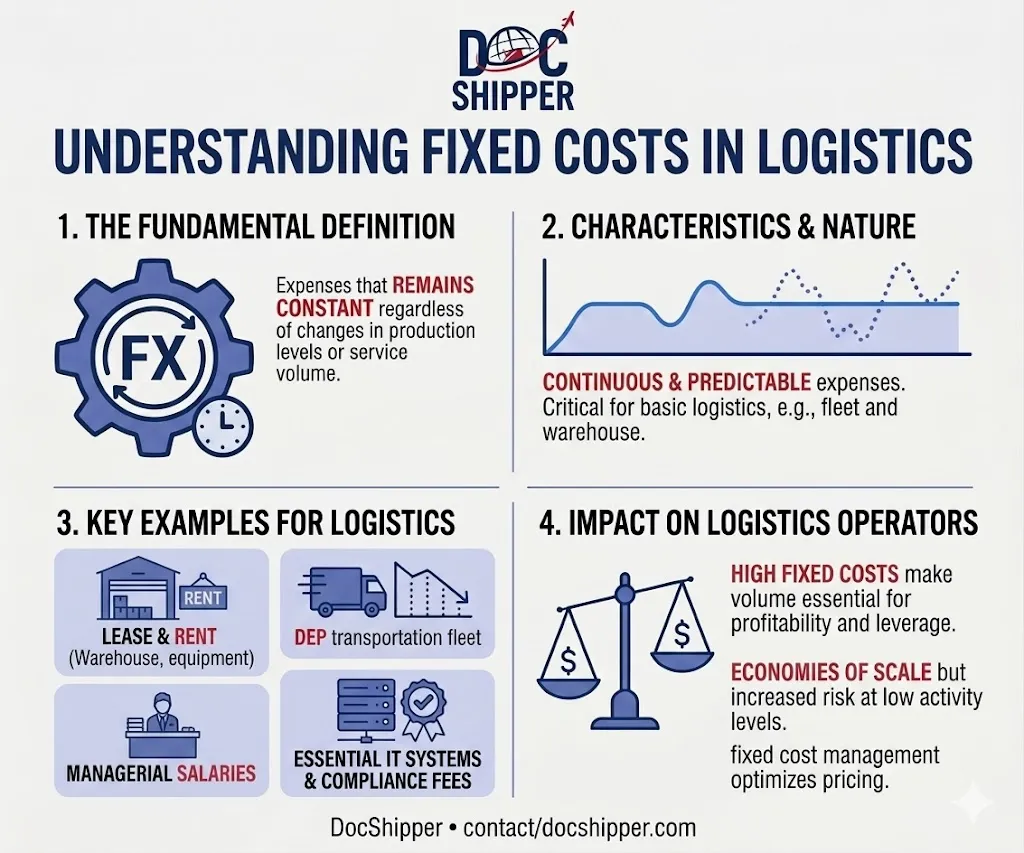
Fixed costs are expenses that remain constant regardless of production volume or business activity levels. These costs must be paid whether a company produces one unit or one million units, including expenses like rent, insurance, salaries, and equipment leasing.Introduction
Many businesses confuse fixed costs with variable costs, leading to catastrophic pricing decisions and cash flow problems. Understanding this distinction is crucial for import/export operations where margins are tight and cost structures determine competitive positioning.
In international logistics, fixed costs represent the baseline operational expenses that persist regardless of shipment volumes. A freight forwarder pays warehouse rent whether handling 10 containers or 100 per month. Recognizing these costs enables accurate break-even analysis and strategic pricing decisions.
- Time-based consistency: Fixed costs remain unchanged over specific accounting periods
- Volume independence: Production levels do not affect these expense amounts
- Predictability: Easier to forecast and budget than variable costs
- Economies of scale impact: Per-unit fixed costs decrease as volume increases
- Cash flow implications: Must be covered even during low-activity periods
Deep Dive & Expert Analysis
Fixed costs represent the foundational infrastructure of any logistics operation. Unlike variable costs that fluctuate with activity, these expenses create the operational capacity that enables business functions. The commitment nature of fixed costs demands strategic planning.
In international trade, typical fixed costs include warehouse leases, customs brokerage licenses, transportation management system subscriptions, permanent staff salaries, and insurance policies. These costs establish your operational readiness regardless of actual business volumes.
The legal and contractual dimension cannot be overlooked. Most fixed costs stem from binding agreements—lease contracts, employment contracts, insurance policies—that cannot be easily terminated. According to U.S. International Trade Administration, understanding these commitments is essential for market entry planning.
The concept of relevant range qualifies the “fixed” nature of these costs. While stable within normal operating parameters, fixed costs can change if business scales dramatically. Opening a second warehouse or hiring additional permanent staff increases the fixed cost baseline.
From a financial perspective, fixed costs create operating leverage. High fixed costs mean profitability accelerates rapidly once break-even is achieved, but losses mount quickly during low-volume periods. This risk-reward dynamic fundamentally shapes business strategy.
At DocShipper, we systematically analyze clients’ fixed cost structures during consultation to identify optimization opportunities. Many businesses carry unnecessary fixed expenses that could be converted to variable costs through outsourcing or flexible arrangements.
Concrete Examples & Data
Understanding fixed costs requires examining real-world scenarios where these expenses impact profitability and decision-making. The following examples illustrate how fixed costs function across different logistics contexts.
Comparative Analysis: Fixed vs. Variable Cost Structure
| Cost Category | Fixed Costs | Variable Costs |
|---|---|---|
| Warehouse Operations | Monthly rent: $8,000 Property insurance: $1,200/month Permanent staff: $15,000/month |
Temporary labor: $20/hour Utility costs: Variable with usage Packaging materials: Per unit |
| Transportation | Vehicle leasing: $2,500/month Fleet insurance: $800/month Driver salaries: $12,000/month |
Fuel costs: Per kilometer Toll fees: Per trip Maintenance: Usage-based |
| Administrative | Office rent: $3,000/month Software licenses: $500/month Accounting staff: $8,000/month |
Document processing fees: Per shipment Communication costs: Per transaction Customs duties: Per import |
Case Study: Break-Even Analysis
A freight forwarding company faces monthly fixed costs of $45,000 (warehouse, salaries, insurance, licenses). Their average margin per shipment is $180 after variable costs. Break-even calculation:
- Break-even formula: Fixed Costs ÷ Contribution Margin per Unit = Required Units
- Calculation: $45,000 ÷ $180 = 250 shipments per month
- Interpretation: The company must handle minimum 250 shipments monthly to cover fixed costs
- Profitability threshold: Every shipment beyond 250 contributes directly to profit
- Strategic insight: At 400 shipments, the company generates $27,000 profit (150 units × $180)
Practical Scenario: Seasonal Business Impact
An import/export business experiences seasonal fluctuations. Fixed costs remain at $30,000 monthly regardless of season. During peak season (3 months), they handle 500 shipments monthly. Off-peak season (9 months), volume drops to 150 shipments monthly.
Peak season performance: Fixed cost per shipment = $30,000 ÷ 500 = $60 per shipment. Off-peak performance: Fixed cost per shipment = $30,000 ÷ 150 = $200 per shipment. This 233% increase in per-unit fixed costs during slow periods dramatically impacts pricing competitiveness.
DocShipper helps clients navigate these challenges through capacity-sharing arrangements and flexible operational models that convert some fixed costs into variable structures, reducing break-even points and improving resilience during slow periods.
Conclusion
Fixed costs form the operational foundation of logistics businesses, creating both opportunities through economies of scale and risks during low-volume periods. Mastering fixed cost management enables strategic pricing, accurate break-even analysis, and sustainable growth.
Need expert guidance on optimizing your logistics cost structure? Contact DocShipper for personalized consultation.
📚 Quiz
Test Your Knowledge: Fixed Costs
Which statement correctly defines fixed costs in logistics operations?
A common misconception is that fixed costs never change. What is the correct understanding?
A freight forwarder has $45,000 monthly fixed costs and earns $180 margin per shipment after variable costs. How many shipments are needed monthly to break even?
🎯 Your Result
📞 Free Personalized QuoteFAQ | Fixed Costs: Definition, Calculation & Concrete Examples
Fixed costs remain constant regardless of shipment volume (rent, salaries, insurance), while variable costs change proportionally with business activity (fuel, customs fees, packaging materials). Fixed costs must be paid even with zero shipments, whereas variable costs only occur when handling cargo. This distinction fundamentally affects pricing strategies and break-even calculations.
Fixed costs establish the minimum revenue threshold required for profitability. Companies with high fixed costs need higher volumes to achieve competitive per-unit pricing. During negotiations, understanding fixed cost allocation helps determine minimum acceptable margins. Businesses often offer volume discounts because additional shipments spread fixed costs across more units, improving overall profitability.
Fixed costs are "fixed" only within a specific time period and operating range. They can change when contracts renew, leases expire, or business scales significantly. For example, doubling warehouse capacity increases rent (a fixed cost). Additionally, insurance premiums may adjust annually. The key characteristic is that these costs don't fluctuate with short-term production or shipment volumes.
The break-even point is the sales volume where total revenue equals total costs, resulting in zero profit or loss. Higher fixed costs increase the break-even point, requiring more shipments to cover expenses before profitability begins. The formula is: Fixed Costs ÷ (Price per Unit - Variable Cost per Unit). Reducing fixed costs directly lowers the break-even threshold, improving financial resilience.
Strategies include converting ownership to leasing, outsourcing non-core functions, implementing flexible staffing models, sharing warehouse space, utilizing cloud-based software instead of perpetual licenses, and negotiating shorter contract terms. The goal is converting fixed commitments into variable arrangements that scale with business activity, though this often involves trade-offs in control and potentially higher per-unit costs.
Fixed costs create financial obligations that persist regardless of revenue levels. During downturns, shipment volumes decline but expenses like rent, salaries, and insurance continue. This increases per-unit costs dramatically, eroding margins and potentially causing losses. Companies with high fixed costs face greater bankruptcy risk during prolonged slow periods compared to businesses with variable cost structures.
Economies of scale occur when increasing production volume reduces per-unit costs. Fixed costs drive this phenomenon because total fixed expenses remain constant while being divided across more units. A warehouse costing $10,000 monthly represents $100 per shipment at 100 units but only $20 per shipment at 500 units. This creates competitive advantages for high-volume operations.
Critical fixed costs include warehouse leasing, permanent employee salaries and benefits, liability insurance, customs brokerage licenses, transportation management system subscriptions, office space rental, communication infrastructure, and compliance-related expenses. These costs typically represent 60-70% of total operational expenses in the freight forwarding industry, making their management crucial for profitability.
Operating leverage measures how revenue changes affect profitability. High fixed costs create high operating leverage—small revenue increases produce disproportionately large profit increases once break-even is exceeded. However, this cuts both ways: revenue decreases cause equally dramatic profit declines. Companies must balance the profit acceleration potential against vulnerability during slow periods.
Generally yes. New logistics companies face volume uncertainty, making high fixed costs extremely risky. Starting with outsourced warehousing, contract workers, and shared resources minimizes commitments while testing market demand. As volume stabilizes and grows, strategically converting variable costs to fixed arrangements (owning vs. leasing) can improve margins. The transition timing depends on sustained revenue confidence.
Entering new markets requires establishing local fixed cost infrastructure—warehouses, staff, licenses, and partnerships. These commitments represent significant financial risk before revenue materializes. Companies must forecast volume accurately and assess whether potential margins justify the fixed cost investment. Many businesses initially partner with local providers to test markets before committing to permanent fixed cost structures.
Make-or-buy analysis compares internal production fixed costs against outsourcing variable costs. Building in-house capacity involves substantial fixed investments (equipment, facilities, permanent staff) but lower per-unit costs at high volumes. Outsourcing eliminates fixed commitments but typically costs more per unit. The decision depends on projected volumes, capital availability, and strategic control preferences.
Need Help with
Logistics or Sourcing ?
First, we secure the right products from the right suppliers at the right price by managing the sourcing process from start to finish. Then, we simplify your shipping experience - from pickup to final delivery - ensuring any product, anywhere, is delivered at highly competitive prices.


Fill the Form
Prefer email? Send us your inquiry, and we’ll get back to you as soon as possible.
Contact us




