


In short ⚡
Fixed Order Quantity is an inventory management strategy where businesses order the same predetermined quantity of goods each time stock reaches a reorder point, regardless of current demand variations. This method simplifies procurement planning and helps maintain consistent supply chain operations by establishing predictable ordering patterns that balance carrying costs with ordering efficiency.
Introduction
Many import-export companies struggle with inconsistent inventory levels—sometimes facing stockouts, other times holding excessive inventory that ties up capital. The Fixed Order Quantity system addresses this challenge by establishing a repeatable ordering rhythm.
In international trade, where lead times can span weeks or months, predictable ordering becomes essential. This methodology helps businesses coordinate with suppliers, manage customs clearances, and optimize warehouse space without constant recalculation.
Key characteristics of Fixed Order Quantity include:
- Consistent order volumes that remain unchanged between replenishment cycles
- Variable reorder timing triggered when inventory reaches a predetermined threshold
- Simplified supplier relationships through standardized purchase orders
- Reduced administrative workload by eliminating complex order quantity calculations
- Predictable freight planning enabling better negotiation with carriers and forwarders
Understanding Fixed Order Quantity Systems
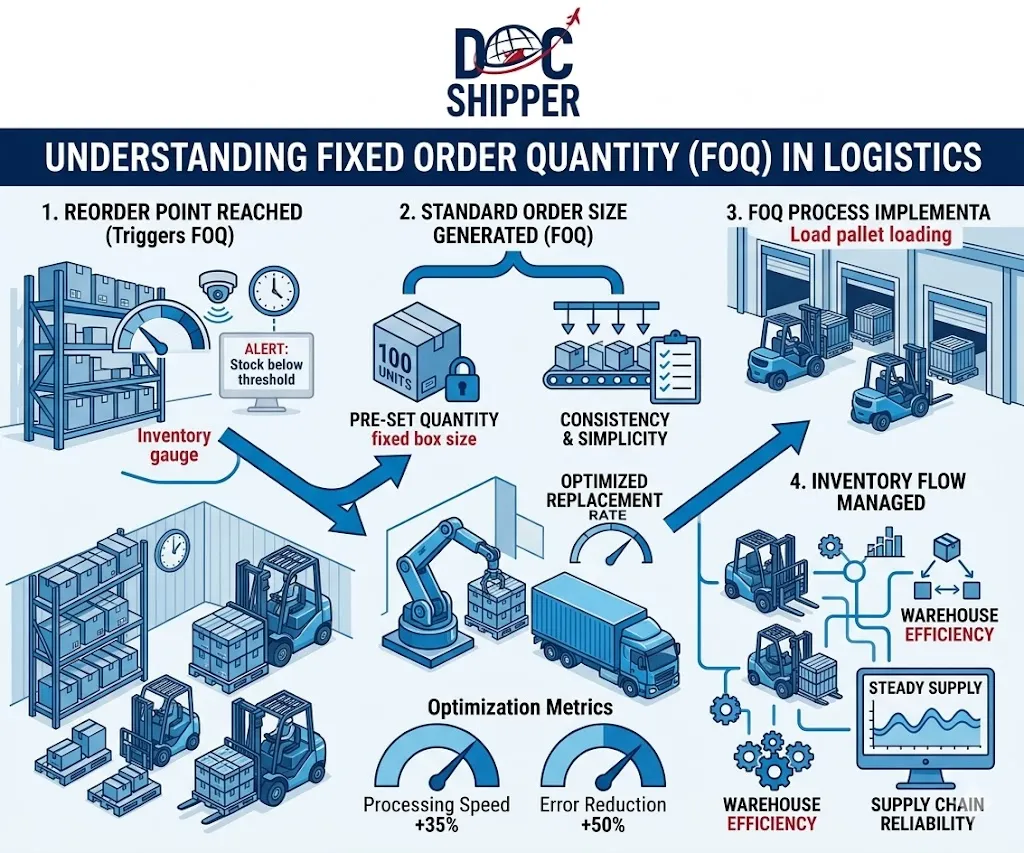
The Fixed Order Quantity approach operates on a continuous review basis. Businesses monitor inventory levels constantly and trigger orders when stock falls to the reorder point. Unlike periodic review systems that order at fixed intervals, FOQ maintains variable timing but consistent quantities.
Determining the optimal fixed quantity requires analyzing several factors. The Economic Order Quantity (EOQ) formula provides the mathematical foundation: EOQ = √(2DS/H), where D represents annual demand, S is ordering cost per purchase, and H represents holding cost per unit annually.
However, international logistics introduces complexities beyond the basic formula. Minimum order quantities (MOQs) imposed by suppliers, container capacity constraints, and customs valuation thresholds all influence the practical fixed quantity. A supplier might require 5,000-unit minimum orders, while a 20-foot container holds exactly 4,800 units—necessitating practical adjustments.
The reorder point calculation becomes equally critical: ROP = (Average Daily Usage × Lead Time) + Safety Stock. For importers, lead time encompasses production time, international shipping, customs clearance, and inland transportation. At DocShipper, we systematically analyze these timelines for clients to establish reliable reorder points that prevent stockouts during lengthy international transit periods.
Safety stock levels require special consideration in cross-border trade. Port congestion, customs delays, or unexpected inspections can extend lead times unpredictably. Businesses typically add 10-30% buffer stock depending on supply chain reliability and demand variability.
The system’s administrative efficiency provides significant advantages. Once established, purchasing teams simply release standard purchase orders without recalculating quantities. This consistency also enables better supplier relationships—manufacturers can plan production more efficiently when orders arrive in predictable volumes.
Regulatory compliance benefits from FOQ standardization as well. Customs documentation remains consistent, and experienced brokers familiar with recurring shipments can expedite clearances. The World Customs Organization guidelines emphasize how predictable shipment patterns facilitate risk assessment and faster processing.
Practical Examples & Data Analysis
Consider a European electronics retailer importing smartphone accessories from Asia. After analyzing historical sales data showing average monthly demand of 12,000 units with 15% standard deviation, they establish a fixed order quantity.
Case Study: Smartphone Accessory Importer
| Parameter | Value | Notes |
|---|---|---|
| Annual Demand | 144,000 units | Based on 12-month forecast |
| Ordering Cost | $850 per order | Includes freight, customs, admin |
| Holding Cost | $2.40 per unit/year | 20% of $12 unit cost |
| Calculated EOQ | 9,519 units | Theoretical optimal quantity |
| Fixed Order Quantity | 10,000 units | Rounded for container efficiency |
| Lead Time | 45 days | Production + ocean freight + customs |
| Safety Stock | 2,500 units | 15 days additional coverage |
| Reorder Point | 7,900 units | ROP = (400 daily × 45) + 2,500 |
This company now orders exactly 10,000 units every time inventory drops to 7,900 units. The standardized quantity fills one 40-foot container optimally, maximizing freight efficiency while staying close to the theoretical EOQ.
Comparative Analysis: FOQ vs. Variable Ordering
Research from supply chain management studies reveals significant operational differences:
- Administrative time: FOQ systems reduce procurement workload by 40-60% compared to dynamic quantity calculations
- Supplier pricing: Consistent volumes enable negotiated discounts averaging 3-8% below standard pricing
- Forecasting accuracy: Fixed quantities simplify demand planning, improving forecast accuracy by 15-25%
- Freight optimization: Standardized shipments reduce per-unit logistics costs by 12-18% through better container utilization
- Working capital: Average inventory levels typically run 10-15% higher than dynamic systems but with lower variance
At DocShipper, we’ve observed that clients implementing FOQ systems experience smoother customs processing because documentation patterns become familiar to border authorities. Repeated shipment profiles reduce inspection rates and clearance times.
Industry Application Examples:
Different sectors apply Fixed Order Quantity with varying parameters:
- Pharmaceutical importers: Order 5,000-unit batches matching regulatory approval quantities, ensuring traceability and expiration management
- Automotive parts distributors: Use FOQ aligned with OEM production schedules, typically ordering in multiples of 1,000 or 2,000 units
- Fashion retailers: Establish fixed quantities per style/color combination, simplifying allocation across store networks
- Industrial equipment suppliers: Order complete pallet quantities (often 200-500 units) optimizing warehouse handling and freight efficiency
- Food importers: Match container capacities precisely—for instance, 24,000 units of canned goods filling a refrigerated container
Conclusion
Fixed Order Quantity provides a pragmatic inventory management framework particularly valuable in international trade where predictability reduces complexity across logistics, customs, and supplier coordination. While it may not achieve the theoretical minimum cost of dynamic systems, the operational simplicity and relationship benefits often outweigh marginal cost differences.
Need assistance optimizing your inventory ordering strategy for international supply chains? Contact DocShipper for expert guidance on establishing effective reorder systems.
📚 Quiz
Test Your Knowledge: Fixed Order Quantity
What remains constant in a Fixed Order Quantity inventory system?
A company calculates EOQ as 9,519 units but sets their Fixed Order Quantity at 10,000 units. Is this approach incorrect?
An importer experiences a sudden 30% demand spike. Under FOQ, what is the most appropriate immediate response?
🎯 Your Result
📞 Free Quote in 24hFAQ | Fixed Order Quantity: Definition, Calculation & Concrete Examples
EOQ is a formula that calculates the theoretically optimal order quantity minimizing total inventory costs. Fixed Order Quantity is the actual implemented ordering policy, which may equal EOQ or be adjusted for practical constraints like supplier MOQs, container capacities, or budget limitations. FOQ represents the operational decision, while EOQ provides the mathematical starting point.
Most businesses review FOQ settings quarterly or semi-annually, unless significant changes occur in demand patterns, supplier pricing, or logistics costs. Seasonal businesses might adjust before peak periods. International traders should reassess when shipping routes change, tariffs are modified, or currency fluctuations exceed 10-15%. The goal is stability while remaining responsive to major market shifts.
FOQ performs best with relatively stable demand. For highly variable products, consider alternatives like periodic review systems or min-max approaches. However, you can implement FOQ for the base demand level and handle variability through safety stock adjustments or supplemental spot orders. Products with coefficient of variation (standard deviation/mean) below 0.5 typically suit FOQ well.
FOQ creates predictable cash outflows, simplifying financial planning. Orders trigger at consistent quantities, enabling better payment term negotiations with suppliers. However, it may increase average inventory investment by 10-20% compared to just-in-time approaches. The trade-off is between working capital efficiency and operational simplicity—most importers find the predictability worth the modest capital increase.
The reorder point will be reached faster, triggering orders more frequently rather than larger orders. If the spike is temporary, the system self-corrects as inventory rebuilds. For sustained increases, you'll need to recalculate both the fixed quantity and reorder point. Many businesses maintain a strategic reserve or expedited ordering option for true emergencies while keeping the base FOQ unchanged.
Certain customs thresholds influence FOQ selection. Orders exceeding specific values may trigger additional scrutiny, formal entry requirements, or higher duty calculations. Some countries offer simplified procedures for regular shipments below certain amounts. Businesses often set FOQ just below these thresholds—for example, ordering quantities valued at $2,400 when the simplified clearance limit is $2,500.
FOQ works for perishables if properly calibrated to shelf life. The fixed quantity must turn over well before expiration, typically aiming for 60-70% of shelf life as maximum cycle time. For products with 90-day shelf life, orders should occur when approximately 60 days remain. Combining FOQ with FEFO (First-Expired-First-Out) warehouse management ensures freshness. Temperature-controlled shipping adds urgency to accurate reorder point calculations.
Container capacity often determines practical FOQ. A 20-foot container holds roughly 28 cubic meters, while 40-foot containers hold 58 cubic meters. Smart importers calculate FOQ to maximize container utilization—ordering quantities that fill 95-100% of available space. This might mean adjusting theoretical EOQ from 8,750 units to 9,000 units if the larger quantity perfectly fills a container, reducing per-unit freight costs significantly.
Most ERP systems (SAP, Oracle, Microsoft Dynamics) include FOQ functionality within inventory modules. Specialized logistics platforms like Fishbowl, Cin7, or TradeGecko offer FOQ settings with reorder point triggers. Even sophisticated spreadsheet models can work for smaller operations. The key features needed are: automatic reorder alerts when inventory hits reorder point, historical demand tracking, and lead time monitoring for adjustment recommendations.
You can implement FOQ with multiple suppliers by establishing separate reorder points and fixed quantities for each source. Alternatively, maintain a combined FOQ but split orders between suppliers based on allocation rules (primary supplier gets 70%, secondary gets 30%). This approach builds supply chain resilience while maintaining quantity consistency. The total FOQ remains constant; only the supplier mix varies based on availability, pricing, or risk management strategies.
FOQ can increase average inventory levels compared to more dynamic systems, tying up working capital. It responds slowly to demand changes—significant shifts require manual intervention and recalculation. The system assumes relatively stable costs, but international trade faces currency fluctuations, tariff changes, and volatile freight rates. Businesses in rapidly changing markets or with highly seasonal products may find FOQ too rigid, requiring frequent adjustments that undermine the system's simplicity benefits.
Safety stock = Z × σ × √LT, where Z is the service level factor (1.65 for 95% service level), σ is demand standard deviation, and LT is lead time in periods. For international shipments, add lead time variability: Safety Stock = Z × √[(Avg LT × σD²) + (Avg D × σLT²)]. This accounts for both demand uncertainty and shipping unreliability. Conservative importers use the 95th percentile of historical lead times rather than averages when dealing with unpredictable routes.
Need Help with
Logistics or Sourcing ?
First, we secure the right products from the right suppliers at the right price by managing the sourcing process from start to finish. Then, we simplify your shipping experience - from pickup to final delivery - ensuring any product, anywhere, is delivered at highly competitive prices.


Fill the Form
Prefer email? Send us your inquiry, and we’ll get back to you as soon as possible.
Contact us




