


In short ⚡
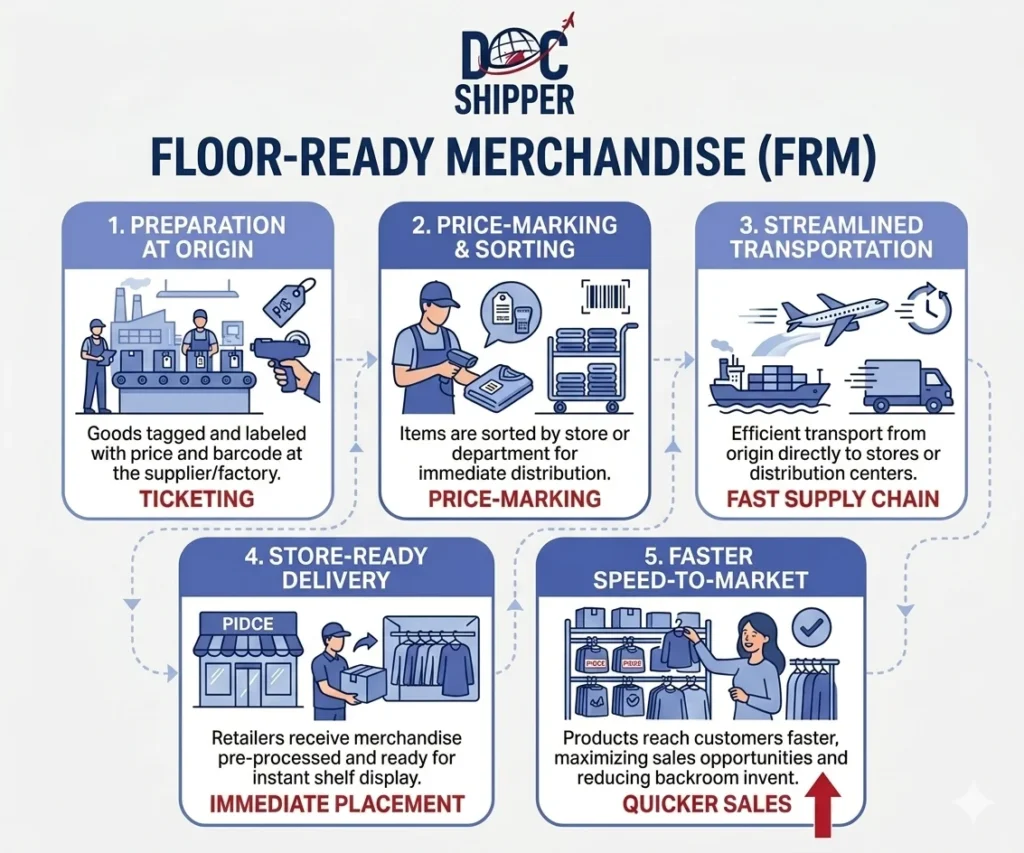
Floor-Ready Merchandise (FRM) refers to products delivered to retail locations in a pre-prepared, shelf-ready condition that requires minimal handling before being placed on the sales floor. This logistics approach includes pre-ticketing, hanging, folding, or packaging merchandise according to retail specifications, eliminating time-consuming store-level preparation and accelerating the path from receiving dock to consumer purchase point.
Introduction
Retailers constantly face a critical challenge: how to minimize the time between merchandise arrival and sales floor placement while controlling labor costs. Traditional distribution models require significant store-level handling—unpacking, ticketing, steaming, folding—consuming valuable hours that could be dedicated to customer service.
Floor-Ready Merchandise transforms this paradigm by shifting preparation activities upstream in the supply chain. Instead of stores receiving bulk shipments requiring extensive processing, products arrive ready for immediate display. This approach has become essential in fast-fashion, grocery, and consumer electronics sectors where speed-to-shelf directly impacts sales performance.
Key characteristics of Floor-Ready Merchandise include:
- Pre-ticketing: Price tags, security devices, and promotional labels affixed before shipping
- Display-ready packaging: Cartons designed to open and function as display units
- Hanging or folding: Garments prepared on hangers or folded to retail standards
- Retail compliance: Products configured to meet specific retailer planogram requirements
- Reduced handling: Minimized touch points between distribution center and sales floor
FRM Implementation & Strategic Advantages
Implementing Floor-Ready Merchandise requires sophisticated coordination between manufacturers, third-party logistics providers, and retailers. The process begins during production planning, where packaging specifications and labeling requirements are integrated into manufacturing workflows rather than treated as post-production activities.
The compliance dimension proves critical. Major retailers publish detailed vendor compliance manuals specifying exact requirements for hangers, poly bags, ticketing placement, and carton labeling. Non-compliance can trigger chargebacks ranging from $50 to $500 per violation, making adherence financially imperative. According to GS1 standards organizations, uniform labeling and packaging protocols reduce supply chain friction by standardizing expectations across trading partners.
From a labor economics perspective, FRM redistributes workload from high-cost retail environments to lower-cost distribution facilities. Store associates in metropolitan areas may cost $18-25 per hour including benefits, while warehouse workers in logistics hubs average $13-17 per hour. This arbitrage, combined with specialized equipment and batch processing efficiencies, generates substantial cost advantages.
The inventory velocity impact cannot be overstated. Traditional merchandising creates a 24-72 hour delay between truck unloading and product availability. FRM collapses this timeline to 2-6 hours, directly improving sales capture during promotional windows or trend-driven demand spikes. At DocShipper, we systematically configure FRM protocols during the sourcing phase, ensuring Asian manufacturers understand specific retailer requirements before production begins, eliminating costly rework cycles.
Technology integration amplifies FRM effectiveness through RFID tagging and automated sorting systems. When floor-ready units incorporate radio-frequency identification at the item level, receiving processes become nearly instantaneous, and inventory accuracy approaches 99%+ compared to 60-70% with manual counting methods.
Concrete Examples & Performance Data
Real-world FRM implementation demonstrates measurable performance improvements across retail categories. Studies indicate that retailers adopting comprehensive FRM programs reduce store labor requirements by 30-40% while simultaneously improving in-stock positions by 12-18%.
| Retail Category | Traditional Processing Time | FRM Processing Time | Labor Savings |
|---|---|---|---|
| Apparel (hanging) | 48-72 hours | 3-6 hours | 85-92% |
| Consumer Electronics | 24-36 hours | 2-4 hours | 88-90% |
| Grocery (shelf-ready) | 12-18 hours | 1-2 hours | 83-89% |
| Home Goods | 36-48 hours | 4-8 hours | 78-83% |
Use Case: Fast-Fashion Retailer Implementation
A European fashion chain importing 2.5 million garment units monthly from Bangladesh implemented comprehensive FRM protocols. Previously, merchandise required 52 hours of store-level processing across their 180-location network. After transitioning to hanging garments with pre-affixed security tags and pricing, processing time dropped to 6 hours per shipment.
Financial impact included:
- Annual labor savings: €3.2 million (calculated at 46 hours saved × 180 stores × €19/hour × 52 weeks)
- Sales lift: 7.3% attributed to improved product availability during peak shopping periods
- Shrinkage reduction: 2.1% due to earlier security tag application
- Compliance chargebacks eliminated: previously averaging €127,000 annually
Another quantifiable advantage emerges in promotional execution accuracy. When promotional pricing is applied at the distribution center rather than individual stores, pricing errors drop from 8-12% to below 1%, preventing revenue leakage and customer dissatisfaction.
The grocery sector demonstrates particularly compelling FRM economics through shelf-ready packaging that converts shipping cartons into display fixtures. A leading European supermarket chain reported that switching 40% of center-store categories to shelf-ready formats reduced restocking labor by 23% while improving on-shelf availability by 9 percentage points.
Conclusion
Floor-Ready Merchandise represents a fundamental shift from store-centric to supply-chain-centric merchandising optimization. By consolidating preparation activities in controlled environments, retailers simultaneously reduce costs, accelerate inventory turnover, and improve customer experience through better product availability.
Need expert guidance on implementing FRM protocols for your import operations? Contact DocShipper to discuss how we can configure your supply chain for floor-ready excellence.
📚 Quiz
Test Your Knowledge: Floor-Ready Merchandise (FRM)
What is the primary defining characteristic of Floor-Ready Merchandise?
A retailer mandates that all suppliers deliver garments on hangers with pre-affixed price tags and security devices. Where does this preparation typically occur to maximize efficiency?
A supplier believes that "shelf-ready packaging" and "Floor-Ready Merchandise" are completely different concepts with no overlap. Is this interpretation accurate?
🎯 Your Result
📞 Free Quote in 24hFAQ | Floor-Ready Merchandise (FRM): Definition, Benefits & Concrete Examples
While often used interchangeably, shelf-ready packaging specifically refers to corrugated packaging designed to function as retail displays, common in grocery and mass merchandising. Floor-Ready Merchandise encompasses this but includes broader preparation activities like garment hanging, pre-ticketing, and any configuration that eliminates store-level handling across all retail categories including apparel and electronics.
Cost allocation varies by negotiation and market power dynamics. Large retailers often mandate FRM compliance as a cost of doing business, pushing expenses to suppliers or manufacturers. In balanced partnerships, the demonstrable labor savings may be shared through adjusted wholesale pricing. Third-party logistics providers sometimes offer FRM as a value-added service, creating a separate revenue stream while enabling smaller suppliers to meet retailer requirements.
FRM preparation typically occurs post-customs clearance at domestic distribution centers to accommodate last-minute pricing changes and avoid complications with declared values. However, some basic preparation like security tag application may occur at origin if products won't be repriced. The additional packaging materials and labor can slightly increase shipping volumes and weights, though improved handling efficiency often offsets these marginal increases.
Compliance requirements are primarily retailer-specific rather than governed by universal standards, though GS1 labeling protocols provide foundational guidelines. Major retailers publish vendor compliance manuals detailing exact specifications for hanger types, poly bag thickness, ticket placement coordinates, and carton markings. Industry associations like VICS (Voluntary Interindustry Commerce Standards) work to harmonize certain elements, but retailers maintain proprietary requirements reflecting their operational systems and brand standards.
While large retailers drove initial FRM adoption due to scale economics, small and mid-sized retailers increasingly access these benefits through collaborative distribution arrangements or third-party consolidators. A boutique with 5-10 locations may not justify dedicated FRM infrastructure but can partner with logistics providers serving multiple small retailers, sharing preparation costs while still achieving faster merchandising cycles and reduced store labor requirements.
FRM can complicate returns since products configured for specific retailers may not easily transfer to other channels. Security tags must be removed, and retailer-specific ticketing replaced. However, the same preparation capabilities can be applied in reverse—consolidating returned merchandise at distribution centers and reconditioning it for secondary markets more efficiently than at individual store locations, ultimately improving recovery value on returned goods.
Automation transforms FRM economics, particularly for high-volume operations. Automated hanging systems can process 800-1,200 garments per hour versus 120-180 manually. Robotic ticketing applicators ensure consistent placement and reduce errors to near-zero levels. Vision systems verify packaging compliance before shipping, preventing costly chargebacks. These technologies require significant capital investment but deliver rapid ROI for operations processing over 500,000 units monthly.
Retailers handle promotional pricing through multiple approaches: some apply promotional signage at store level while maintaining regular price tickets; others use price lookup systems where shelf tags display promotional prices regardless of ticket prices; advanced systems employ electronic shelf labels synchronized with POS systems. For planned promotions, tickets can be prepared with promotional pricing and held for time-release shipments. Emergency price changes may require store-level over-labeling.
FRM introduces sustainability trade-offs. Individual poly bags and additional packaging materials increase plastic consumption, while hangers add to shipping volumes. However, consolidated preparation often enables bulk material purchasing with better recycling infrastructure than dispersed stores. Some retailers mandate sustainable FRM materials—recycled hangers, biodegradable poly bags, or reusable packaging systems. The net environmental impact depends on material choices, transportation efficiency gains, and end-of-life handling protocols.
Transition timelines range from 6-16 weeks depending on complexity. Simple ticketing additions may require only 6-8 weeks for equipment acquisition and staff training. Comprehensive FRM including hanging, specialized packaging, and RFID integration typically needs 12-16 weeks to establish processes, validate compliance with retailer specifications, and complete pilot testing. Working with experienced logistics partners like DocShipper can compress timelines by leveraging existing infrastructure and expertise.
Key performance indicators include: store labor hours per unit processed (primary savings metric), time from receiving to sales floor (speed-to-shelf), compliance chargeback frequency and cost, on-shelf availability percentages, pricing accuracy rates, and total landed cost per unit including FRM preparation expenses. Advanced programs track sales lift during the first 48 hours of product availability, correlating faster merchandising with revenue capture during peak demand windows.
Omnichannel complexity can challenge FRM approaches since products may need different configurations for stores versus e-commerce fulfillment. Leading retailers solve this through bifurcated inventory streams—FRM preparation for store-destined units and standard packaging for direct-to-consumer shipments. Unified commerce models sometimes employ modular FRM where basic preparation occurs universally, with channel-specific finishing applied at final sortation points based on real-time demand allocation.
Need Help with
Logistics or Sourcing ?
First, we secure the right products from the right suppliers at the right price by managing the sourcing process from start to finish. Then, we simplify your shipping experience - from pickup to final delivery - ensuring any product, anywhere, is delivered at highly competitive prices.


Fill the Form
Prefer email? Send us your inquiry, and we’ll get back to you as soon as possible.
Contact us




:%20Definition,%20Benefits%20&%20Concrete%20Examples)