


In short ⚡
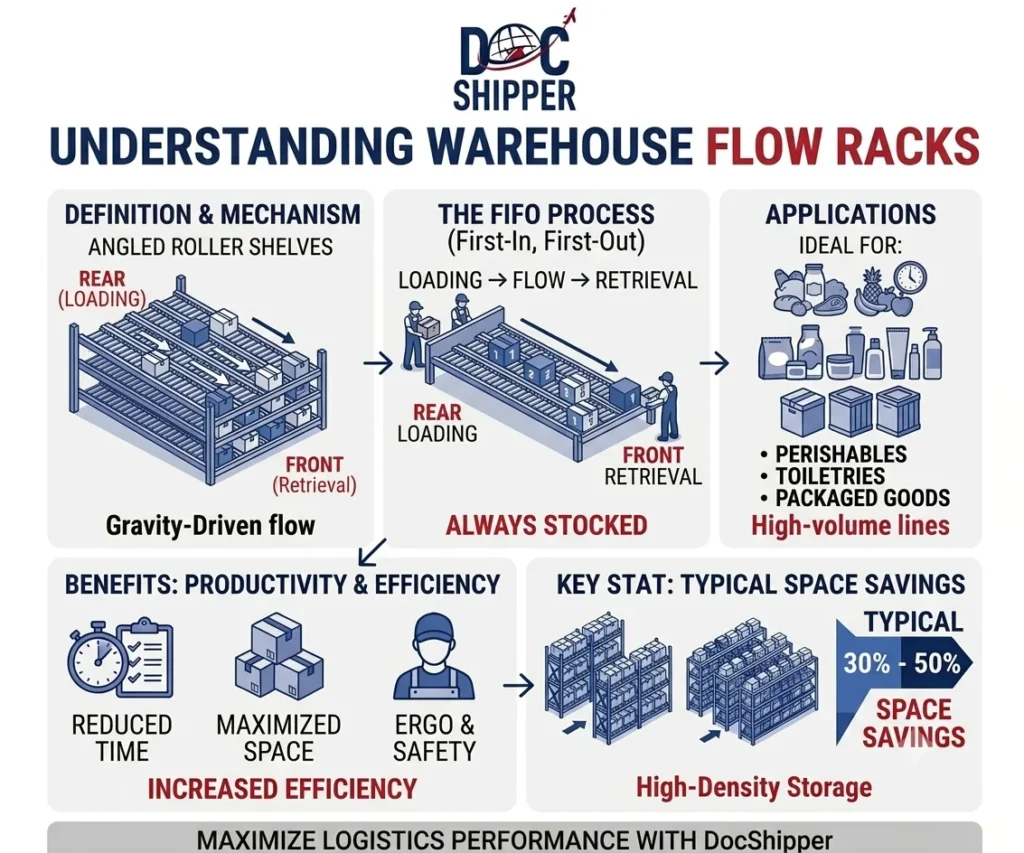
A flow rack is a gravity-fed storage system using inclined roller or wheel lanes that allow products to move automatically from the loading side to the picking face. This FIFO-compliant (First-In, First-Out) solution maximizes space utilization, reduces labor costs, and accelerates order fulfillment in warehouses handling high-turnover inventory such as food, pharmaceuticals, or e-commerce parcels.
Introduction
Many warehouse managers struggle with inventory rotation issues, particularly when dealing with perishable goods or time-sensitive products. Traditional static shelving forces workers to manually verify dates and pull older stock from the back, creating bottlenecks and increasing the risk of product expiration.
Flow racks solve this operational challenge by leveraging gravity to ensure automatic stock rotation. In international logistics, where speed and accuracy determine profitability, this system has become essential for companies managing cross-border distribution centers and fulfillment hubs.
Key characteristics of flow rack systems include:
- Gravity-driven product movement eliminating manual rotation
- Dual-access configuration separating replenishment from picking zones
- Space optimization through vertical and depth utilization
- FIFO enforcement ensuring chronological order fulfillment
- Scalable modularity adapting to SKU variety and volume fluctuations
Technical Design & Operational Mechanics
Flow racks operate on a simple yet highly efficient principle. Products loaded from the rear elevation slide forward on inclined roller tracks or skate wheel conveyors, stopping at the picking face where a brake mechanism or physical stop prevents them from falling. When a worker removes the front unit, the next item automatically advances into position.
The system’s angle of inclination typically ranges from 3° to 5°, calculated based on product weight, packaging friction coefficient, and desired flow speed. Heavier items require steeper angles, while fragile goods need gentler slopes with speed controllers or retarder strips to prevent impact damage at the picking face.
Structural components include uprights forming the vertical frame, beams supporting the roller lanes, and flow tracks made from aluminum, steel, or polymer materials. Lane width adjusts to carton dimensions, with dividers preventing SKU mixing. Advanced systems integrate pick-to-light indicators or RFID sensors for automated inventory tracking.
From a regulatory standpoint, flow racks in Europe must comply with Machinery Directive 2006/42/EC regarding worker safety, particularly concerning load capacity labeling and anti-tip mechanisms. In warehouses handling food products, stainless steel or food-grade plastic components may be required to meet hygiene standards.
At DocShipper, we assess warehouse infrastructure during our pre-shipment inspections to ensure flow rack systems are correctly dimensioned for imported goods, preventing costly rework or storage delays at destination facilities.
Concrete Applications & Performance Data
Flow racks deliver measurable improvements across diverse industries. In pharmaceutical distribution, a European logistics provider reported 47% reduction in picking errors after implementing carton flow racks for temperature-controlled medications, as the FIFO system eliminated manual date verification.
E-commerce fulfillment centers utilize flow racks for fast-moving SKUs, typically products with daily order volumes exceeding 50 units. Amazon’s fulfillment networks extensively deploy this solution for mid-velocity items, positioning them between high-speed automated systems and static shelving for slower movers.
| Industry Sector | Typical Product Type | Average Pick Time Reduction | Space Utilization Gain |
|---|---|---|---|
| Food & Beverage | Canned goods, bottled drinks | 35-40% | 30% (vs. static shelving) |
| Automotive Parts | Boxed components, filters | 25-30% | 25% (depth utilization) |
| Pharmaceuticals | Medication cartons, supplies | 40-45% | 35% (vertical stacking) |
| Electronics | Small packaged devices | 30-35% | 28% (lane density) |
Case Study: A French cosmetics importer handling Asian shipments integrated flow racks into their Marseille distribution hub. With 1,200 SKUs rotating through the facility, they achieved 32% faster order processing and reduced warehouse footprint by 22%, allowing them to handle increased import volumes without facility expansion.
Critical success factors for implementation include:
- Product uniformity – cartons must have consistent dimensions for smooth flow
- Load balancing – avoid overfilling lanes, which causes jamming
- Regular maintenance – roller cleaning and alignment checks prevent slowdowns
- Zoning strategy – placing high-velocity items at optimal ergonomic heights (waist level)
- Integration planning – coordinating with WMS systems for real-time inventory accuracy
Conclusion
Flow racks represent a proven investment for any operation requiring efficient FIFO management and space optimization. Their gravity-driven simplicity reduces operational complexity while delivering quantifiable gains in pick accuracy and throughput.
Need expert guidance on warehouse infrastructure for your import operations? Contact DocShipper for tailored logistics solutions that streamline your supply chain from origin to final delivery.
📚 Quiz
Test Your Knowledge: Flow Rack Systems
What is the primary operating principle of a flow rack system?
A warehouse manager claims flow racks work best for slow-moving inventory with unpredictable demand patterns. Is this correct?
A pharmaceutical distributor needs to store temperature-sensitive medications with strict expiration date management. Which flow rack characteristic makes it the best solution?
🎯 Your Result
📞 Free Quote in 24hFAQ | Flow Rack: Definition, Design & Applications in Warehouse Logistics
Standard carton flow racks support 50-75 lbs per lane, while heavy-duty pallet flow systems handle up to 2,500 lbs. Capacity depends on roller type, lane length, and structural reinforcement. Always verify manufacturer specifications and conduct load testing before deployment.
Yes, through adjustable lane dividers and modular beam configurations. However, best performance occurs when grouping similar-sized products. Mixing extremely disparate dimensions (e.g., small boxes with large cartons) reduces efficiency and may require custom lane widths.
Initial investment is typically 40-60% higher than basic shelving, but ROI occurs within 18-24 months through labor savings and increased throughput. For operations with daily pick volumes above 500 units, the payback period often shortens to under 12 months.
Quarterly inspections should include roller cleaning, axle lubrication, brake adjustment, and structural integrity checks. High-volume facilities may need monthly maintenance. Neglecting upkeep causes product jamming, uneven flow speeds, and premature component wear.
Absolutely. Cold storage and freezer-rated flow racks use stainless steel or corrosion-resistant coatings. Special lubricants prevent roller seizure in sub-zero temperatures. The pharmaceutical and food industries extensively deploy these systems in climate-controlled facilities.
Speed controllers, cushioned stops, and adjustable braking mechanisms regulate flow velocity. For fragile items, reduce lane angle to 2-3° and incorporate foam bumpers at the picking face. Proper packaging also plays a critical role in damage prevention.
Yes, through pick-to-light modules, voice-directed systems, or robotic arms. The static picking face provides a consistent product presentation point, simplifying automation integration. Many advanced fulfillment centers combine flow racks with AS/RS technology.
With proper maintenance, industrial-grade systems last 15-20 years. Rollers may require replacement every 5-7 years in high-volume operations. Structural components (uprights and beams) often outlast the building itself if corrosion is prevented.
Lane depth equals (average daily pick quantity × replenishment interval in days) ÷ units per carton, plus 20% buffer. For example, if you pick 100 units daily with 2-day restocking cycles and 10 units per carton, you need (100 × 2 ÷ 10) + 20% = 24 carton positions.
Floor slabs must support point loads (typically 500-1,000 lbs per upright). Ceiling height should accommodate the tallest configuration plus 12-18 inches clearance for safety. Adequate aisle width (minimum 8-10 feet for forklifts) is essential for rear loading access.
Most systems include rear access for manual intervention. Preventive measures include proper lane width sizing, avoiding overstuffing, and rejecting damaged cartons during replenishment. Some advanced systems use sensors to alert operators of flow stoppages before they impact picking operations.
Modular designs allow beam repositioning and lane width adjustments without complete disassembly. However, major SKU profile changes (e.g., switching from small cartons to large totes) may require new flow tracks. Design flexibility upfront minimizes future reconfiguration costs.
Need Help with
Logistics or Sourcing ?
First, we secure the right products from the right suppliers at the right price by managing the sourcing process from start to finish. Then, we simplify your shipping experience - from pickup to final delivery - ensuring any product, anywhere, is delivered at highly competitive prices.


Fill the Form
Prefer email? Send us your inquiry, and we’ll get back to you as soon as possible.
Contact us




