


In short ⚡
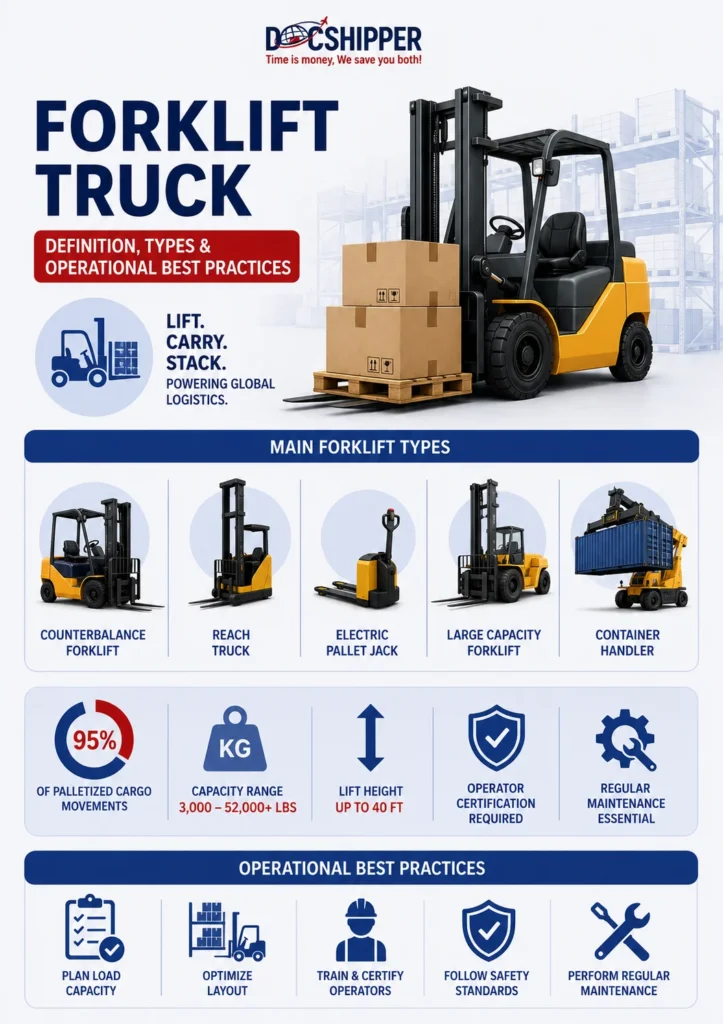
A forklift truck is a powered industrial vehicle equipped with a mast and fork attachment designed to lift, carry, and stack palletized goods within warehouses, distribution centers, and freight terminals. This essential material handling equipment enables vertical storage optimization and horizontal cargo movement, supporting efficient loading/unloading operations in global supply chains.
Introduction
In international logistics, cargo damage often occurs not during ocean transit, but during warehouse handling operations. Inadequate forklift selection or improper operation can lead to significant product loss, insurance claims, and shipment delays that disrupt entire supply chains.
The forklift truck represents the backbone of modern warehousing infrastructure. From container unloading at ports to last-mile distribution center operations, these machines facilitate 95% of all palletized cargo movements in commercial logistics facilities worldwide.
Understanding forklift classifications, capacity ratings, and operational protocols is crucial for:
- Load capacity planning – ensuring equipment matches cargo weight specifications
- Warehouse layout optimization – aisle width requirements vary by forklift type
- Operator certification compliance – OSHA and international safety standards mandate training
- Equipment rental decisions – matching the right machine to specific logistics operations
- Insurance and liability management – proper usage reduces workplace accidents and cargo claims
Technical Specifications & Operational Requirements
Forklift trucks are classified into seven primary categories by the Industrial Truck Association (ITA), each designed for specific operational environments and load characteristics. The most common types in international freight handling include counterbalance forklifts (Class I-V), reach trucks, and specialized container handlers.
The load capacity of a forklift is determined by its rated capacity at a standard load center, typically 24 inches (600mm) from the fork face. Moving the load center forward significantly reduces lifting capacity due to leverage physics—a 5,000-pound capacity forklift may only safely handle 3,000 pounds if the load center extends to 36 inches.
Lift height specifications directly impact warehouse storage density. Standard counterbalance forklifts reach 15-20 feet, while reach trucks and turret trucks can access racking heights up to 40 feet. At DocShipper, we assess warehouse ceiling heights and racking configurations during facility surveys to recommend appropriate equipment for our clients’ warehousing solutions.
Power source selection—electric, diesel, LPG, or hydrogen fuel cell—depends on operational environment. Electric forklifts dominate indoor facilities due to zero emissions and lower noise levels, while diesel units provide superior power for outdoor container handling at ports. The European Union’s stringent emission standards (Stage V) have accelerated the transition toward electric and hydrogen-powered equipment in logistics hubs.
Operator certification requirements vary by jurisdiction but universally mandate hands-on training and periodic recertification. In the United States, OSHA Standard 1910.178 requires formal instruction, practical training, and performance evaluations. The OSHA forklift standards establish minimum training protocols that international logistics operators must follow when operating in U.S. facilities.
Practical Applications & Performance Data
Understanding forklift selection through real-world scenarios demonstrates the operational and financial impact of proper equipment matching:
| Operation Type | Recommended Equipment | Capacity Range | Typical Handling Rate |
|---|---|---|---|
| Container unloading (FCL) | Counterbalance forklift | 5,000-8,000 lbs | 22-28 pallets/hour |
| High-density warehouse storage | Reach truck | 3,000-4,500 lbs | 18-24 pallets/hour |
| Heavy machinery handling | Large capacity forklift | 15,000-36,000 lbs | 8-12 units/hour |
| Cross-docking operations | Electric pallet jack | 4,000-6,000 lbs | 30-40 pallets/hour |
| Port container yard | Laden container handler | 20,000-52,000 lbs | 15-20 containers/hour |
Case Study: E-commerce Fulfillment Optimization
A DocShipper client operating a 150,000 sq ft e-commerce fulfillment center was experiencing 23% productivity loss due to mismatched forklift equipment. The facility used standard counterbalance forklifts in narrow aisles designed for reach trucks.
After conducting operational analysis, we implemented the following changes:
- Replaced 8 counterbalance units with narrow-aisle reach trucks
- Reduced aisle width from 12 feet to 8.5 feet, increasing storage capacity by 18%
- Improved picking efficiency from 95 lines/hour to 142 lines/hour
- Decreased forklift-related damage incidents by 67% within six months
The equipment transition investment was recovered in 14 months through improved throughput and reduced insurance claims. This demonstrates how proper forklift selection directly impacts operational ROI in logistics environments.
Maintenance Cost Comparison: Electric forklifts typically cost 30-40% less to maintain annually compared to internal combustion models. However, battery replacement costs ($3,000-$6,000 every 5-7 years) must be factored into total cost of ownership calculations. DocShipper provides comprehensive equipment assessments for clients establishing long-term warehousing operations.
Conclusion
The forklift truck remains an indispensable tool in global logistics operations, with proper selection and operation directly influencing warehouse efficiency, cargo safety, and overall supply chain performance. Understanding capacity ratings, equipment classifications, and operational best practices enables informed decisions that reduce costs and improve throughput.
Need expert guidance on warehouse equipment selection or operational optimization? Contact DocShipper for customized logistics solutions tailored to your specific handling requirements.
📚 Quiz
Test Your Knowledge: Forklift Truck
What is the primary function of a forklift truck in warehouse operations?
A forklift rated at 5,000 lbs capacity with a 24-inch load center will maintain the same lifting capacity when the load center extends to 36 inches.
Your client operates a high-density warehouse with 150,000 sq ft and narrow aisles. Which equipment would optimize storage capacity and operational efficiency?
🎯 Your Result
📞 Free Quote in 24hFAQ | Forklift Truck: Definition, Types & Operational Best Practices
Most general-purpose warehouses utilize forklifts with 4,000-6,000 pound capacity ratings. This range accommodates standard palletized goods (1,500-2,500 lbs per pallet) with adequate safety margin. Specialized operations requiring heavy machinery handling may need equipment rated up to 36,000 pounds.
The load center represents the horizontal distance from the fork face to the cargo's center of gravity. Standard ratings assume a 24-inch load center. Moving the load center outward reduces lifting capacity proportionally—a 5,000 lb capacity forklift at 24" load center may only safely lift 3,500 lbs at 36" due to increased moment arm and tipping risk.
Counterbalance forklifts use rear-mounted weights to offset front loads and require wider operating aisles (10-13 feet). Reach trucks feature extending masts that bring loads inward over the base, allowing narrow-aisle operation (8-9.5 feet) and higher lift heights (up to 40 feet) for dense storage configurations.
Yes, virtually all developed nations mandate forklift operator training and certification. The U.S. follows OSHA Standard 1910.178, the EU implements EN 16307, and most countries require documented training combining classroom instruction, hands-on practice, and periodic recertification (typically every 3 years).
Industrial electric forklifts typically operate 10,000-15,000 hours before major component replacement. With proper maintenance schedules, units can achieve 15-20 years of service. Battery packs require replacement every 5-7 years (1,500-2,000 charge cycles), representing the most significant ongoing cost in electric forklift ownership.
No, standard warehouse forklifts lack sufficient gradeability and stability for container ramp operations. Loading/unloading containers on chassis requires specialized container forklifts or yard ramps with dedicated equipment. Most warehouse forklifts are limited to maximum grades of 10-15%, while container ramps often exceed 20%.
Current safety standards mandate overhead guards (FOPS), load backrests, seat belts, audible reverse alarms, flashing lights, and operator presence systems that prevent operation unless the driver is properly seated. Advanced models incorporate stability monitoring systems, speed limiters, and collision avoidance technology with proximity sensors.
Calculate maximum load weight including pallet (typically 40-60 lbs), determine load center distance, then select equipment rated at least 20% above your maximum requirement. For example, handling 4,000 lb loads at 24" load center requires minimum 5,000 lb rated capacity to maintain safety margins and account for load distribution variations.
Pneumatic tires (air-filled or solid rubber) provide better traction and shock absorption for outdoor/rough surface operations. Cushion tires (solid rubber pressed onto steel bands) offer superior maneuverability in tight spaces and smooth indoor surfaces, with lower ground clearance ideal for warehouse environments and loading docks.
Hydrogen fuel cell forklifts offer rapid refueling (3-5 minutes vs. battery charging times of 8+ hours) and consistent performance throughout shifts. However, infrastructure costs ($500,000-$2 million for hydrogen generation/storage systems) make them economically viable primarily for high-volume operations running multiple shifts with fleets exceeding 50 units.
Counterbalance forklifts require 10-13 feet, stand-up reach trucks need 8-9.5 feet, narrow-aisle turret trucks operate in 6-7 feet, and very narrow aisle (VNA) systems function in aisles as tight as 5.5-6 feet. Aisle width directly impacts storage density—reducing aisles from 12 to 8 feet can increase pallet positions by 15-25%.
Lead-acid batteries lose approximately 35% capacity at 0°F (-18°C) and suffer accelerated degradation above 113°F (45°C). Cold storage operations require battery warmers and oversized capacity, while high-temperature environments benefit from lithium-ion batteries that maintain 90%+ performance across wider temperature ranges without thermal management systems.
Need Help with
Logistics or Sourcing ?
First, we secure the right products from the right suppliers at the right price by managing the sourcing process from start to finish. Then, we simplify your shipping experience - from pickup to final delivery - ensuring any product, anywhere, is delivered at highly competitive prices.


Fill the Form
Prefer email? Send us your inquiry, and we’ll get back to you as soon as possible.
Contact us




