


In short ⚡
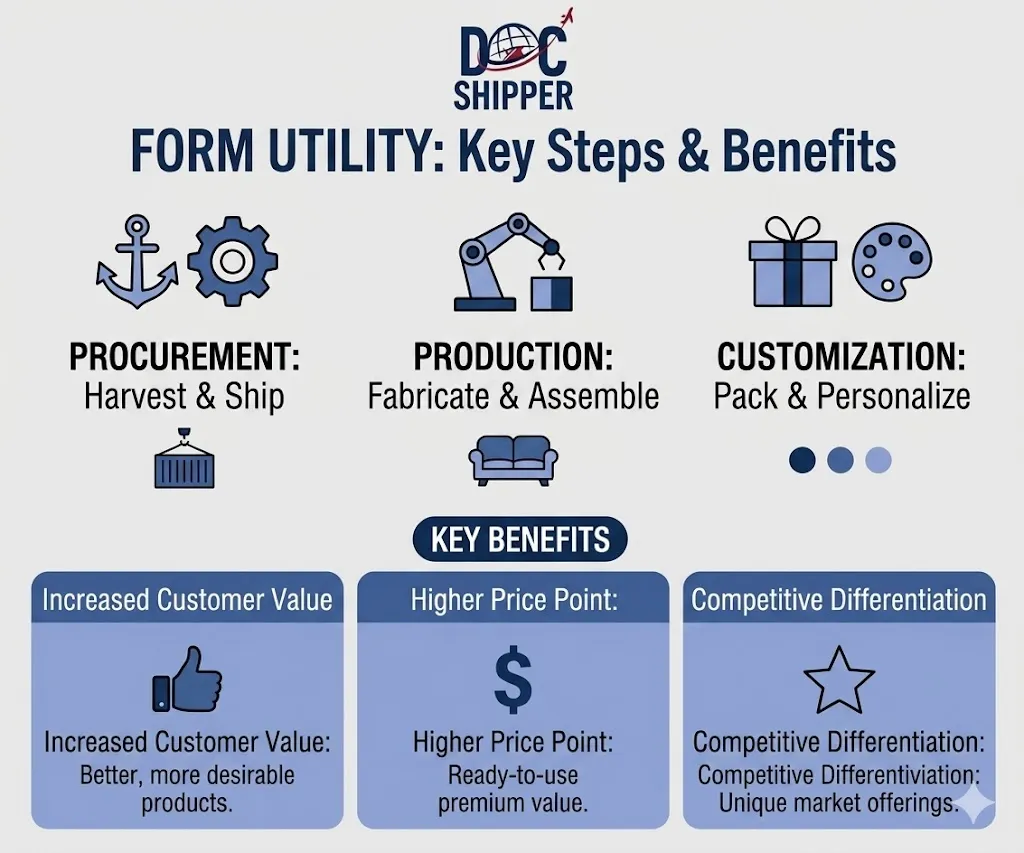
Form utility is the value added to a product through manufacturing or transformation processes that convert raw materials into finished goods. It represents the enhanced utility a product gains when its form is changed to make it more useful, desirable, or marketable to end consumers.Introduction
Many businesses struggle to understand why identical raw materials command vastly different prices once transformed into finished products. This pricing disparity stems directly from form utility—the economic value creation that occurs during manufacturing and transformation processes.
In international trade and logistics, form utility represents a critical value-addition stage where products gain their commercial identity. Whether transforming cotton into garments, steel into automobile parts, or cocoa beans into chocolate, this concept determines pricing strategies, sourcing decisions, and supply chain configurations.
Key characteristics of form utility in global logistics include:
- Value multiplication: Raw materials typically increase 3-10x in value after transformation
- Quality differentiation: Manufacturing processes create product distinctions that justify premium pricing
- Market positioning: Form changes enable products to target specific consumer segments
- Regulatory compliance: Certain forms meet safety, quality, or certification standards required for market entry
- Supply chain optimization: Strategic decisions about where to add form utility impact total landed costs
Strategic Mechanisms & Supply Chain Impact
Form utility operates through transformation processes that fundamentally alter product characteristics. In manufacturing economics, this represents the conversion of inputs (raw materials, components, energy) into outputs with substantially higher market value. The differential between input costs and output prices constitutes the measurable economic benefit of form utility.
The location decision for adding form utility dramatically affects international logistics strategies. Companies must evaluate whether to manufacture near raw material sources, close to consumer markets, or in cost-optimized production zones. At DocShipper, we help clients analyze these trade-offs, considering tariffs, shipping costs, and time-to-market requirements when configuring global supply chains.
From a regulatory perspective, form utility intersects with customs classification and duty structures. Products at different transformation stages face different tariff codes and rates. According to World Customs Organization guidelines, substantial transformation—where form utility is significantly enhanced—can alter country-of-origin determinations, affecting preferential trade agreements and duty assessments.
The concept also influences inventory management strategies. Holding inventory in raw material form versus finished goods form involves different cost structures, risk profiles, and flexibility levels. Raw materials offer postponement advantages—keeping products in adaptable forms until final market demand is known—while finished goods provide faster market response times.
Quality control integration represents another critical mechanism. Form utility creation provides natural inspection points where product specifications can be verified. Manufacturing processes inherently include checkpoints where defects are identified before additional value is added, minimizing waste and rework costs throughout the supply chain.
Concrete Applications & Data-Driven Examples
The textile industry demonstrates form utility’s value multiplication effect clearly. Raw cotton costs approximately $1.50 per pound, while finished cotton fabric sells for $8-15 per pound, and completed garments command $30-200 per pound—representing 20-133x value increase through successive transformation stages.
| Transformation Stage | Form State | Approximate Value/lb | Value Multiplier |
|---|---|---|---|
| Raw Material | Cotton fiber | $1.50 | 1x (baseline) |
| Yarn Production | Spun yarn | $4.50 | 3x |
| Fabric Manufacturing | Woven/knitted fabric | $12.00 | 8x |
| Garment Assembly | Finished apparel | $75.00 | 50x |
| Brand/Retail | Designer clothing | $200.00 | 133x |
Use Case: Electronics Manufacturing
A smartphone manufacturer sources components globally: semiconductors from Taiwan ($45), displays from South Korea ($38), batteries from China ($12), and aluminum frames from Canada ($8). Total component cost: $103 per unit. After assembly in Vietnam, quality testing, and software installation, the finished smartphone’s wholesale value reaches $450—a 4.4x value increase attributable solely to form utility creation through manufacturing processes.
The postponement strategy in automotive manufacturing illustrates form utility’s flexibility advantages. Volkswagen maintains engine blocks and chassis components in semi-finished states at regional distribution centers. Final configuration—specific engine tuning, trim packages, color application—occurs only after dealer orders are confirmed, reducing inventory holding costs by 23% while maintaining 5-day delivery commitments.
In food processing, form utility creates shelf stability and convenience premiums. Fresh tomatoes sell for $1.20/lb, while canned tomatoes command $0.95/lb (accounting for weight changes), tomato paste reaches $2.80/lb equivalent, and sun-dried tomatoes achieve $12.50/lb—demonstrating how different transformation processes create distinct market segments with varying value propositions.
Customs valuation implications become apparent when raw leather ($4.50/sq ft) transforms into finished leather goods. Handbags can reach $200-2,000 retail, with customs duties calculated on transaction values that reflect all value-added stages. At DocShipper, we ensure proper documentation of manufacturing costs and value additions to facilitate accurate customs declarations and duty assessments across borders.
Conclusion
Form utility represents the fundamental value creation mechanism in manufacturing and international trade, where strategic transformation decisions determine product positioning, pricing power, and supply chain efficiency. Understanding where and how to add form utility enables companies to optimize global operations while managing costs, risks, and market responsiveness effectively.
Need expert guidance on optimizing your supply chain’s value-addition stages? Contact DocShipper for comprehensive logistics consulting tailored to your manufacturing and distribution requirements.
📚 Quiz
Test Your Knowledge: Form Utility
1. What is the primary definition of form utility?
2. According to the textile industry example, how does form utility impact product value?
3. In the smartphone manufacturing scenario, when is form utility primarily created?
🎯 Your Result
📞 Free Personalized QuoteFAQ | Form Utility: Definition, Strategic Value & Concrete Examples
Need Help with
Logistics or Sourcing ?
First, we secure the right products from the right suppliers at the right price by managing the sourcing process from start to finish. Then, we simplify your shipping experience - from pickup to final delivery - ensuring any product, anywhere, is delivered at highly competitive prices.


Fill the Form
Prefer email? Send us your inquiry, and we’ll get back to you as soon as possible.
Contact us




