


In short ⚡
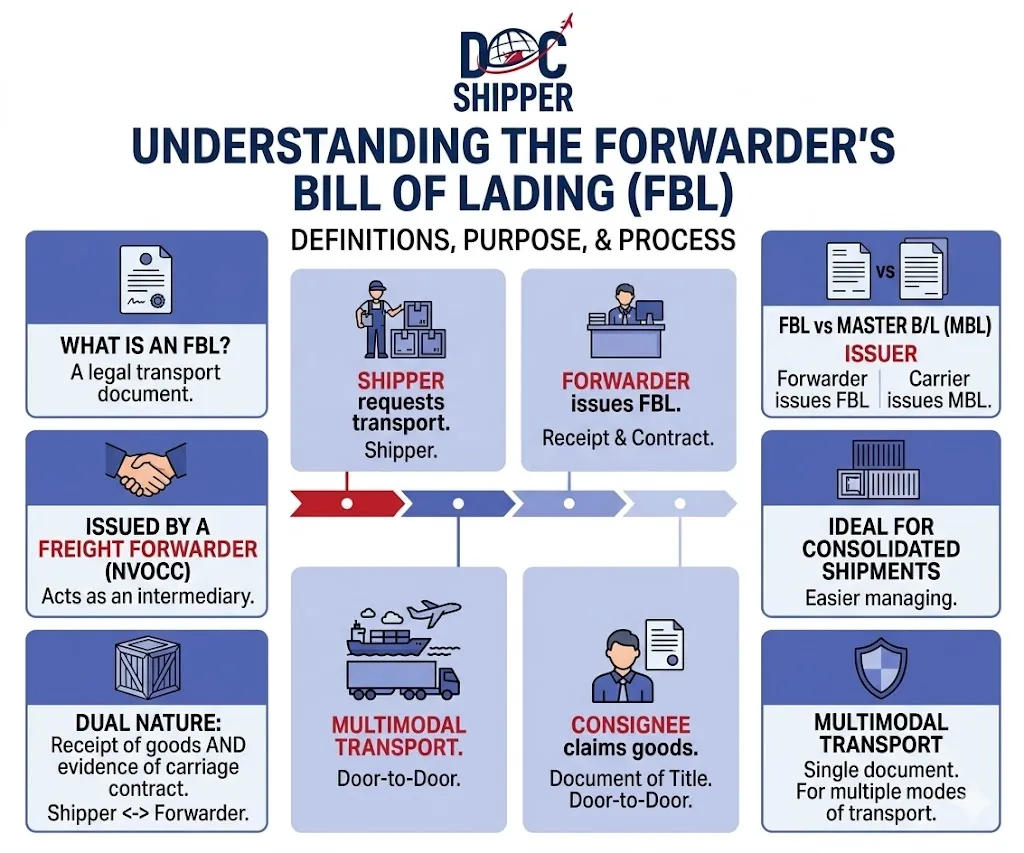
A Forwarder's Bill of Lading (FBL) is a transport document issued by a freight forwarder, not a carrier, acknowledging receipt of cargo for shipment. It serves as a contract of carriage between the forwarder and shipper, covering multimodal or consolidated shipments. Unlike an ocean bill of lading, it's non-negotiable and cannot transfer ownership of goods.
Introduction
Confusion often arises when shippers receive a bill of lading from their freight forwarder rather than the ocean carrier. This creates uncertainty about ownership rights, liability, and negotiability. Understanding the distinction between a Forwarder’s Bill of Lading and a carrier-issued document is critical to avoid payment disputes and customs delays.
In international logistics, freight forwarders consolidate shipments from multiple clients into container loads. The FBL becomes essential documentation in these scenarios, particularly for LCL (Less than Container Load) shipments where direct carrier contracts are impractical.
Key characteristics of a Forwarder’s Bill of Lading:
- Non-negotiable status: Cannot be endorsed or transferred to third parties for ownership transfer
- House document: Issued by the forwarder as a house bill, while the carrier issues a master bill
- Multimodal coverage: Often covers door-to-door or multiple transport modes under one document
- Limited liability: Forwarder liability typically capped at lower amounts than carrier liability
- Payment instrument: Not accepted by banks as negotiable security in Letter of Credit transactions
Technical Framework & Legal Implications
The legal nature of an FBL differs fundamentally from ocean bills of lading governed by Hague-Visby Rules or Rotterdam Rules. When a forwarder issues an FBL, they assume responsibility as the principal contracting party, not merely as an agent.
This creates a two-tier documentation system. The Master Bill of Lading (MBL) is issued by the actual carrier (shipping line) to the freight forwarder. The House Bill of Lading (HBL) or FBL is then issued by the forwarder to the actual shipper or consignee. The forwarder essentially acts as a carrier to their client while simultaneously being a shipper to the ocean carrier.
Liability limitations represent a critical consideration. Under standard FIATA (International Federation of Freight Forwarders Associations) terms, forwarder liability is typically capped at 2 SDR per kilogram (Special Drawing Rights, approximately $2.70 USD). This contrasts with carrier liability under Hague-Visby Rules at 2 SDR per kilogram or 666.67 SDR per package, whichever is higher.
The non-negotiable nature of most FBLs has profound implications for trade finance. Banks generally refuse to accept FBLs as security documents under Letters of Credit unless specifically authorized. This stems from the inability to transfer title through endorsement, a fundamental requirement in documentary credit transactions.
Regulatory compliance adds another layer of complexity. Customs authorities in most jurisdictions accept FBLs for clearance purposes, but specific requirements vary. The U.S. Customs and Border Protection, for example, requires that the party filing the Importer Security Filing (ISF) must be the party named on the bill of lading, whether MBL or HBL.
At DocShipper, we systematically verify which bill of lading type is issued and ensure alignment with payment terms, insurance coverage, and customs documentation to prevent delays or financial exposure for our clients.
Practical Scenarios & Data Analysis
Understanding the practical application of FBLs requires examining real-world logistics scenarios. Consider the following comparative analysis between different bill of lading types:
| Feature | Ocean B/L (Carrier) | Forwarder’s B/L |
|---|---|---|
| Issuer | Shipping line/carrier | Freight forwarder/NVOCC |
| Negotiability | Negotiable (if “to order”) | Usually non-negotiable |
| L/C Acceptance | Fully accepted | Often rejected unless specified |
| Liability Cap | 666.67 SDR/package or 2 SDR/kg | 2 SDR/kg (FIATA terms) |
| Typical Use | FCL shipments, direct contracts | LCL consolidations, multimodal |
Use Case: LCL Shipment from Shanghai to Hamburg
A German importer orders 3 cubic meters of electronics from a Chinese supplier. The shipment is too small for a full container. The forwarder in Shanghai consolidates this cargo with other shipments into a 40-foot container.
Documentation flow:
- Step 1: Forwarder issues FBL to the shipper/importer covering door-to-door transport
- Step 2: Ocean carrier issues MBL to the forwarder for the entire consolidated container
- Step 3: Upon arrival in Hamburg, the forwarder deconsolidates and releases cargo against the FBL
- Step 4: Importer clears customs using the FBL as proof of ownership
In this scenario, the cost savings are substantial. The LCL rate might be $120 per cubic meter ($360 total) versus $2,800 for booking an entire container. However, the trade-off includes accepting the forwarder’s liability limits and non-negotiable documentation.
Critical Data Point: According to industry analysis, approximately 65% of global LCL shipments are documented with House Bills of Lading (FBLs) rather than direct carrier bills, reflecting the dominance of freight forwarder consolidation services in the market.
Conclusion
The Forwarder’s Bill of Lading serves as an essential instrument in modern freight consolidation, enabling cost-effective multimodal transport while introducing specific limitations in negotiability and liability. Understanding these distinctions prevents costly errors in trade finance and customs compliance.
Need expert guidance on bill of lading selection and logistics documentation? Contact DocShipper for tailored support across your international shipping operations.
📚 Quiz
Test Your Knowledge: Forwarder's Bill of Lading
1. What is the primary defining characteristic of a Forwarder's Bill of Lading compared to an ocean carrier B/L?
2. Under standard FIATA terms, what is the typical liability limitation for cargo damage when using a Forwarder's Bill of Lading?
3. Your company ships 5 CBM of electronics via LCL from Shanghai to Rotterdam. The freight forwarder offers documentation with either their House Bill or requests you arrange a direct ocean B/L. Which scenario correctly describes the practical application?
🎯 Your Result
📞 Free Quote in 24hFAQ | Forwarder's Bill of Lading: Definition, Function & Practical Examples
Generally no. Most banks reject FBLs under Letters of Credit because they are non-negotiable and cannot transfer title. However, if the L/C specifically authorizes "Forwarder's Bill of Lading" or "House Bill of Lading," banks may accept it. Always verify L/C terms before shipment to avoid payment refusal.
The terms are often used interchangeably. Both refer to bills of lading issued by freight forwarders rather than carriers. "House B/L" emphasizes the forwarder's role in consolidation (the "house" managing multiple shipments), while "Forwarder's B/L" identifies the issuer type. Functionally, they serve the same purpose in multimodal and LCL logistics.
The freight forwarder who issued the FBL bears primary liability to the shipper/consignee. However, this liability is typically limited to 2 SDR per kilogram under FIATA standard trading conditions, significantly lower than carrier liability. The forwarder may then pursue claims against the actual carrier using the Master Bill of Lading, but this remains the forwarder's responsibility, not the cargo owner's.
For FCL (Full Container Load) shipments, you can negotiate direct contracts with carriers to receive an ocean B/L. For LCL shipments, this is typically impractical as carriers deal with forwarders for consolidated cargo. Some forwarders offer "surrendered" ocean B/Ls for specific routes, but this requires advance arrangement and may incur additional costs.
Yes, customs authorities worldwide generally accept Forwarder's Bills of Lading for clearance purposes. The document proves cargo ownership and contains essential information (description, weight, origin). However, ensure the consignee name matches exactly with the customs declaration and that the FBL contains all regulatory data fields required by the destination country.
An NVOCC (Non-Vessel Operating Common Carrier) is a freight forwarder that issues its own bills of lading without owning vessels. NVOCCs consolidate cargo, contract with actual carriers, and issue House Bills/FBLs to shippers. They operate as carriers to their clients while functioning as shippers to ocean carriers, creating the two-tier MBL/HBL documentation system.
Check the consignee field. A negotiable B/L states "To Order" or "To Order of [Bank Name]" and can be endorsed. A non-negotiable B/L (typical for FBLs) names a specific consignee and often includes "Non-Negotiable" stamped or printed on the document. Most Forwarder's Bills are non-negotiable by design, restricting ownership transfer capabilities.
Yes, some NVOCCs and freight forwarders issue negotiable House Bills of Lading, particularly for trade finance requirements. These are called "FIATA FBL" (using FIATA's standardized format) and can be endorsed. However, they remain less preferred by banks than carrier-issued ocean B/Ls due to perceived higher risk and lower legal precedent in disputes.
Discrepancies between House and Master Bills can cause serious delays. The ocean carrier follows the MBL exclusively. If your FBL shows a different consignee, destination, or cargo description than the MBL, customs clearance may be blocked. Always ensure your forwarder aligns both documents, or request copies of the MBL before shipment to verify consistency.
Freight charges on an FBL represent the forwarder's invoice to the shipper/consignee. They may include markup over actual carrier costs. These charges are contractually binding based on the booking agreement. However, additional charges shown on the MBL (carrier's bill to the forwarder) are not your direct concern unless you're named on the MBL as well.
Release speed depends on the forwarder's processes and destination port operations. With an FBL, you deal with the forwarder's local agent for release, which can be faster for LCL since they manage deconsolidation. With an ocean B/L for FCL, you deal directly with the carrier/terminal. Average difference is typically 6-24 hours, but varies by location and forwarder efficiency.
Always purchase cargo insurance independent of B/L liability limits. The forwarder's 2 SDR/kg limit (approximately $2.70 USD/kg) is inadequate for most cargo values. Comprehensive marine cargo insurance (typically 110% of CIF value) protects against all risks during transit, regardless of whether you hold an FBL or ocean B/L. Never rely solely on carrier or forwarder liability for financial protection.
Need Help with
Logistics or Sourcing ?
First, we secure the right products from the right suppliers at the right price by managing the sourcing process from start to finish. Then, we simplify your shipping experience - from pickup to final delivery - ensuring any product, anywhere, is delivered at highly competitive prices.


Fill the Form
Prefer email? Send us your inquiry, and we’ll get back to you as soon as possible.
Contact us




