



In short ⚡
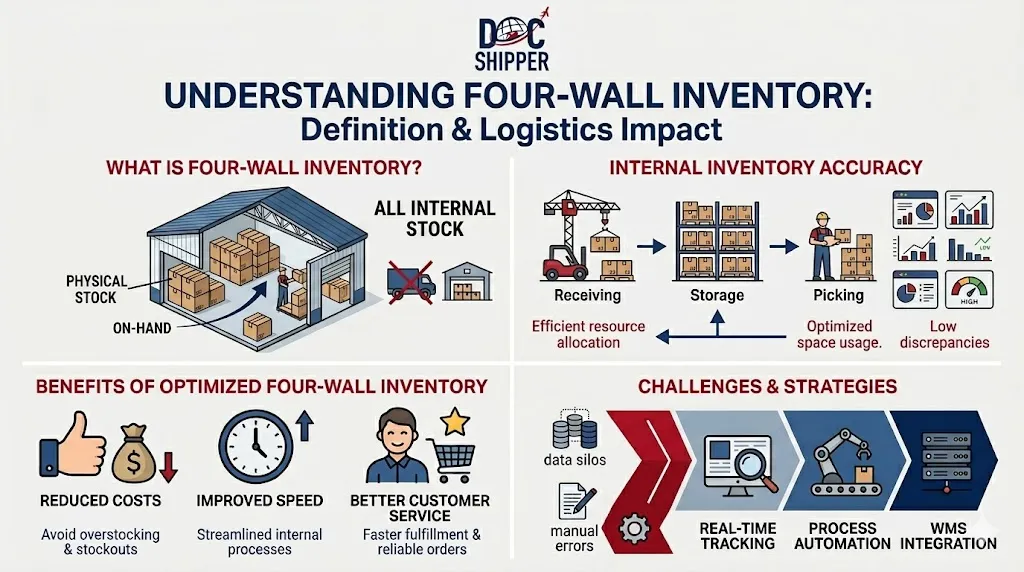
Four-Wall Inventory refers to the total physical stock present within a single warehouse, distribution center, or retail location at a specific point in time. This metric measures all inventory confined within the "four walls" of a facility, excluding in-transit goods, stock at other locations, or items held by third parties.Introduction
Many businesses struggle with inventory visibility when stock is scattered across multiple warehouses, third-party logistics providers, and in-transit shipments. This fragmentation creates blind spots in inventory accuracy that can lead to stockouts, overstocking, and inefficient capital allocation.
Four-wall inventory serves as a fundamental concept in supply chain management by establishing clear boundaries for physical stock control. Understanding what inventory actually exists within a specific facility enables better demand planning, reduces shrinkage, and improves operational decision-making.
Key characteristics of four-wall inventory include:
- Location-specific measurement – counts only stock physically present at one site
- Excludes in-transit goods – items being shipped between locations are not included
- Real-time snapshot capability – provides immediate visibility into available stock
- Foundation for inventory accuracy – baseline metric for cycle counting and audits
- Critical for fulfillment planning – determines what can be shipped from that specific location
Understanding Four-Wall Inventory Mechanisms & Management
The concept of four-wall inventory emerged as businesses expanded their distribution networks and needed granular visibility into location-specific stock levels. Unlike total inventory (which aggregates all stock across an entire organization), four-wall inventory focuses on the physical reality within a single facility’s boundaries.
From a warehouse management perspective, four-wall inventory represents the legal and physical custody of goods at a specific location. This distinction becomes crucial during inventory audits, financial reporting, and insurance claims. Only products physically present within the facility’s perimeter count toward this metric, regardless of ownership status or intended destination.
The calculation methodology involves several components. Warehouse management systems (WMS) track four-wall inventory through receiving transactions, putaway confirmations, picking activities, and shipping manifests. When goods are received, they increment the four-wall count. When items ship out, they decrement it. This transactional approach maintains a perpetual inventory balance.
Regulatory compliance adds another layer of importance. According to U.S. Census Bureau manufacturing inventory guidelines, businesses must report inventory by location for tax purposes and economic statistics. Four-wall inventory provides the foundation for these location-based reporting requirements.
The relationship between four-wall inventory and inventory ownership can be complex. A warehouse might store goods it owns, customer-owned consignment stock, and third-party items simultaneously. Four-wall inventory counts all physical items present, while accounting systems segregate ownership for financial reporting. At DocShipper, we help clients establish clear inventory segregation protocols to maintain accurate four-wall counts while managing multi-party storage arrangements.
Modern supply chains leverage real-time four-wall visibility for dynamic decision-making. Advanced WMS platforms integrate with enterprise resource planning (ERP) systems to provide instant four-wall inventory snapshots. This capability enables same-day fulfillment decisions, emergency stock transfers, and rapid response to demand fluctuations without waiting for manual counts.
Practical Examples & Calculation Methods
Understanding four-wall inventory through concrete scenarios and calculations demonstrates its practical application in international logistics and warehouse operations.
Use Case: Multi-Location Retailer Inventory Calculation
Consider a consumer electronics company operating three distribution centers. Their total corporate inventory is 50,000 units, distributed as follows:
| Location | Units on Hand | In-Transit to Location | Four-Wall Inventory |
|---|---|---|---|
| East Coast DC | 18,500 | 2,200 | 18,500 |
| Central DC | 15,300 | 1,800 | 15,300 |
| West Coast DC | 12,200 | 3,500 | 12,200 |
| Total | 46,000 | 7,500 | 46,000 |
In this scenario, the total four-wall inventory across all locations is 46,000 units. The 7,500 in-transit units are excluded from four-wall counts because they’re not physically within any facility. This distinction matters when determining available-to-promise quantities for customer orders.
Four-Wall Inventory Accuracy Metrics
Measuring inventory accuracy requires comparing system records against physical counts. Industry benchmarks for four-wall inventory accuracy include:
- World-class accuracy: 99%+ match between WMS records and physical counts
- Acceptable accuracy: 95-98% for most distribution operations
- Problematic accuracy: Below 90% indicates systemic issues requiring intervention
- Cycle counting frequency: High-value items counted weekly, lower-value monthly
- Reconciliation timeframe: Discrepancies investigated and resolved within 24-48 hours
At DocShipper, we implement four-wall inventory verification protocols during warehouse takeovers and facility transitions to establish accurate baseline counts before operational handoff.
Calculation Example: Four-Wall Inventory Turnover
A warehouse holds $2.4 million in four-wall inventory value. Annual cost of goods sold (COGS) for products stored at this location totals $14.4 million. The four-wall inventory turnover ratio calculation:
Inventory Turnover = Annual COGS / Average Four-Wall Inventory Value
Turnover = $14,400,000 / $2,400,000 = 6.0 turns per year
This indicates the warehouse cycles through its entire four-wall inventory approximately every 60 days. Higher turnover ratios generally indicate efficient inventory management, though optimal rates vary by industry and product characteristics.
Conclusion
Four-wall inventory provides the foundational metric for location-specific stock control, enabling accurate fulfillment decisions and financial reporting. Mastering this concept allows businesses to optimize warehouse operations and maintain precise inventory visibility.
Need expert guidance on implementing four-wall inventory tracking across your distribution network? Contact DocShipper for customized warehouse management solutions.
📚 Quiz
Test Your Knowledge: Four-Wall Inventory
What does four-wall inventory measure?
A warehouse currently holds 5,000 units on hand, with 1,200 units in-transit from a supplier. What is the four-wall inventory count?
Your distribution center stores both company-owned inventory and customer consignment stock. How should consignment items be treated in four-wall inventory counts?
🎯 Your Results
📞 Free Custom QuoteFAQ | Four-Wall Inventory: Definition, Calculation & Concrete Examples
Four-wall inventory counts only the physical stock present within a specific warehouse or facility at a given time. Total inventory includes all stock owned by the company across all locations, including in-transit goods, items at third-party logistics providers, and inventory at multiple distribution centers. Four-wall inventory provides location-specific visibility, while total inventory represents enterprise-wide stock levels.
In-transit goods are explicitly excluded from four-wall inventory calculations. Once items leave a facility's loading dock and are manifested for shipment, they decrement that location's four-wall count. They don't increment the receiving location's count until physically unloaded and processed through the receiving dock. This creates a temporary gap where in-transit inventory exists in the supply chain but doesn't appear in any facility's four-wall count.
Four-wall inventory serves as the foundation for physical inventory audits and cycle counting programs. Auditors verify that system records match the actual physical stock within the facility's boundaries. This location-specific approach ensures accountability for each warehouse, identifies discrepancies quickly, and maintains the integrity of inventory records for financial reporting and operational decision-making.
Yes, consignment inventory physically present in a warehouse is included in four-wall inventory counts, even though ownership remains with the supplier until consumption. The four-wall metric measures physical presence, not ownership. However, warehouse management systems must track ownership separately for accounting purposes, segregating owned stock from customer-owned or supplier-owned consignment goods within the overall four-wall count.
Modern warehouse management systems track four-wall inventory perpetually, updating counts in real-time with each receiving, putaway, picking, and shipping transaction. Physical verification occurs through cycle counting programs, with high-value items counted weekly and lower-value items monthly or quarterly. Annual full physical inventories verify overall accuracy, though perpetual systems reduce reliance on disruptive wall-to-wall counts.
Common causes include unrecorded transactions (receiving or shipping without system updates), picking errors, theft or damage, misidentified products, incorrect putaway locations, system data entry mistakes, and timing differences between physical movement and system recording. Regular cycle counting, barcode scanning, RFID technology, and robust receiving/shipping protocols minimize these discrepancies and maintain inventory accuracy above 95%.
Four-wall inventory determines what can be promised and shipped from a specific location. When a customer order arrives, the system checks four-wall inventory at the nearest distribution center. If sufficient stock exists within those four walls, fulfillment proceeds. If not, the order may route to another facility with available four-wall inventory, or the system backorders the item until replenishment arrives and increments that location's four-wall count.
Safety stock represents buffer inventory maintained to protect against demand variability and supply disruptions. This safety stock is part of the four-wall inventory when physically present in the warehouse. Inventory planners set minimum four-wall inventory levels that include both anticipated demand during replenishment lead time plus safety stock. When four-wall counts approach these minimums, replenishment orders trigger to maintain adequate stock levels.
WMS platforms use transactional logic to maintain perpetual four-wall inventory balances. Receiving transactions increment counts when goods are checked in and putaway. Picking transactions decrement available quantities. Shipping manifests further reduce four-wall counts when trucks depart. Adjustments occur through cycle counting and physical inventory processes. Advanced systems integrate with ERP platforms, providing real-time four-wall visibility across multiple facilities.
Optimal four-wall inventory levels balance service requirements against carrying costs. Factors include demand variability, replenishment lead times, storage capacity, capital constraints, and product shelf life. Common approaches use economic order quantity (EOQ) models, just-in-time principles, or days-of-supply targets. E-commerce operations often maintain higher four-wall inventory for rapid fulfillment, while manufacturing warehouses use pull systems to minimize on-hand stock.
Four-wall inventory represents physical stock location for operational purposes, while financial inventory reporting values stock according to accounting standards (FIFO, LIFO, weighted average). A warehouse might have 10,000 units of four-wall inventory, but the financial value depends on acquisition costs and accounting methods. Additionally, financial statements may include in-transit inventory in total inventory value, while four-wall counts exclude goods not physically present.
Absolutely. Accurate four-wall inventory enables better demand forecasting, reduces expedited shipping costs, minimizes stockouts, optimizes warehouse space utilization, and improves cash flow management. By understanding exactly what inventory exists at each location, companies can make smarter replenishment decisions, balance stock across distribution networks, and reduce total inventory investment while maintaining service levels. This location-specific visibility drives measurable supply chain improvements.
Need Help with
Logistics or Sourcing ?
First, we secure the right products from the right suppliers at the right price by managing the sourcing process from start to finish. Then, we simplify your shipping experience - from pickup to final delivery - ensuring any product, anywhere, is delivered at highly competitive prices.


Fill the Form
Prefer email? Send us your inquiry, and we’ll get back to you as soon as possible.
Contact us




