


In short ⚡
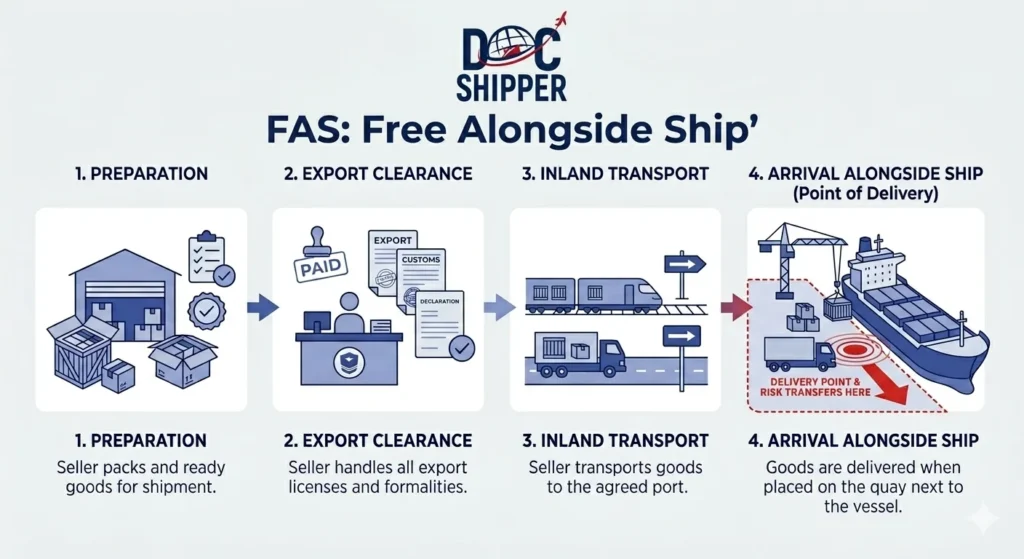
Free Alongside Ship (FAS) is an Incoterm® where the seller fulfills their obligation by placing goods alongside the vessel at the named port of shipment. The buyer assumes all costs and risks from that point onward, including loading, freight, and insurance.Introduction
Many importers mistakenly assume that FAS includes vessel loading, leading to unexpected costs and shipment delays. This confusion stems from the fact that FAS transfers responsibility earlier than most other Incoterms.
Understanding Free Alongside Ship is crucial for maritime trade negotiations. It defines a precise handover point that affects pricing, liability insurance, and customs clearance strategies.
Key characteristics of FAS include:
- Applies exclusively to sea and inland waterway transport
- Seller delivers goods alongside the nominated vessel at the port of shipment
- Buyer bears all costs from the moment goods are placed alongside the ship
- Export customs clearance remains the seller’s responsibility
- Risk transfers when goods are positioned alongside the vessel, not when loaded
Obligations & Expertise
The Free Alongside Ship Incoterm creates a distinctive division of responsibilities. The seller must deliver goods to the quayside, typically within reach of the ship’s lifting tackle. This requires precise coordination with port authorities and vessel schedules.
Export formalities represent a critical seller obligation. The seller handles all documentation, licenses, and customs procedures needed to clear goods for export. At DocShipper, we systematically verify export clearance completion before positioning cargo alongside vessels to prevent costly demurrage charges.
The buyer assumes loading costs and risks from the handover point. This includes stevedoring fees, cargo securing, and potential damage during lifting operations. Unlike FOB where the seller loads the vessel, FAS places this burden squarely on the buyer.
Insurance considerations under FAS require careful attention. Neither party is obligated to insure the goods, but the buyer should arrange comprehensive marine insurance starting from the quayside position. A gap in coverage during the loading phase represents a common risk exposure.
Port selection significantly impacts FAS transactions. The named port must have adequate facilities for alongside delivery, which may exclude smaller terminals. According to ICC Incoterms® 2020, parties should specify the precise quay or berth location to avoid ambiguity.
Documentation under FAS includes the delivery note confirming placement alongside the vessel. This proof of delivery is essential for triggering payment terms and establishing when risk transferred. The seller must provide this document promptly to enable the buyer’s subsequent operations.
Practical Examples & Data
A European manufacturer sells machinery to a Brazilian importer under FAS Hamburg, Germany. The seller transports equipment to Hamburg port, completes export customs clearance, and positions the machinery on the quay next to the designated vessel. Total seller cost: €8,500 (transport + customs).
The buyer then contracts stevedores to load the machinery aboard, paying €1,200 for crane services and lashing. Ocean freight to Santos costs €4,800, and the buyer arranges marine insurance for €320. The buyer’s total landed cost before import duties: €14,820.
| Cost Element | FAS | FOB (Comparison) | Responsible Party (FAS) |
|---|---|---|---|
| Inland Transport (Origin) | €6,800 | €6,800 | Seller |
| Export Customs Clearance | €1,700 | €1,700 | Seller |
| Loading on Vessel | €1,200 | Included in seller cost | Buyer |
| Ocean Freight | €4,800 | €4,800 | Buyer |
| Marine Insurance | €320 | €320 | Buyer |
According to 2023 trade data, FAS accounts for approximately 3-5% of global maritime shipments, significantly less popular than FOB or CIF. It’s primarily used when buyers have established port operations or prefer direct control over vessel loading.
Use Case: Bulk Commodity Trading – A grain exporter in Argentina sells 5,000 metric tons of soybeans FAS Buenos Aires. The seller trucks grain to the port silo and completes phytosanitary export certification. The buyer, a European processor, arranges a bulk carrier and coordinates direct silo-to-ship loading through pneumatic systems, maintaining quality control throughout the loading process.
Critical considerations when using FAS:
- Vessel nomination timing – Buyer must provide vessel details sufficiently early for quayside positioning
- Demurrage risk – Seller faces charges if goods aren’t ready when vessel arrives
- Loading equipment availability – Port must have cranes/equipment suitable for the cargo type
- Weather exposure – Goods may sit exposed on quayside awaiting loading authorization
- Security considerations – Cargo vulnerability increases during the transfer period
Conclusion
Free Alongside Ship provides a clear demarcation of seller and buyer responsibilities, particularly valuable when buyers maintain specialized loading capabilities or require direct oversight of vessel stowage operations.
Need expert guidance on selecting the optimal Incoterm for your shipments? Contact DocShipper for personalized logistics consulting.
📚 Quiz
Test Your Knowledge: Free Alongside Ship (FAS)
Under FAS Incoterms, at what precise moment does risk transfer from seller to buyer?
Which party is responsible for vessel loading costs under FAS terms?
A European electronics exporter is shipping sensitive equipment to Asia. Which scenario correctly applies FAS terms?
🎯 Your Result
📞 Free Quote in 24hFAQ | Free Alongside Ship (FAS): Definition, Obligations & Practical Examples
Under FAS, the seller places goods alongside the vessel but does not load them; the buyer handles loading costs and risks. With FOB (Free On Board), the seller is responsible for loading goods onto the vessel, and risk transfers only after the cargo crosses the ship's rail. FAS transfers responsibility earlier in the shipping process, typically reducing the seller's costs but increasing buyer obligations.
While technically possible, FAS is poorly suited for container shipping. Modern container terminals operate on integrated systems where containers are delivered directly to terminal stacking areas, not positioned alongside specific vessels. FCA (Free Carrier) is the recommended Incoterm for containerized shipments, as it better reflects actual port operations and terminal handling procedures.
Terminal handling charges (THC) fall on the buyer under FAS terms. Since the seller's obligation ends when goods are placed alongside the vessel, all subsequent costs including THC, loading, lashing, and port security fees are buyer expenses. This contrasts with some other Incoterms where terminal costs may be included in the seller's delivery obligations.
Vessel delays create complex cost allocation issues under FAS. If goods are already positioned alongside the vessel, the seller may incur demurrage or storage charges. However, these costs typically become negotiable based on the cause of delay. Contracts should specify whether the seller must maintain goods quayside indefinitely or can relocate them after a reasonable waiting period, with associated costs addressed.
Neither party is obligated to provide insurance under FAS terms, unlike CIF or CIP where the seller must arrange minimum coverage. However, buyers should obtain comprehensive marine insurance starting from the quayside delivery point. Without insurance, the buyer bears full risk of damage or loss from the moment goods are positioned alongside the vessel through final destination.
FAS requires precise identification of the named port of shipment, ideally including the specific berth or quay location. Generic port names like "FAS New York" create ambiguity about the exact delivery point. Best practice involves specifying "FAS Berth 42, Port Newark, New Jersey" to eliminate uncertainty about where the seller must position goods and when delivery obligations are fulfilled.
Yes, the seller retains responsibility for export customs clearance under FAS, including obtaining all necessary licenses, permits, and documentation required by the country of export. This obligation remains consistent across most Incoterms where the seller controls the goods in the export country. Only import-related licenses and clearances fall to the buyer.
No, FAS applies exclusively to sea and inland waterway transport. The term "alongside ship" inherently requires a vessel, making it incompatible with air, road, or rail transport modes. For air shipments, appropriate Incoterms include FCA (Free Carrier), CPT (Carriage Paid To), or CIP (Carriage and Insurance Paid To), depending on the desired cost and risk allocation.
The seller must provide proof of delivery alongside the vessel, typically a dock receipt or quay delivery confirmation stamped by port authorities. Additionally, the seller supplies export customs documentation, commercial invoice, packing list, and any certificates of origin or compliance required for export clearance. Unlike FOB, the seller does not provide a bill of lading, as this is issued to the party arranging vessel loading.
Weather poses significant risks under FAS since goods positioned on open quaysides may be exposed to elements before loading. Sensitive cargo like electronics or paper products can suffer damage from rain or humidity during the transfer period. Buyers should factor weather exposure into their risk assessment and insurance coverage, while sellers may need weather-protected staging areas to preserve cargo condition until handover.
Port charges under FAS are split between parties based on the delivery point. Sellers typically pay wharfage or quay rental fees for positioning cargo alongside the vessel. Buyers pay stevedoring charges, crane rental, lashing/securing costs, port security fees, and any terminal handling charges associated with vessel operations. Total buyer port costs often range from 5-15% of the FOB value depending on cargo type and port infrastructure.
FAS is generally impractical for small shipments due to the complexity of coordinating quayside delivery for less-than-container loads. The term works best for bulk commodities, project cargo, or situations where the buyer operates regular vessel charters and can efficiently consolidate multiple FAS purchases. For small shipments, FCA or EXW provide more flexible and cost-effective alternatives with simpler logistics coordination.
Need Help with
Logistics or Sourcing ?
First, we secure the right products from the right suppliers at the right price by managing the sourcing process from start to finish. Then, we simplify your shipping experience - from pickup to final delivery - ensuring any product, anywhere, is delivered at highly competitive prices.


Fill the Form
Prefer email? Send us your inquiry, and we’ll get back to you as soon as possible.
Contact us




:%20Definition,%20Obligations%20&%20Practical%20Examples)