


In short ⚡
Free On Board (FOB) is an international trade term (Incoterm) defining that the seller fulfills their obligation when goods pass the ship's rail at the named port of shipment. The buyer assumes all costs and risks from that point, including ocean freight, insurance, and import duties.
Introduction
Confusion about freight responsibility causes thousands of shipment disputes annually. Who pays for container loading? When does risk actually transfer? These questions plague importers daily.
Free On Board represents one of the most commonly used Incoterms in international commerce. It establishes clear boundaries between seller and buyer obligations in maritime transport.
Understanding FOB is crucial because it directly impacts:
- Cost structure – Determines which party pays ocean freight and insurance
- Risk transfer point – Identifies when liability shifts from seller to buyer
- Documentation responsibilities – Clarifies who handles export customs clearance
- Insurance coverage – Defines which party needs cargo insurance from loading point
- Price negotiations – Affects the total landed cost calculations
This Incoterm applies exclusively to sea and inland waterway transport. For other transport modes, different Incoterms like FCA apply.
FOB Mechanisms & Legal Framework
The FOB term operates under specific mechanisms defined by the International Chamber of Commerce (ICC) Incoterms® 2020. These rules standardize international trade practices globally.
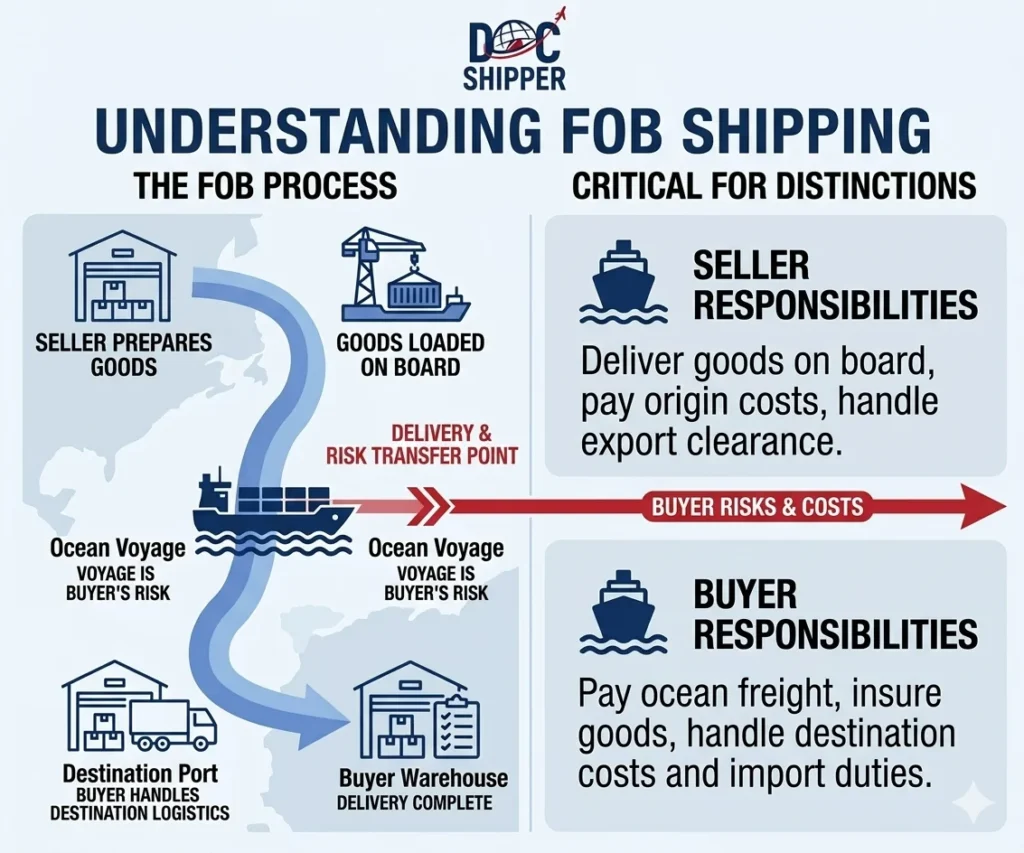
Under FOB terms, the seller’s obligations include delivering goods on board the vessel at the named port of shipment. They must handle export customs clearance and bear all costs until goods cross the ship’s rail. The seller completes their responsibility once loading is confirmed.
The buyer’s obligations begin at the vessel’s rail. They arrange and pay for ocean freight, marine insurance, destination handling, and import customs clearance. Risk transfers the moment goods are loaded, even before the ship departs.
The critical transfer point occurs when cargo passes the ship’s rail at the loading port. This specific moment determines liability. If goods are damaged during loading, the seller bears responsibility. Once on board, the buyer assumes all risk.
FOB requires precise port designation in the sales contract. “FOB Shanghai” differs significantly from “FOB Ningbo” in terms of inland transport costs. The named port must be specified to avoid disputes.
At DocShipper, we systematically verify the exact FOB point with clients to ensure proper cost allocation and prevent misunderstandings during the shipping process. Our expertise covers complete freight coordination from factory to final destination.
Practical Examples & Cost Calculations
Understanding FOB pricing requires analyzing real-world scenarios. Let’s examine how costs distribute between parties in typical transactions.
Cost Breakdown Example: FOB Shanghai to Los Angeles
| Cost Element | Responsibility | Amount (USD) |
|---|---|---|
| Product manufacturing | Seller | $15,000 |
| Inland transport to Shanghai port | Seller | $450 |
| Export customs clearance | Seller | $200 |
| Loading onto vessel | Seller | $150 |
| FOB Price Total | Seller’s Total | $15,800 |
| Ocean freight (20ft container) | Buyer | $2,400 |
| Marine insurance (1.5% of cargo value) | Buyer | $237 |
| Destination port charges | Buyer | $850 |
| Import customs clearance & duties | Buyer | $1,900 |
| Total Landed Cost | $21,187 |
Industry Statistics & Usage Patterns
Approximately 38% of global maritime contracts use FOB terms according to ICC trade surveys. This makes it the second most popular Incoterm after CIF for ocean shipments.
Key advantages for buyers include:
- Freight control – Direct negotiation with shipping lines for better rates
- Consolidation opportunities – Combining shipments from multiple suppliers
- Insurance choice – Selecting preferred coverage levels and providers
- Logistics visibility – Complete tracking from loading point to destination
- Cost optimization – Leveraging volume discounts on freight contracts
Use Case: Electronics Importer from Shenzhen
A US retailer orders $50,000 worth of electronics FOB Shenzhen. The Chinese supplier delivers to Yantian port and loads the container. Total FOB cost: $51,200 including inland transport and loading.
The buyer arranges ocean freight at $2,800 and insures cargo for $780. After paying $4,200 in destination charges and $6,500 in duties, the total landed cost reaches $65,480. This represents a 31% markup over FOB price.
By controlling freight selection, the buyer saved approximately $900 compared to accepting the seller’s CIF quote. This demonstrates FOB’s value for cost-conscious importers.
Conclusion
Free On Board establishes clear responsibility division in maritime trade. It empowers buyers with freight control while limiting seller obligations to origin handling. This clarity reduces disputes and enables precise cost planning.
Need assistance navigating FOB shipments or comparing Incoterm options? Contact DocShipper for expert guidance on your international logistics strategy.
📚 Quiz
Test Your Knowledge: Free On Board (FOB)
Under FOB terms, when exactly does the seller's responsibility end and the buyer's risk begin?
A common misconception is that FOB can be used for any transport mode. Which statement is correct?
You're importing electronics FOB Shenzhen valued at $30,000. Container damage occurs during ocean transit. Who bears the financial loss?
🎯 Your Result
📞 Free Personalized QuoteFAQ | Free On Board (FOB): Definition, Calculation & Concrete Examples
FOB stands for Free On Board, an Incoterm where the seller delivers goods on board a vessel at the named port. The buyer assumes all costs and risks once cargo crosses the ship's rail. This term applies exclusively to sea and inland waterway transport.
The buyer pays ocean freight under FOB terms. The seller's responsibility ends when goods are loaded on board the vessel. All subsequent transportation costs, including main carriage and destination charges, fall to the buyer.
Under FOB, the buyer arranges and pays for ocean freight and insurance. Under CIF (Cost, Insurance, and Freight), the seller includes these costs in the quoted price. FOB gives buyers more control over shipping arrangements, while CIF offers convenience with all-inclusive pricing.
Risk transfers when goods pass the ship's rail at the port of shipment. This is the critical moment when liability shifts from seller to buyer. Any damage occurring during loading is the seller's responsibility; damage after loading belongs to the buyer.
No, FOB is exclusively for sea and inland waterway transport. For air freight, the appropriate Incoterm is FCA (Free Carrier). Using incorrect Incoterms creates legal ambiguity and potential disputes. Always match the Incoterm to the transport mode.
The seller handles export customs clearance under FOB terms. This includes preparing documentation, paying export duties, and obtaining necessary permits. The buyer only manages import customs procedures at the destination country.
The seller provides commercial invoice, packing list, bill of lading (or equivalent), export declaration, and certificate of origin if required. They must deliver clean documentation enabling the buyer to claim goods at destination and clear import customs.
FOB price includes product cost, inland transport to loading port, export customs fees, and loading charges. It excludes ocean freight, insurance, destination handling, and import duties. Sellers quote FOB prices as the total cost to deliver goods on board the vessel.
Insurance is not mandatory under FOB, but highly recommended. The buyer assumes risk once goods are loaded, making cargo insurance essential protection. Without coverage, buyers bear full financial loss if goods are damaged or lost during ocean transit.
Common disputes include unclear port designation, disagreement about loading completion timing, damage claims at the transfer point, and confusion over who pays terminal handling charges. Precise contract language specifying the exact FOB point prevents most disputes.
Yes, parties can modify standard FOB terms through explicit contract clauses. However, modifications should be clearly documented to avoid confusion. Deviating significantly from standard Incoterms may create legal interpretation issues. Consult trade law experts before substantial modifications.
Buyers prefer FOB when they have established freight contracts, need shipment consolidation flexibility, want insurance control, or possess better logistics negotiating power. FOB enables cost optimization through volume shipping agreements and preferred carrier relationships that sellers cannot match.
Need Help with
Logistics or Sourcing ?
First, we secure the right products from the right suppliers at the right price by managing the sourcing process from start to finish. Then, we simplify your shipping experience - from pickup to final delivery - ensuring any product, anywhere, is delivered at highly competitive prices.


Fill the Form
Prefer email? Send us your inquiry, and we’ll get back to you as soon as possible.
Contact us




:%20Definition,%20Calculation%20&%20Concrete%20Examples)