


In short ⚡
Freight charge is the cost levied by a carrier for transporting goods from origin to destination. It encompasses handling, fuel, customs clearance, and delivery fees, varying by shipment mode, weight, volume, and route complexity.
Introduction
Every international shipment generates costs that many importers and exporters struggle to predict accurately. Freight charges represent a significant portion of total logistics expenses, yet their calculation remains opaque for businesses unfamiliar with industry mechanisms.
Understanding freight charges is essential to optimize your supply chain budget. These costs directly impact your landed cost calculations, pricing strategy, and overall competitiveness in global markets.
Key characteristics of freight charges include:
- Multi-factor pricing: Weight, volume, distance, and commodity type all influence final costs
- Mode-specific structures: Ocean freight differs fundamentally from air, road, or rail pricing
- Surcharge complexity: Fuel adjustments, peak season fees, and security charges add layers to base rates
- Contractual variations: Negotiated rates versus spot market pricing can create significant price differences
- Hidden cost elements: Documentation fees, terminal handling, and last-mile delivery often surprise first-time shippers
Understanding Freight Charges: Components & Mechanisms
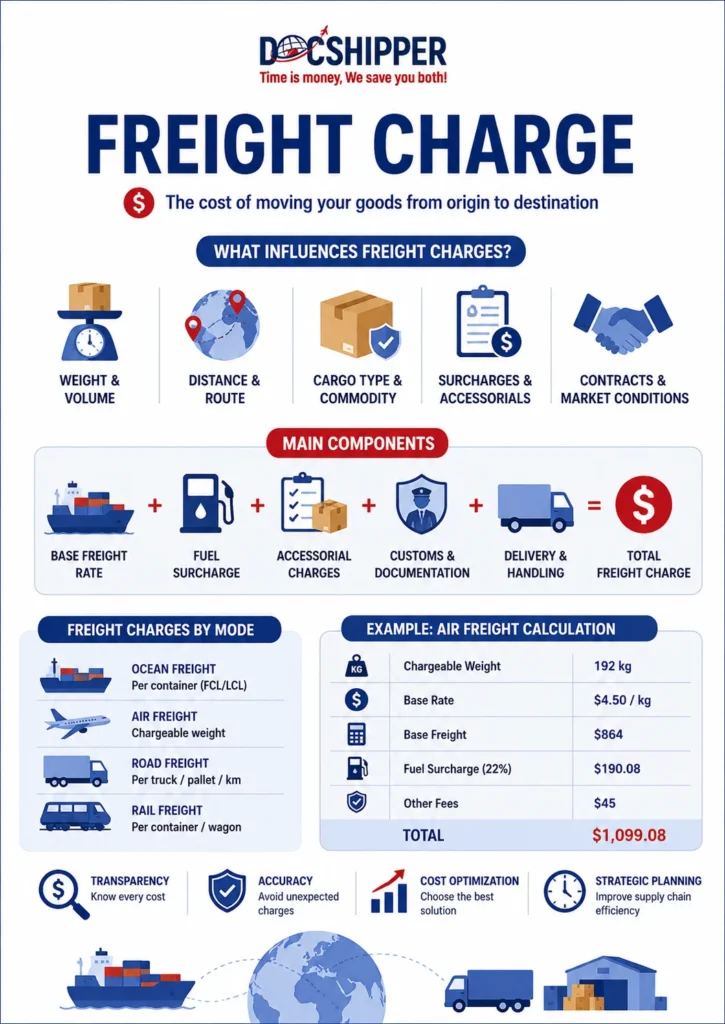
Freight charges comprise multiple components that carriers combine into a total transportation cost. The base freight rate forms the foundation, calculated using either weight or volume—whichever yields higher revenue for the carrier.
Chargeable weight determines the primary cost driver in air and express shipments. Carriers compare actual weight against volumetric weight (length × width × height ÷ dimensional factor) and charge based on the greater value. This mechanism prevents shippers from sending lightweight but bulky goods at unrealistically low rates.
Ocean freight typically uses container-based pricing for Full Container Load (FCL) shipments. A standard 20-foot container (TEU) or 40-foot container (FEU) commands a fixed rate regardless of how much cargo fills the space. Less than Container Load (LCL) shipments, however, revert to volume-based charging per cubic meter.
Accessorial charges represent additional services beyond basic transportation. These include customs clearance assistance, cargo insurance, warehousing, liftgate delivery for locations without loading docks, and residential delivery fees. According to ICC International Chamber of Commerce, accessorial fees can add 15-40% to base freight costs.
Fuel surcharges fluctuate monthly based on global oil prices. Carriers publish Bunker Adjustment Factor (BAF) for ocean freight and Fuel Surcharge (FSC) percentages for air and road transport. These surcharges protect carriers from volatile energy costs while passing market fluctuations to shippers.
At DocShipper, we systematically break down every freight charge component in our quotations, ensuring complete cost transparency before your shipment departs. Our clients appreciate knowing exactly what drives each line item in their logistics invoice.
Calculation Methods & Concrete Examples
Understanding theoretical components matters less than seeing how freight charges apply to real shipments. The following scenarios illustrate typical calculation methodologies across different transport modes.
Air Freight Calculation Example
| Parameter | Value | Calculation |
|---|---|---|
| Actual Weight | 150 kg | — |
| Dimensions | 120×80×100 cm | — |
| Volumetric Weight | 192 kg | (120×80×100) ÷ 5000 |
| Chargeable Weight | 192 kg | Higher of two values |
| Base Rate | $4.50/kg | — |
| Base Freight | $864 | 192 kg × $4.50 |
| Fuel Surcharge (22%) | $190.08 | $864 × 0.22 |
| Security Fee | $45 | Flat rate |
| Total Freight Charge | $1,099.08 | Sum of all components |
Ocean Freight LCL Comparison
Less than Container Load shipments demonstrate volume-based pricing where carriers charge per cubic meter (CBM) with minimum charges applied.
| Route | Rate per CBM | 5 CBM Shipment Cost | Transit Time |
|---|---|---|---|
| Shanghai to Los Angeles | $65/CBM | $325 | 18-22 days |
| Hamburg to New York | $55/CBM | $275 | 14-18 days |
| Singapore to Rotterdam | $72/CBM | $360 | 25-30 days |
Critical cost consideration: Ocean LCL shipments incur additional terminal handling charges (THC), documentation fees, and destination port charges that can add $150-$300 to the base freight, regardless of volume shipped.
FCL cost dynamics work differently. A 40-foot container from Shanghai to Hamburg might cost $2,800 during low season but surge to $8,500 during peak periods (September-November). The same container holds approximately 67 CBM, making FCL dramatically more economical when shipping volumes exceed 15-20 CBM.
Road freight in Europe typically charges by pallet position or linear meter for partial loads. A standard Euro pallet (1.2m × 0.8m) from Lyon to Warsaw costs approximately €85-€120 depending on urgency, with full truckload rates offering better per-pallet economics above 20 pallets.
Rail freight between Asia and Europe provides middle-ground pricing. A 40-foot container from Chengdu to Duisburg averages $4,500-$6,000 with 16-18 days transit—slower than air, faster than ocean, and often price-competitive for mid-weight, time-sensitive cargo.
At DocShipper, we compare all transport modes for your specific cargo profile, presenting the most cost-effective solution that meets your delivery timeline. Our volume discounts with major carriers translate to freight charge savings we pass directly to clients.
Conclusion
Freight charges represent complex calculations involving base rates, surcharges, and accessorial fees that vary by mode, route, and cargo characteristics. Mastering these components enables accurate budgeting and informed logistics decisions that protect your profit margins.
Need expert guidance on optimizing your freight costs? Contact DocShipper for a detailed freight analysis tailored to your supply chain requirements.
📚 Quiz
Test Your Knowledge: Freight Charge
What does "freight charge" specifically represent in international logistics?
Your air shipment weighs 150 kg but has dimensions of 120×80×100 cm. Using a volumetric factor of 5000, what determines your freight charge calculation?
A client receives a quote showing "Base Freight: $800" for their shipment. What should they realistically budget for the final freight charge?
🎯 Your Result
📞 Free Quote in 24hFAQ | Freight Charge: Definition, Calculation & Practical Examples
The freight rate represents the unit price (per kg, CBM, or container), while the freight charge is the total amount invoiced after applying the rate to your shipment's specifications plus all applicable surcharges and fees. The charge is always equal to or greater than the base rate calculation.
Volumetric weight (also called dimensional weight) equals length × width × height divided by a volumetric factor. Air freight uses 5000 or 6000 cm³/kg depending on the carrier. Express couriers typically use 5000. Ocean LCL converts volume directly to cubic meters without weight conversion, charging whichever metric yields higher revenue.
Freight charges vary based on fuel prices, seasonal demand, capacity availability, and geopolitical events affecting specific routes. Peak season (August-October for ocean, November-December for air) sees rates increase 30-200%. Carriers adjust Bunker Adjustment Factors monthly, and spot market rates respond to real-time supply-demand imbalances.
Contract rates negotiated with carriers based on annual volume commitments offer 15-40% savings versus spot market pricing. However, small shippers with inconsistent volumes receive minimal discounts. Freight forwarders leverage aggregated volumes across multiple clients to secure better rates than individual companies typically access directly.
Common additional charges include customs clearance fees, destination terminal handling, port congestion surcharges, documentation fees, inspection costs, demurrage (container detention), and last-mile delivery. Budget an extra 20-35% above the base freight quote for ocean shipments and 10-15% for air freight to cover these ancillary expenses.
Carriers classify goods by density, value, fragility, and risk level. Hazardous materials incur 25-75% surcharges. High-value electronics may require special handling fees. Refrigerated cargo (reefer) costs 40-60% more than standard containers. Odd-sized or overweight items trigger out-of-gauge charges that can double standard rates.
Air freight makes economic sense for high-value, low-weight goods where inventory holding costs exceed transport premiums. Products with short lifecycles, seasonal demand peaks, or just-in-time manufacturing requirements justify air freight's 4-8x ocean cost. Calculate total landed cost including inventory carrying charges, not just freight charges in isolation.
Incoterms define freight cost responsibility. Under FOB (Free on Board), buyers pay ocean freight. CIF (Cost, Insurance, Freight) places freight payment on sellers. DAP (Delivered at Place) requires sellers to cover all freight charges to the destination. Misunderstanding Incoterms creates unexpected freight charge liabilities that damage profit margins.
Carriers impose minimum charges (typically $100-$300 for air, $150-$250 for ocean LCL) regardless of actual shipment size. This prevents unprofitable micro-shipments. If your calculated freight charge falls below the minimum, you pay the minimum amount. Consolidating multiple small shipments into one larger shipment often proves more economical.
Optimized packaging significantly reduces volumetric weight and chargeable weight. Collapsible containers, vacuum packing, and custom-sized boxes minimize dimensional charges. For example, reducing a shipment's dimensions from 2.5 CBM to 2.0 CBM saves $50-$150 per shipment on typical LCL ocean freight. Packaging optimization typically delivers 8-15% freight charge reduction.
Freight forwarders operate on buy-sell models or commission structures. Buy-sell models mark up carrier rates 10-25% depending on service complexity and shipment value. Commission arrangements charge carriers' actual costs plus fixed fees ($150-$500 per shipment) for coordination services. Transparent forwarders detail their markup separately from carrier charges.
Current market benchmarks (Q1 2024) show Shanghai-Los Angeles FCL at $1,800-$2,500 per 40-foot container, transatlantic rates at $1,200-$1,800, and Asia-Europe rail at $4,000-$5,500. Air freight from Asia to North America ranges $4.50-$7.50 per kg. Rates exceeding these ranges by more than 20% warrant quote comparison from alternative providers.
Need Help with
Logistics or Sourcing ?
First, we secure the right products from the right suppliers at the right price by managing the sourcing process from start to finish. Then, we simplify your shipping experience - from pickup to final delivery - ensuring any product, anywhere, is delivered at highly competitive prices.


Fill the Form
Prefer email? Send us your inquiry, and we’ll get back to you as soon as possible.
Contact us




