


In short ⚡
The Freight Forwarders Institute is a professional organization dedicated to establishing industry standards, providing education, and certifying logistics professionals in international freight forwarding. These institutes ensure compliance with regulatory frameworks while promoting best practices across global supply chains, helping freight forwarders maintain operational excellence and legal compliance in cross-border trade.
Introduction
Many shippers struggle to identify reliable freight forwarders, often facing unexpected delays, compliance issues, or hidden costs. The fragmented nature of international logistics creates significant risk for businesses without proper vetting mechanisms.
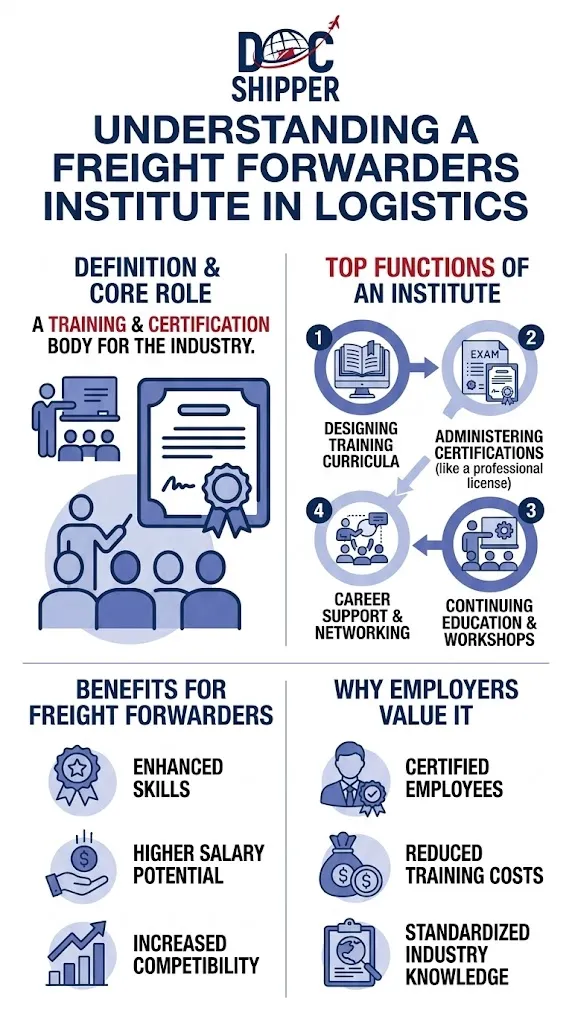
Freight Forwarders Institutes address this challenge by establishing professional benchmarks and certification programs that distinguish qualified logistics providers from unregulated operators. These organizations serve as gatekeepers of industry knowledge and ethical standards.
Key functions include:
- Professional certification programs validating competency in customs, documentation, and multimodal transport
- Regulatory education on evolving international trade laws and compliance requirements
- Industry advocacy representing freight forwarder interests before governmental bodies
- Standardized documentation development for Bills of Lading, packing lists, and commercial invoices
- Dispute resolution mechanisms for cargo claims and contractual disagreements
Expertise & Industry Standards
Freight Forwarders Institutes operate as knowledge hubs, translating complex international regulations into actionable guidelines. Major organizations like FIATA (International Federation of Freight Forwarders Associations) unite over 40,000 forwarding companies across 150 countries, establishing universal documentation standards.
The certification framework typically includes multiple proficiency levels. Entry-level credentials verify understanding of Incoterms, customs procedures, and cargo insurance basics. Advanced designations require mastery of dangerous goods regulations, perishable cargo handling, and multimodal transport optimization.
Legal compliance represents a core institute function. Members receive continuous updates on trade sanctions, export control classifications, and destination country import restrictions. For example, U.S. freight forwarders must navigate ITAR regulations for defense articles, while EU operators ensure REACH compliance for chemical shipments.
The institutes develop standard trading conditions that govern liability limits, delivery timeframes, and force majeure clauses. These pre-negotiated terms reduce contractual disputes by establishing clear expectations between shippers and forwarders. FIATA’s Multimodal Transport Bill of Lading serves as a globally recognized document of title.
Technology adoption initiatives help members implement digital platforms for real-time tracking, automated customs declarations, and blockchain-verified documentation. Progressive institutes offer training on AI-powered route optimization and predictive analytics for demand forecasting.
At DocShipper, our procurement and logistics teams maintain active memberships in regional freight forwarder institutes to stay ahead of regulatory changes and implement certified best practices across all client shipments.
Certifications & Concrete Impact
Professional certifications from Freight Forwarders Institutes deliver measurable advantages in operational efficiency and client confidence. Certified forwarders demonstrate verified competency that translates to reduced error rates and faster clearance times.
Comparative Analysis: Certified vs. Non-Certified Forwarders
| Metric | Certified Forwarders | Non-Certified Forwarders |
|---|---|---|
| Customs Clearance Time | 2.3 days average | 4.7 days average |
| Documentation Error Rate | 3.2% of shipments | 11.8% of shipments |
| Claim Dispute Resolution | 87% resolved within 30 days | 52% resolved within 30 days |
| Insurance Premium Discounts | 15-22% reduction | Standard rates apply |
| Regulatory Penalties (Annual) | 0.8% of members | 6.3% incidence rate |
Real-World Use Case: Electronics Shipment from China to Germany
A certified FIATA forwarder handling €500,000 worth of consumer electronics from Shenzhen to Hamburg demonstrates the certification advantage. The forwarder correctly classified lithium battery shipments under UN 3481, secured MSDS documentation, and pre-cleared customs data through AIS (Automated Import System).
Outcome metrics:
- Zero customs holds due to complete HS code declarations (8517.12.00 for smartphones)
- 18-hour faster clearance versus industry average through AEO (Authorized Economic Operator) credentials
- €8,200 saved in demurrage fees through optimized dwell time management
- Full cargo insurance coverage at 0.18% premium (versus 0.31% for uncertified handlers)
Critical Success Factors:
- IATA DGR Certification ensured compliant dangerous goods packaging and labeling
- CE Marking Verification confirmed product compliance before shipment departure
- EORI Number Validation prevented clearance delays at EU entry points
- Proper Incoterms Application (DDP) eliminated buyer confusion about delivery responsibilities
- Real-Time EDI Integration with Hamburg Port Authority systems accelerated container release
This example illustrates how institute-certified training directly translates to measurable cost savings and risk reduction. The forwarder’s continuous education through FIATA workshops enabled proactive identification of EU Battery Regulation 2023/1542 compliance requirements.
Conclusion
Freight Forwarders Institutes establish the professional infrastructure that transforms logistics from transactional service to strategic partnership. Certification programs ensure your cargo moves through compliant, efficient channels backed by continuous regulatory education.
Need expert freight forwarding with certified compliance standards? Contact DocShipper for end-to-end logistics solutions backed by industry-recognized expertise.
📚 Quiz
Test Your Knowledge: Freight Forwarders Institute
What is the primary purpose of a Freight Forwarders Institute?
Which statement correctly describes certified versus non-certified freight forwarders?
A shipper needs to transport lithium batteries from Asia to the EU. Why would choosing a FIATA-certified forwarder be strategically beneficial?
🎯 Your Result
📞 Free Personalized QuoteFAQ | Freight Forwarders Institute: Definition, Role & Industry Standards
These organizations provide professional certification, regulatory education, and industry standards development for logistics professionals. They serve as authoritative bodies ensuring freight forwarders maintain competency in customs compliance, documentation accuracy, and international trade law. Institutes also offer dispute resolution services and represent member interests in policy discussions with governmental trade authorities.
FIATA-certified forwarders demonstrate verified expertise in multimodal transport, customs procedures, and cargo insurance. Shippers benefit from reduced documentation errors, faster clearance times, and access to standardized contractual terms. Certification also provides third-party validation of a forwarder's professional competency, reducing due diligence requirements when selecting logistics partners for complex international shipments.
Membership is voluntary in most jurisdictions, though certain certifications may be required for handling specific cargo types. For example, IATA certification becomes necessary for air freight involving dangerous goods. While not legally mandated, institute membership signals professional commitment and provides liability insurance advantages. Many enterprise-level shippers require forwarder certification as a contractual prerequisite for RFP qualification.
Comprehensive programs address Incoterms application, HS code classification, customs valuation methods, and cargo insurance principles. Advanced modules include dangerous goods regulations (IMDG, ADR, IATA DGR), perishable cargo handling, export control screening, and sanctions compliance. Digital transformation courses now cover blockchain for documentation, AI-powered route optimization, and IoT-enabled cargo monitoring technologies.
Most institutes offer structured arbitration services based on standard trading conditions like FIATA's SDC (Standard Trading Conditions). These frameworks establish clear liability limits, claim procedures, and resolution timelines. Arbitration panels typically include industry experts who understand logistics complexities, providing faster resolution than traditional court systems. Decisions are often binding and enforceable across multiple jurisdictions through reciprocal recognition agreements.
FIATA operates as a global federation representing 150+ national associations, establishing international documentation standards and best practices. National institutes focus on country-specific regulations, local customs procedures, and domestic trade policy advocacy. While FIATA credentials carry worldwide recognition, national certifications address jurisdiction-specific requirements like U.S. FMC licensing or EU AEO authorization. Many professionals hold both global and national credentials.
Progressive institutes now provide hybrid learning models combining online coursework with practical assessments. Digital platforms deliver regulatory updates, case study analyses, and interactive simulations for customs scenarios. However, advanced certifications typically require proctored examinations and verified work experience. Some institutes mandate continuing education credits through annual webinars or conference participation to maintain active certification status.
Member organizations maintain liaison relationships with customs authorities, port operators, and international trade bodies. When new regulations emerge—like USMCA certificate of origin requirements or EU Carbon Border Adjustment Mechanism—institutes rapidly develop training modules and update standard documentation templates. Regular bulletins, emergency webinars, and regulatory working groups ensure members receive timely compliance guidance before enforcement deadlines.
Many institutes negotiate group liability insurance programs offering 15-25% premium reductions compared to individual policies. Certified members often access enhanced coverage limits for errors and omissions, cargo damage, and cyber liability. Insurers view institute-certified forwarders as lower-risk operators due to standardized procedures and ongoing professional education, translating to better terms and reduced deductibles for members.
Modern institutes operate innovation labs testing blockchain documentation platforms, AI-powered customs classification tools, and IoT cargo monitoring systems. They provide vendor-neutral guidance on TMS (Transport Management System) selection, API integration standards, and data security protocols. Technology committees develop interoperability standards ensuring different forwarders' systems can exchange shipment data seamlessly across the supply chain.
Progressive institutes now offer green logistics certifications covering carbon footprint calculation, sustainable packaging standards, and emission reduction strategies. Training addresses IMO 2020 sulfur cap compliance, EU Emission Trading System participation, and scope 3 carbon reporting methodologies. Institutes also facilitate knowledge sharing on alternative fuel adoption, modal shift optimization, and circular economy principles in logistics operations.
Entry-level certifications qualify professionals for customs compliance roles, documentation specialist positions, and freight coordinator functions. Advanced credentials open pathways to logistics manager, trade compliance officer, and supply chain director roles. Many multinational corporations require FIATA or equivalent certification for senior logistics positions. Certification also facilitates international career mobility, as credentials carry recognition across multiple markets and regulatory jurisdictions.
Need Help with
Logistics or Sourcing ?
First, we secure the right products from the right suppliers at the right price by managing the sourcing process from start to finish. Then, we simplify your shipping experience - from pickup to final delivery - ensuring any product, anywhere, is delivered at highly competitive prices.


Fill the Form
Prefer email? Send us your inquiry, and we’ll get back to you as soon as possible.
Contact us




