


In short ⚡
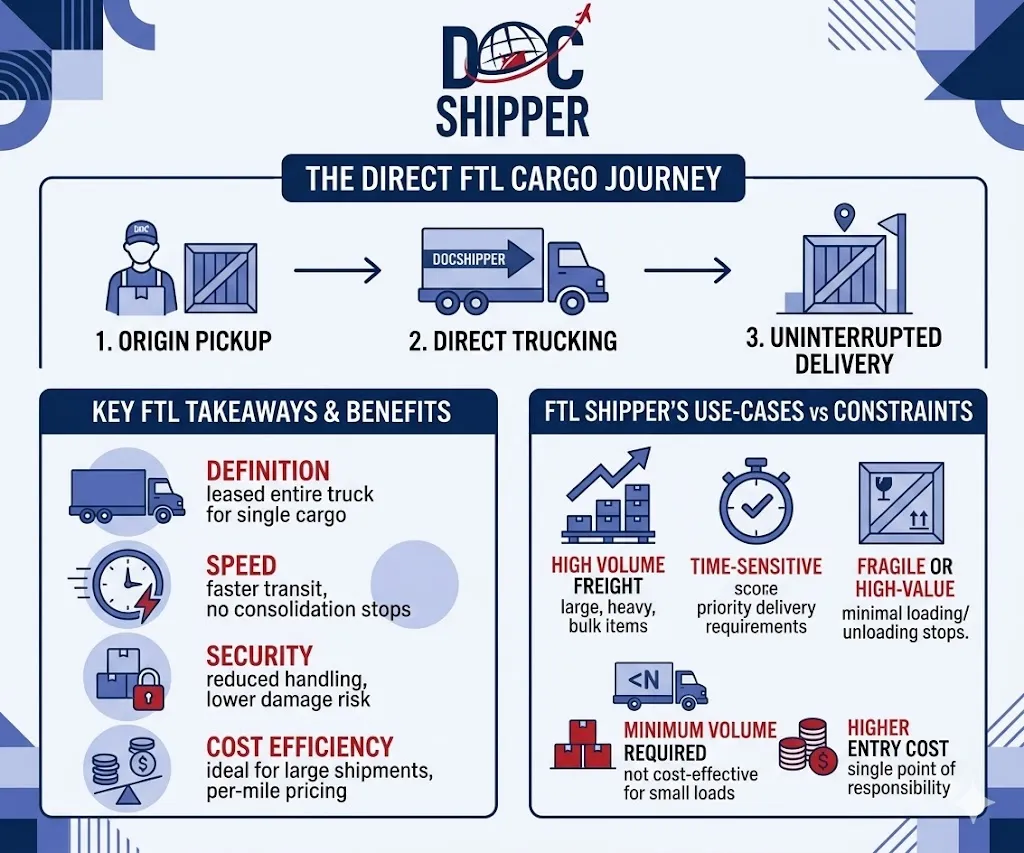
FTL (Full Truckload) is a shipping method where an entire truck is dedicated to a single shipper's cargo, regardless of whether the load fills the truck's full capacity. This exclusive transportation mode provides direct delivery from origin to destination without intermediate stops, offering faster transit times and reduced handling risks compared to consolidated shipments.Introduction
Many importers struggle to determine when paying for an entire truck makes financial sense. The confusion often arises from comparing per-unit costs without considering total logistics value. In international trade, understanding FTL shipping becomes crucial when managing large volumes, time-sensitive deliveries, or fragile goods requiring dedicated handling.
Full Truckload transportation represents a fundamental pillar of supply chain management, particularly for businesses moving substantial cargo quantities between manufacturers and distribution centers. This method directly impacts delivery speed, product integrity, and overall logistics expenses.
Key characteristics of FTL shipping:
- Exclusive capacity: One shipper controls the entire truck space
- Direct routing: No intermediate stops or cargo transfers
- Flexible scheduling: Departure times aligned with shipper needs
- Reduced handling: Cargo loaded once, unloaded once
- Enhanced security: Lower theft and damage risks
FTL Mechanisms & Strategic Advantages
FTL operates on a straightforward principle: a carrier assigns an entire vehicle to transport goods from point A to point B without consolidating freight from other shippers. The truck capacity utilization becomes the shipper’s responsibility, whether loading 10 or 26 pallets onto a standard 53-foot trailer.
The pricing structure differs fundamentally from LTL (Less Than Truckload). Carriers calculate FTL rates based on distance, fuel costs, and lane demand rather than weight classifications. This creates a threshold where FTL becomes economically superior to LTL, typically occurring when shipments exceed 10,000 pounds or occupy more than 6 linear feet of trailer space.
From a regulatory perspective, FTL shipments must comply with FMCSA regulations governing weight limits, driver hours of service, and safety standards. International FTL movements require customs documentation, including commercial invoices, packing lists, and certificates of origin.
Transit time advantages emerge as a critical differentiator. FTL shipments typically deliver 2-3 days faster than LTL equivalents on the same lane. This speed comes from eliminating cross-dock operations where LTL freight gets sorted, reloaded, and consolidated with other shipments.
At DocShipper, we systematically analyze shipment characteristics before recommending FTL solutions. Our logistics coordinators verify weight distribution, stackability requirements, and destination accessibility to optimize truck utilization and prevent costly routing errors.
The damage reduction factor cannot be overstated. Industry data shows FTL shipments experience 40-60% fewer handling incidents than LTL freight. This protection proves invaluable for temperature-sensitive pharmaceuticals, high-value electronics, or precision machinery where even minor impacts compromise product integrity.
Cost Calculation & Practical Examples
Understanding when FTL pricing outperforms LTL requires analyzing the cost-per-mile threshold. Carriers typically charge FTL based on a base rate plus fuel surcharges, which fluctuate with diesel prices. The calculation becomes straightforward once you establish the route-specific rate.
FTL vs LTL Cost Comparison (Chicago to Atlanta – 715 miles):
| Shipment Weight | FTL Cost | LTL Cost | Optimal Choice |
|---|---|---|---|
| 5,000 lbs (4 pallets) | $1,850 | $920 | LTL |
| 12,000 lbs (10 pallets) | $1,850 | $1,680 | FTL |
| 20,000 lbs (16 pallets) | $1,850 | $2,340 | FTL |
| 40,000 lbs (26 pallets) | $1,850 | $3,120 | FTL |
This comparison reveals the breakeven point occurs around 10,000 pounds on this specific lane. However, rates vary significantly based on regional supply-demand dynamics, seasonality, and carrier availability.
Practical Use Case – Electronics Manufacturer: A California-based electronics company ships 18,000 pounds of laptops to a New Jersey distribution center monthly. Their LTL quote stands at $4,200 with a 7-day transit time. The FTL alternative costs $3,800 with 4-day delivery. Beyond the $400 monthly savings, the company reduces inventory carrying costs by maintaining lower safety stock levels due to predictable FTL delivery schedules.
Additional cost factors impacting FTL decisions include:
- Detention fees: Charges for exceeding standard 2-hour loading/unloading windows ($50-100/hour)
- Accessorial charges: Liftgate service, inside delivery, or residential delivery ($75-300 per service)
- Layover costs: Driver rest period compensation for multi-day transits ($200-400/day)
- Deadhead miles: Empty return trips increasing effective cost per mile (10-25% premium)
- Capacity surcharges: Peak season premiums during Q4 holiday periods (15-40% markup)
Shippers optimizing FTL economics focus on backhaul opportunities and continuous moves. Arranging return loads reduces effective transportation costs by 30-50%, transforming FTL from a one-way expense into a bidirectional asset.
Conclusion
FTL shipping delivers unmatched value for high-volume shipments requiring speed, security, and minimal handling. The economic threshold typically emerges around 10,000-15,000 pounds, though strategic factors like transit time and damage prevention often justify FTL selection below these weights.
Need expert guidance on optimizing your freight strategy? Contact DocShipper for a customized logistics assessment.
📚 Quiz
Test Your Knowledge: FTL (Full Truckload)
What is the core definition of FTL (Full Truckload) shipping?
How is FTL pricing primarily structured?
A company needs to ship 8,000 pounds of fragile electronics from Los Angeles to New York with a 3-day delivery deadline. Which statement best reflects the correct FTL application?
🎯 Your Result
📞 Free Quote in 24hFAQ | FTL (Full Truckload): Definition, Calculation & Practical Examples
Need Help with
Logistics or Sourcing ?
First, we secure the right products from the right suppliers at the right price by managing the sourcing process from start to finish. Then, we simplify your shipping experience - from pickup to final delivery - ensuring any product, anywhere, is delivered at highly competitive prices.


Fill the Form
Prefer email? Send us your inquiry, and we’ll get back to you as soon as possible.
Contact us




:%20Definition,%20Calculation%20&%20Practical%20Examples)