


In short ⚡
A feeder vessel is a smaller container ship designed to transport cargo between secondary ports and major hub terminals. Operating as a crucial link in the maritime supply chain, these vessels typically carry 500 to 3,000 TEU, enabling efficient distribution of goods from mega-ships to regional destinations where larger vessels cannot access due to draft or infrastructure limitations.Introduction
In international shipping, a common misconception is that all cargo travels directly from origin to destination aboard a single vessel. In reality, most containerized goods undergo transshipment at strategic hub ports, where feeder vessels play an indispensable role.
These specialized ships bridge the gap between global trade arteries and regional markets. Without feeder services, ports with limited depth, smaller terminals, or lower cargo volumes would struggle to connect with international shipping networks.
Key characteristics of feeder vessel operations include:
- Shallow draft capability – Accessing ports where ultra-large container vessels (ULCV) cannot navigate
- Flexible scheduling – Higher frequency sailings compared to mainline services
- Regional connectivity – Linking secondary markets to global hubs like Singapore, Rotterdam, or Dubai
- Cost efficiency – Optimizing cargo consolidation for smaller volume shipments
- Multi-port itineraries – Serving multiple destinations in a single voyage loop
Understanding feeder networks is essential for importers and exporters managing transit times and logistics costs across diverse geographic markets.
Operational Strategy & Hub-Spoke Systems
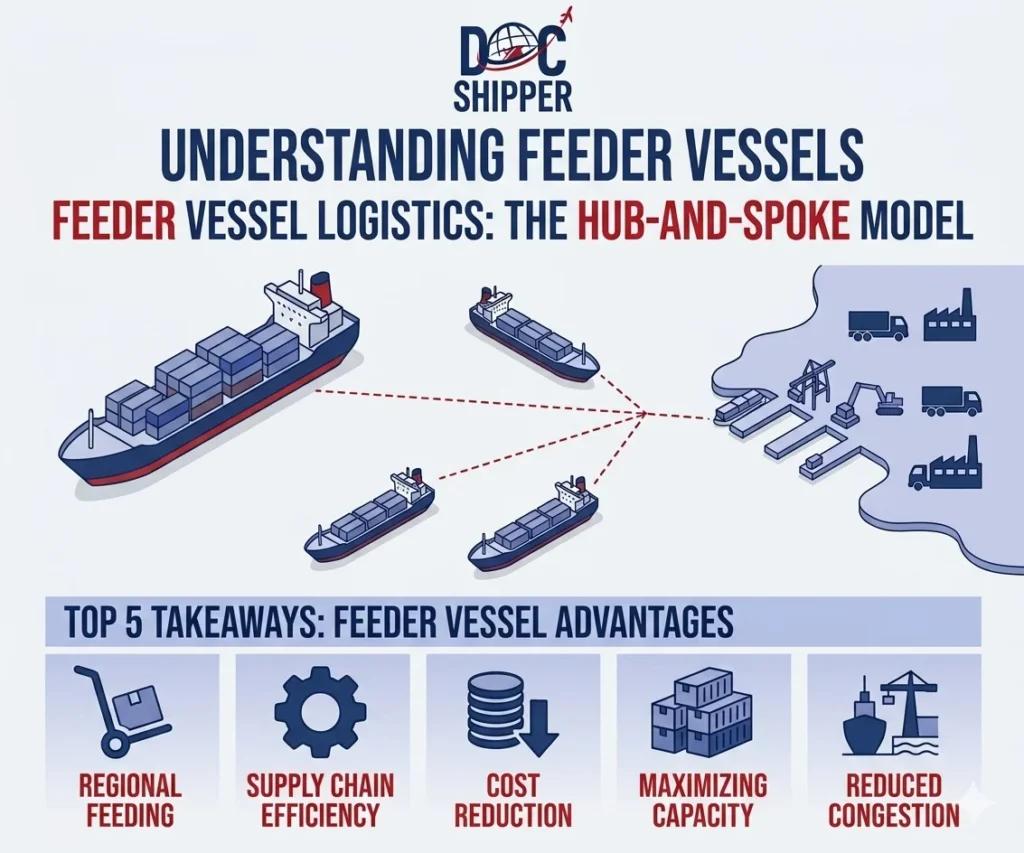
The feeder vessel concept operates within a hub-and-spoke distribution model, mirroring airline networks. Major shipping lines deploy ultra-large vessels on east-west mainline routes between continents, while feeder ships distribute containers to and from smaller ports within specific regions.
This system provides several strategic advantages. First, mainline vessels maximize economies of scale by maintaining fixed schedules between mega-terminals. Second, feeder operators customize routes based on regional demand fluctuations. Third, the model reduces congestion at secondary ports while maintaining competitive transit times.
Typical operational parameters include:
- Vessel capacity: 500–3,000 TEU (compared to 18,000+ TEU for mainline ships)
- Speed: 15–18 knots (optimized for fuel efficiency on shorter distances)
- Draft limitations: 8–10 meters (enabling access to shallow-water ports)
- Service frequency: Weekly or bi-weekly loops within defined geographic zones
Regulatory compliance differs significantly from mainline operations. Customs clearance procedures at hub ports must account for cargo originating from multiple feeder arrivals. Documentation requirements follow WCO (World Customs Organization) standards, with specific transshipment declarations ensuring proper cargo tracking.
At DocShipper, we coordinate feeder connections seamlessly by monitoring vessel schedules and terminal cut-off times. Our agents verify that containers arrive at hub ports before mainline departure, preventing costly delays and missed connections in complex multi-leg shipments.
The port infrastructure requirements for feeder operations include specialized berths with adequate crane capacity, container stacking areas for transshipment, and efficient rail or truck connections for inland distribution. Ports like Antwerp, Hamburg, and Busan have invested heavily in dedicated feeder terminals to optimize cargo flow.
Environmental considerations are increasingly important. Modern feeder vessels incorporate fuel-efficient engines and scrubber systems to comply with IMO 2020 sulfur emission regulations, particularly in Emission Control Areas (ECAs) where stricter standards apply.
Practical Examples & Route Data
To illustrate feeder vessel operations concretely, consider the Northern Europe–Baltic Sea network. A mainline vessel arriving at Rotterdam from Asia discharges containers destined for Scandinavia, Poland, and Russia. Feeder vessels then distribute these containers to ports like Gdańsk, Helsinki, and St. Petersburg.
Here’s a comparative analysis of feeder versus direct shipping scenarios:
| Route Type | Transit Time | Cost per TEU | Frequency | Port Access |
|---|---|---|---|---|
| Direct Mainline (Shanghai–Helsinki) | 35–40 days | $2,200 | Monthly | Limited seasonal |
| Mainline + Feeder (Shanghai–Rotterdam–Helsinki) | 32–36 days | $1,850 | Weekly | Year-round reliable |
This comparison demonstrates how feeder connections often reduce both cost and transit time while providing superior schedule reliability.
Case Study: Mediterranean Feeder Network
The Port of Piraeus (Greece) serves as a transshipment hub for cargo heading to Black Sea destinations. A typical feeder loop operates as follows:
- Day 0: Feeder vessel departs Piraeus with 800 TEU from Asian imports
- Day 2: Calls at Thessaloniki (Greece) – discharge 200 TEU, load 150 TEU exports
- Day 4: Arrives Constanța (Romania) – discharge 300 TEU, load 180 TEU
- Day 6: Calls at Varna (Bulgaria) – discharge 200 TEU, load 120 TEU
- Day 8: Returns to Piraeus with accumulated export containers for mainline connection
This 8-day rotation provides weekly service to markets that generate insufficient cargo for dedicated mainline calls, while maintaining competitive transit times to global destinations.
Key Operational Metrics:
- Average feeder vessel utilization: 75–85% capacity
- Transshipment dwell time at hubs: 2–4 days
- Feeder market share in intra-regional trade: 60–70% in Europe and Southeast Asia
- Typical feeder operator fleet size: 15–50 vessels
Environmental data shows that feeder vessels emit approximately 40–50 grams CO₂ per TEU-kilometer, significantly lower than truck transport (60–150 g/TEU-km) for equivalent distances, making short-sea shipping an environmentally preferable option for regional distribution.
Conclusion
Feeder vessels form the circulatory system of global maritime logistics, ensuring that even the smallest ports remain connected to worldwide trade flows. Understanding their operational dynamics enables shippers to optimize routing decisions and manage supply chain risks effectively.
Need expert guidance on feeder vessel selection or transshipment coordination? Contact DocShipper for customized logistics solutions tailored to your shipping requirements.
📚 Quiz
Test Your Knowledge: Feeder Vessel Operations
1. What is the primary function of a feeder vessel in maritime logistics?
2. Which operational characteristic distinguishes feeder vessels from ultra-large container vessels (ULCV)?
3. A shipment from Shanghai to Helsinki can use either direct mainline service or mainline-plus-feeder routing. Based on the article data, which statement is correct?
🎯 Your Result
📞 Free Quote in 24hFAQ | Feeder Vessel: Definition, Operations & Concrete Examples
Need Help with
Logistics or Sourcing ?
First, we secure the right products from the right suppliers at the right price by managing the sourcing process from start to finish. Then, we simplify your shipping experience - from pickup to final delivery - ensuring any product, anywhere, is delivered at highly competitive prices.


Fill the Form
Prefer email? Send us your inquiry, and we’ll get back to you as soon as possible.
Contact us




