


In short ⚡
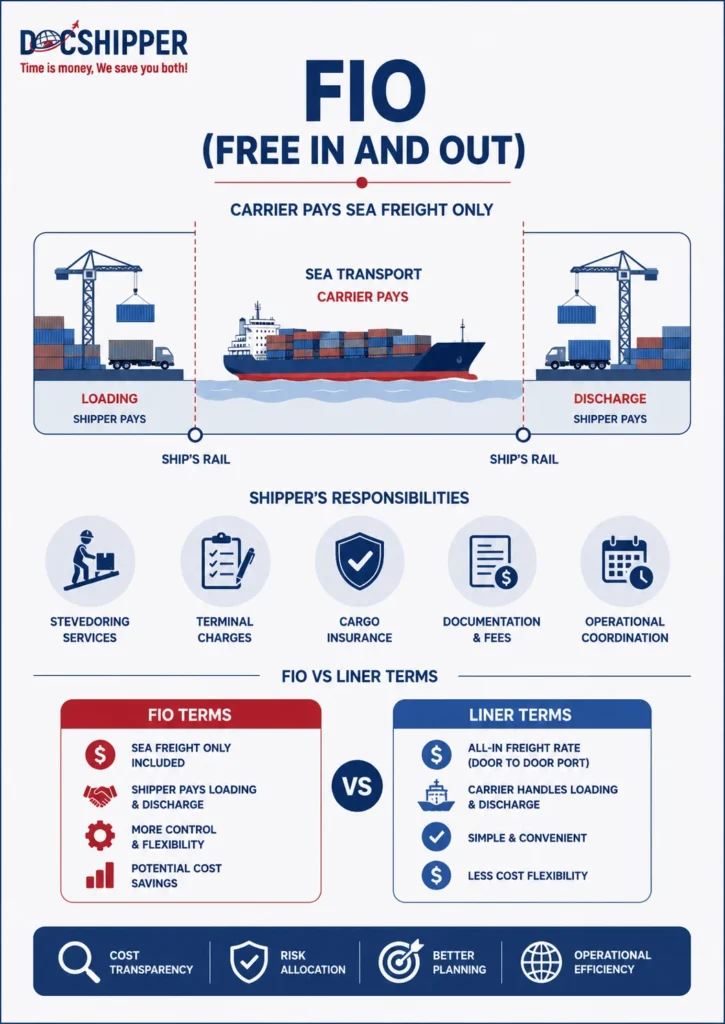
FIO (Free In and Out) is a maritime shipping term indicating that the cargo loading and unloading costs are excluded from the freight rate. Under FIO terms, the charterer or shipper bears all expenses related to stevedoring, while the carrier is only responsible for the sea transport itself.
Introduction
Freight rate quotations can quickly become confusing when additional handling charges appear unexpectedly. Many importers assume that a competitive ocean freight rate covers all operations from origin port to destination port, only to discover substantial loading and discharge fees upon arrival.
FIO terms clarify this ambiguity by explicitly excluding terminal handling from the carrier’s obligations. This contractual framework is particularly relevant in bulk cargo operations and specialized charter agreements where handling requirements vary significantly.
Understanding FIO conditions is essential for accurate budgeting in international logistics:
- Cost transparency: Clear separation between sea freight and terminal operations
- Operational control: Charterer selects stevedoring companies and methods
- Risk allocation: Cargo handling liability transferred to the shipper
- Charter flexibility: Adaptable to various cargo types and port facilities
- Budget precision: Eliminates hidden charges in freight quotations
FIO Mechanisms & Commercial Implications
Under FIO terms, the carrier’s responsibility begins when cargo crosses the ship’s rail and ends at the same point in the discharge port. All operations before and after this moment fall outside the freight contract scope.
This arrangement creates distinct financial obligations. The charterer must contract and pay for stevedoring services, including labor, equipment, and supervision for both loading and unloading operations. Port authorities typically require proof of stevedore appointment before allowing cargo operations.
The commercial advantage lies in cost control. Shippers negotiating directly with terminal operators often secure better rates than bundled carrier services, particularly for regular shipments or specialized handling requirements. At DocShipper, we assist clients in negotiating these terminal contracts to optimize overall logistics costs.
Legal implications require attention to liability boundaries. Damage occurring during loading or discharge falls under the stevedore’s or charterer’s insurance, not the carrier’s cargo liability coverage. Documentation must clearly establish when cargo custody transfers occur.
The operational coordination becomes more complex under FIO terms. The charterer must ensure stevedores are ready when the vessel arrives, as delays generate demurrage charges. Port regulations, available equipment, and labor availability all influence scheduling decisions.
For compliance verification, authorities increasingly scrutinize handling operations. The International Maritime Organization (IMO) provides guidelines on safe cargo handling practices that apply regardless of contractual arrangements. Shippers remain responsible for regulatory compliance during operations they control.
Cost Breakdown & Practical Examples
FIO cost structures vary significantly by cargo type, port location, and handling complexity. Understanding typical expenses helps importers budget accurately and evaluate whether FIO terms offer financial advantages.
| Cost Component | FIO Terms | Liner Terms | Typical Rate Range |
|---|---|---|---|
| Ocean Freight | Shipper pays | Shipper pays | $800-2,500/container |
| Loading (Origin) | Shipper pays | Included in freight | $150-400/container |
| Discharge (Destination) | Shipper pays | Included in freight | $200-500/container |
| Terminal Handling | Negotiable separately | Fixed carrier rate | $100-300/container |
| Equipment Positioning | Shipper arranges | Carrier responsibility | $50-150/container |
Practical Case Study: A European importer shipping 500 tons of steel coils from Shanghai to Rotterdam receives two quotations:
- Liner Terms Quote: $45/ton all-inclusive ($22,500 total)
- FIO Terms Quote: $32/ton ocean freight + $8/ton loading + $10/ton discharge ($25,000 total)
Initially, FIO appears $2,500 more expensive. However, the importer’s logistics partner negotiates direct stevedoring contracts at $6/ton for loading and $7/ton for discharge, reducing total costs to $22,500 ($16,000 freight + $3,000 loading + $3,500 discharge), achieving parity with liner terms while maintaining operational control.
For bulk commodities shipped regularly, FIO terms often deliver savings of 8-15% through optimized stevedoring contracts. Container shipments benefit less unless handling requires specialized equipment or the shipper controls terminal access.
Key financial considerations include:
- Shipment frequency and volume leverage for stevedore negotiations
- Port congestion impact on demurrage risk under FIO terms
- Insurance coverage gaps between carrier and stevedore policies
- Currency fluctuation exposure when paying multiple service providers
- Administrative costs for coordinating separate contracts and invoices
At DocShipper, we evaluate whether FIO or liner terms optimize your specific trade lane economics. Our freight forwarding services include cost modeling to identify the most advantageous contractual structure for your shipments.
Conclusion
FIO terms shift terminal handling costs and control from carriers to shippers, creating opportunities for cost optimization but requiring careful operational coordination. Success depends on accurate cost forecasting, reliable stevedore partnerships, and clear liability documentation.
Need assistance evaluating FIO terms for your shipments? Contact DocShipper for expert guidance on optimizing your international logistics contracts.
📚 Quiz
Test Your Knowledge: FIO (Free In and Out)
What costs are excluded from the freight rate under FIO terms?
A common misconception is that FIO terms mean the carrier handles loading but not discharge. What is the correct interpretation?
An importer receives damage to cargo during discharge operations. Under FIO terms, who is typically liable for this damage?
🎯 Your Result
📞 Free Quote in 24hFAQ | FIO (Free In and Out): Definition, Calculation & Practical Examples
FIO (Free In and Out) means the freight rate excludes loading and unloading costs. The shipper or charterer must arrange and pay for all cargo handling operations at both origin and destination ports, while the carrier only provides sea transportation between ports.
The charterer or shipper pays all stevedoring costs under FIO terms. This includes labor, equipment rental, supervision, and any specialized handling required for cargo operations. The carrier has no financial obligation for these services beyond providing the vessel.
Liner terms include loading and discharge costs in the ocean freight rate, creating a single all-inclusive price. FIO terms separate these costs, allowing shippers to negotiate handling services independently. Liner terms simplify administration but may cost more than optimized FIO arrangements.
FIO terms benefit shippers with regular high-volume shipments who can negotiate favorable stevedoring contracts, specialized cargo requiring specific handling expertise, or direct relationships with terminal operators. They're less advantageous for occasional small shipments where bundled liner services offer simplicity.
FIO terms apply to both containerized and bulk cargo, though they're more common in bulk shipping. Container lines typically use liner terms with terminal handling charges (THC) included. When FIO applies to containers, shippers arrange their own terminal services and equipment positioning.
FIOS (Free In and Out Stowed) includes cargo stowage in the charterer's responsibilities beyond basic FIO. FIOT (Free In and Out Trimmed) adds trimming obligations for bulk cargo. These variations further refine cost allocation between carrier and charterer for specific cargo handling operations.
Under FIO terms, cargo insurance must cover handling operations separately from sea transit. The shipper needs stevedore damage coverage since the carrier's liability excludes loading/discharge periods. Policy boundaries must align precisely with operational responsibility transfers to avoid coverage gaps.
Stevedore delays under FIO terms can trigger demurrage charges against the charterer, even though the carrier didn't provide the handling services. The charterer bears full responsibility for ensuring timely cargo operations, making reliable stevedore selection critical to cost control.
FIO terms are typically fixed in the charter party or booking confirmation and cannot be unilaterally changed. Any modification requires mutual agreement between carrier and charterer, often formalized through contract amendments. Early clarification prevents disputes about cost responsibility.
Port authorities require licensed stevedores for FIO operations and may impose specific safety protocols, equipment standards, and operational timeframes. Shippers must ensure their contracted stevedores meet all local regulatory requirements, including labor certifications and environmental compliance standards.
FIO shipments require separate stevedoring contracts, cargo handling receipts, equipment hire agreements, and liability documentation. Bills of lading should clearly state FIO terms, and insurance certificates must reflect separate coverage for handling operations. Proper documentation prevents liability disputes.
Potential hidden costs include port authority fees not covered by stevedores, equipment positioning charges, waiting time if cargo isn't ready, documentation fees, and specialized handling surcharges. Comprehensive cost breakdowns from stevedores before commitment help avoid budget surprises during operations.
Need Help with
Logistics or Sourcing ?
First, we secure the right products from the right suppliers at the right price by managing the sourcing process from start to finish. Then, we simplify your shipping experience - from pickup to final delivery - ensuring any product, anywhere, is delivered at highly competitive prices.


Fill the Form
Prefer email? Send us your inquiry, and we’ll get back to you as soon as possible.
Contact us




