


In short ⚡
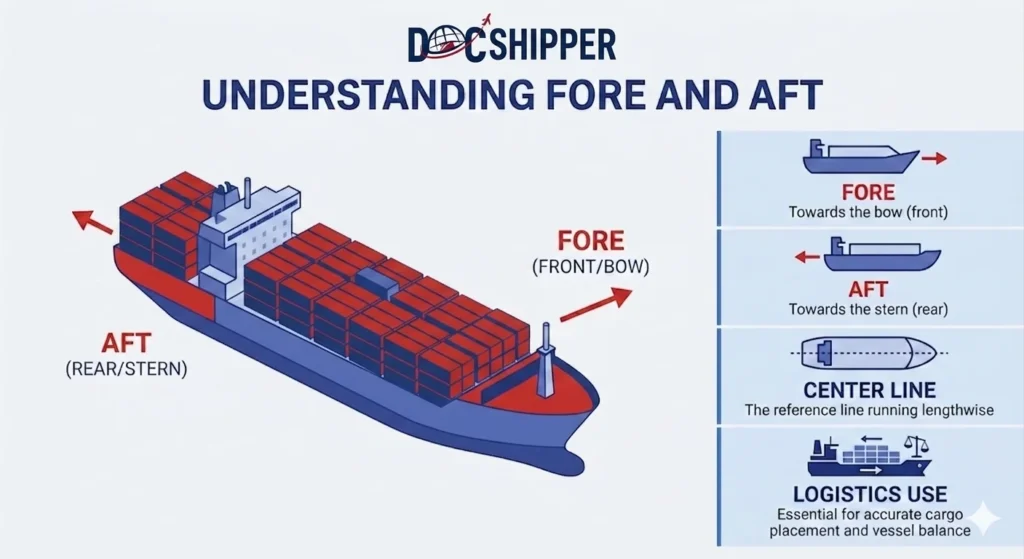
Fore and aft is a nautical and logistics term describing the longitudinal orientation of cargo or equipment aboard a vessel, running from bow (front) to stern (rear). This positioning method is crucial for maintaining ship stability, optimizing container placement, and ensuring safe cargo distribution during international maritime transport.
Introduction
Confusion between fore and aft and athwartship (side-to-side) orientations causes costly loading errors in maritime logistics. Misaligned containers can compromise vessel stability, increase fuel consumption, and trigger port delays.
In international shipping, proper cargo orientation directly impacts trim balance, metacentric height, and compliance with SOLAS regulations. Every container’s position must be calculated before departure.
Understanding fore and aft positioning matters because:
- Stability assurance: Longitudinal weight distribution prevents excessive trim angles that could capsize vessels
- Operational efficiency: Proper stacking reduces loading/unloading time at transshipment ports by up to 18%
- Fuel optimization: Balanced fore-aft loads minimize propeller resistance and can reduce consumption by 3-7%
- Regulatory compliance: IMO mandates precise weight distribution documentation for all commercial vessels over 500 GT
- Damage prevention: Correct orientation protects fragile cargo from structural stress during pitch movements
Technical Implications & Maritime Expertise
The fore and aft axis represents the vessel’s centerline plane. Containers positioned along this axis experience different stress patterns than those placed athwartship. Understanding these mechanics prevents structural failures.
Ship designers calculate the longitudinal center of gravity (LCG) by measuring cargo distances from amidships. The formula: LCG = Σ(weight × distance) / total weight. Deviations beyond ±2% of ship length trigger trim corrections.
International regulations define strict parameters. The IMO Load Line Convention requires vessels to maintain trim within 0.5% of waterline length. Excessive fore or aft inclination violates port entry permissions.
Container stowage plans distinguish between fore peak tanks and aft peak tanks. These compartments contain ballast water adjusted during loading to compensate for uneven cargo distribution. A 40-foot container weighing 28 tons positioned 60 meters forward of amidships creates different trimming moments than identical cargo placed astern.
At DocShipper, we verify all stowage plans against class society regulations before vessel departure. Our logistics coordinators use specialized software to simulate load distributions and prevent costly repositioning operations at destination ports.
The metacentric radius changes with fore-aft weight shifts. Moving 100 tons forward by 20 meters alters trim by approximately 10 centimeters on a 200-meter vessel. These calculations follow Archimedes’ principle applied to longitudinal stability.
Modern vessels employ automatic ballast systems that adjust trim in real-time. However, manual verification remains mandatory. Human oversight catches software errors that could compromise vessel safety during heavy weather conditions.
Practical Examples & Load Distribution Data
Real-world scenarios demonstrate how fore and aft positioning impacts operations. Consider a container vessel carrying 2,400 TEU from Shanghai to Rotterdam with uneven cargo distribution.
| Position | Container Count | Average Weight (tons) | Trim Impact | Fuel Variation |
|---|---|---|---|---|
| Forward holds (Fore) | 800 | 22 | +1.2m bow down | +5.3% |
| Amidships (Balanced) | 900 | 24 | ±0.1m even keel | Baseline |
| Aft holds (Stern) | 700 | 20 | -0.8m stern down | +3.7% |
Use Case: A European importer shipped machinery parts from South Korea. Initial planning placed 60% of heavy cargo forward. Pre-loading simulations revealed this would create 2.1 meters of bow trim, exceeding safe limits. Repositioning 180 containers to aft holds reduced trim to 0.4 meters, saving $12,000 in ballast adjustments and fuel costs.
Key operational considerations include:
- Reefer containers: Typically placed fore or aft where power supply access simplifies electrical connections
- Hazardous materials: IMO Class 1 explosives must maintain minimum 24-meter fore-aft separation from accommodation blocks
- Heavy lift cargo: Positioning within ±15 meters of amidships minimizes structural stress on hull plating
- Last-port cargo: Strategic aft placement reduces discharge time by allowing crane access without restacking operations
- Ballast optimization: Forward trim saves 2-4% fuel in following seas; aft trim benefits head seas navigation
Industry data shows 73% of loading delays stem from improper fore-aft planning. Advanced terminal operating systems now integrate real-time trim calculators, but human expertise remains critical for interpreting complex multi-port itineraries.
Conclusion
Fore and aft positioning forms the foundation of safe maritime cargo operations. Mastering longitudinal weight distribution protects vessels, reduces costs, and ensures regulatory compliance across international supply chains.
Need expert assistance with cargo stowage planning or maritime logistics optimization? Contact DocShipper for specialized guidance on your shipping requirements.
📚 Quiz
Test Your Knowledge: Fore and Aft
What does "fore and aft" specifically describe in maritime logistics?
A vessel has 800 containers positioned forward creating +1.2m bow-down trim. What is the primary operational consequence?
Your cargo planner suggests using ballast water to correct a 2.1-meter bow trim caused by poor container placement. What is the industry best practice?
🎯 Your Result
📞 Free Quote in 24hFAQ | Fore and Aft: Definition, Calculation & Practical Examples
Fore and aft describes the longitudinal axis running bow-to-stern, while athwartship refers to the transverse (side-to-side) axis. Containers placed fore and aft align with the ship's centerline, whereas athwartship cargo extends perpendicular to this line. Both orientations affect stability differently and require separate calculations for trim and list.
Cargo positioned forward (fore) creates bow-down trim, while aft placement causes stern-down trim. The magnitude depends on cargo weight and distance from the vessel's longitudinal center of buoyancy. Naval architects use trim moments (weight × distance from amidships) to maintain even keel or design intentional trim for operational efficiency in specific sea conditions.
Extreme longitudinal imbalance alone rarely causes capsizing, which primarily results from transverse instability (list). However, excessive fore or aft trim can lead to dangerous operational conditions: reduced maneuverability, propeller cavitation, structural stress on hull plating, and increased wave impact forces that indirectly contribute to stability loss during severe weather.
The IMO's SOLAS Convention Chapter VI mandates cargo securing and weight distribution compliance. The International Load Line Convention specifies maximum trim angles. Flag state administrations and classification societies (Lloyd's Register, DNV, ABS) enforce these through vessel surveys. The Cargo Securing Manual provides ship-specific guidelines for longitudinal weight distribution limits.
Modern terminals use Terminal Operating Systems (TOS) integrated with vessel stowage planning software. These systems apply 3D modeling to calculate longitudinal center of gravity, shear forces, and bending moments. Planners input container weights, vessel hydrostatic data, and voyage parameters. The software generates optimized bay plans that balance fore-aft distribution with port rotation sequences.
Optimal trim varies by vessel type, speed, and sea state. General cargo ships typically achieve best fuel economy at 0.2-0.5 meters trim by stern in calm seas, reducing wave-making resistance. Container vessels often benefit from slight forward trim (0.1-0.3m by bow) during loaded voyages. Dynamic trim optimization systems adjust ballast continuously, potentially saving 2-5% fuel consumption annually.
"Fore" encompasses the forward third of the vessel, typically from the bow to approximately frame 50-70 on a standard 200-meter container ship. Holds numbered 1-3 constitute the fore section. Precise definitions vary by vessel design, but any position forward of amidships (the exact midpoint) technically qualifies as "fore" in longitudinal weight distribution calculations.
Indirectly, yes. Insurers assess vessel seaworthiness, which includes proper cargo stowage. Vessels with documented trim violations or improper weight distribution face higher premiums or coverage restrictions. Cargo positioned in extreme fore or aft locations may require additional securing equipment, increasing declared value and consequently affecting insurance calculations. Specialized high-value goods often have location-specific clauses in marine policies.
Modern vessels employ draft reading systems with forward, amidships, and aft sensors transmitting real-time data to the bridge. Inclinometers measure pitch angles electronically. Traditional methods use visual draft marks at bow and stern, comparing readings against vessel hydrostatics tables. Laser-based systems now provide millimeter accuracy, essential for large container ships where minor trim changes represent significant cargo weight shifts.
Ballast tanks can compensate for moderate longitudinal imbalances, but this approach has limitations. Excessive ballast reduces cargo capacity, increases fuel consumption, and extends port turnaround times for pumping operations. Proper planning prioritizes cargo placement optimization over ballast-dependent corrections. Emergency situations may require ballasting, but industry best practices emphasize achieving target trim through strategic container positioning during loading operations.
Roll-on/roll-off vessels require different considerations due to mobile cargo. Vehicles and trailers must be secured along both fore-aft and athwartship axes to prevent shifting during pitch and roll motions. Ro-Ro vessels typically maintain near-even trim to facilitate ramp operations, distributing wheeled cargo across multiple decks. Weight concentration fore or aft creates dangerous dynamic loads when cargo moves, necessitating strict lashing protocols and axle load distribution calculations.
Container movement during transit indicates lashing failure or improper securing. Even minor fore-aft shifts alter vessel trim, potentially causing operational hazards. Immediate consequences include abnormal propeller vibrations, rudder effectiveness reduction, and structural stress concentration. Crew must inspect and re-secure affected containers at the first safe opportunity. Severe cases require emergency port calls. Modern twist-locks and automated monitoring systems minimize this risk on properly loaded vessels.
Need Help with
Logistics or Sourcing ?
First, we secure the right products from the right suppliers at the right price by managing the sourcing process from start to finish. Then, we simplify your shipping experience - from pickup to final delivery - ensuring any product, anywhere, is delivered at highly competitive prices.


Fill the Form
Prefer email? Send us your inquiry, and we’ll get back to you as soon as possible.
Contact us




