


In short ⚡
Free Carrier (FCA) is an Incoterm where the seller delivers goods to a carrier or designated party at a specified location. The seller clears goods for export, and risk transfers when goods are handed to the first carrier, not at destination. FCA offers flexibility for any transport mode and is widely used in containerized shipping.Introduction
One of the most common confusions in international trade involves determining exactly when risk and cost responsibilities transfer between buyer and seller. Many importers mistakenly assume the seller remains liable until goods reach their warehouse, leading to disputes and unexpected expenses.
Free Carrier (FCA) addresses this ambiguity by establishing a precise handover point. Unlike FOB (limited to sea transport), FCA works for all modes: road, rail, air, and maritime. This versatility makes it the preferred choice for modern logistics, particularly when using freight forwarders or integrated logistics providers.
Key characteristics of FCA include:
- Flexible delivery location: seller’s premises, terminal, warehouse, or any agreed point
- Export clearance responsibility: seller handles all export formalities and documentation
- Transport neutrality: applicable to any shipping mode or combination
- Risk transfer clarity: occurs at the moment goods are handed to the carrier
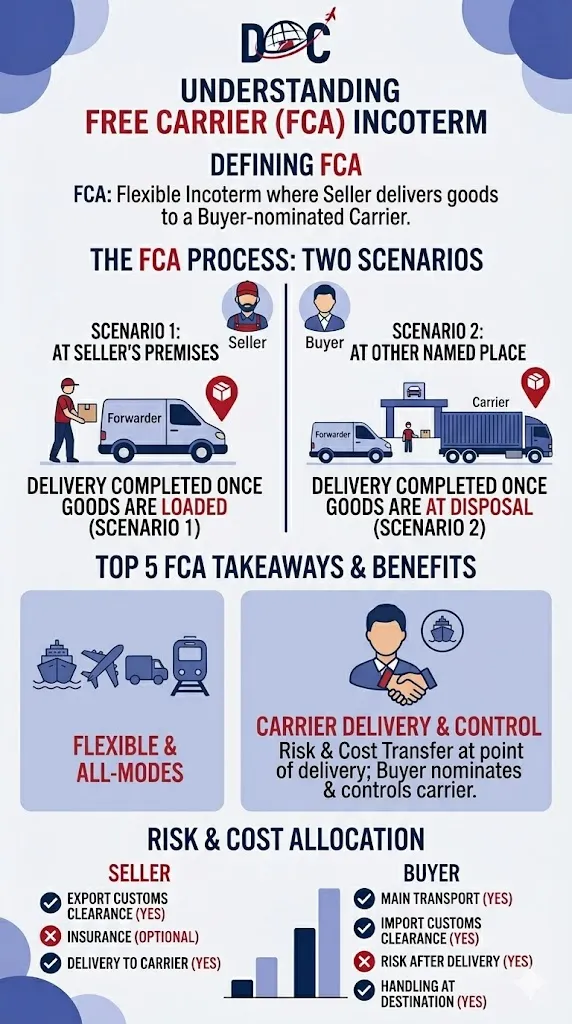
- Reduced seller obligations: no responsibility for main carriage costs or insurance
Understanding FCA: Mechanisms & Responsibilities
FCA operates through two distinct scenarios that fundamentally affect loading responsibilities. When delivery occurs at the seller’s premises, the seller must load goods onto the buyer’s vehicle. When delivery happens at another named place (terminal, warehouse, forwarder’s facility), the seller only needs to make goods available for unloading.
The export clearance obligation remains entirely with the seller. This includes obtaining licenses, certificates of origin, phytosanitary certificates, and completing customs formalities. According to ICC Incoterms 2020 guidelines, sellers must provide proof of delivery to demonstrate they fulfilled their obligations.
Cost allocation divides precisely at the carrier handover point. The seller covers inland transport to the named place, packaging suitable for international transport, and all pre-shipment inspection costs if required by the export country. The buyer assumes all subsequent costs: main carriage, import duties, destination handling, and onward transportation.
Insurance presents a critical consideration under FCA. Neither party has a mandatory obligation to insure goods. The risk transfer mechanism creates a protection gap: once goods leave the seller’s control, the buyer bears risk but may not yet have arranged coverage. At DocShipper, we systematically advise clients to implement immediate insurance activation aligned with the carrier pickup timestamp.
Documentation requirements under FCA include the commercial invoice, packing list, export license, and transport document. The seller must provide proof of delivery (carrier’s receipt, forwarder’s certificate of receipt) showing goods were handed over at the agreed location. This document becomes crucial for payment release under letters of credit, where banks verify compliance with contractual terms.
Practical Examples & Case Studies
Understanding FCA becomes clearer through concrete scenarios that illustrate its application across different transport modes and commercial contexts.
Case Study 1: Electronics Manufacturing
A German electronics manufacturer sells components to a Brazilian importer under FCA Hamburg Terminal. The seller delivers goods to the container freight station, where the buyer’s freight forwarder takes custody. The seller’s costs end at terminal delivery, totaling €2,400 (inland transport €800, packaging €600, export clearance €1,000). The buyer then pays €15,600 for ocean freight, €3,200 for Brazilian import duties, and €1,800 for inland delivery to São Paulo.
Case Study 2: Agricultural Products
A Spanish olive oil producer ships to Japan using FCA seller’s warehouse in Seville. Because delivery occurs at the seller’s premises, the seller loads containers onto the buyer’s contracted trucking company. Loading costs €450 are borne by the seller, whereas if FCA had specified the port of Valencia, the buyer would handle unloading. This €450 difference significantly impacts pricing negotiations.
Comparative Analysis: FCA vs. Alternative Incoterms
| Aspect | FCA | FOB | EXW |
|---|---|---|---|
| Transport modes | All modes | Sea/inland waterway only | All modes |
| Export clearance | Seller | Seller | Buyer |
| Loading at origin | Depends on location | Seller loads on vessel | Buyer responsibility |
| Risk transfer point | Carrier handover | Goods pass ship’s rail | Seller’s premises |
| Seller’s obligations | Moderate | Higher | Minimal |
Data Insight: FCA Usage Trends
According to ICC surveys, FCA accounts for approximately 28% of international trade transactions, second only to FOB in popularity. Its adoption has increased 15% since 2010, driven by containerization growth and multimodal transport development. Industries with highest FCA usage include automotive components (42%), electronics (38%), and machinery (35%).
Critical Success Factors
- Precise location designation: “FCA seller’s warehouse” differs significantly from “FCA port terminal”
- Carrier coordination: buyer must provide carrier details with sufficient advance notice
- Documentation timing: proof of delivery must align with payment terms
- Insurance activation: coverage should commence at handover moment, not later
- Loading equipment: clarify whether seller’s or buyer’s equipment loads containers
Conclusion
Free Carrier (FCA) provides a balanced, flexible framework for international trade, clarifying obligations while accommodating modern logistics realities. Its transport-neutral design and clear risk transfer mechanism make it ideal for transactions involving freight forwarders, consolidators, or multimodal transport.
Need expert guidance on implementing FCA terms in your supply chain? Contact DocShipper for customized logistics solutions that optimize your international shipping strategy.
📚 Quiz
Test Your Knowledge: Free Carrier (FCA)
Under FCA terms, when does risk transfer from seller to buyer?
Who is responsible for loading goods onto the buyer's vehicle when FCA delivery occurs at the seller's warehouse?
A German exporter ships electronics to Brazil using FCA Hamburg Terminal. The container is damaged during ocean transit. Who bears the loss?
🎯 Your Result
📞 Free Quote in 24hFAQ | Free Carrier (FCA): Definition, Applications & Practical Examples
FCA applies to all transport modes and transfers risk when goods are handed to the carrier, while FOB is exclusively for sea transport with risk transferring when goods pass the ship's rail. FCA is more appropriate for containerized cargo, as containers are typically handed to carriers at inland terminals before vessel loading.
It depends on the delivery location. If FCA specifies the seller's premises, the seller must load goods onto the buyer's vehicle. If FCA names another location (terminal, warehouse), the seller only makes goods available; the buyer handles unloading from the seller's vehicle. This distinction significantly impacts cost allocation.
No. Under FCA, neither seller nor buyer has a mandatory insurance obligation according to Incoterms rules. However, buyers should arrange coverage immediately, as risk transfers at carrier handover. The insurance gap between seller's delivery and buyer's policy activation creates vulnerability that requires careful contract management.
Absolutely. FCA is ideal for air freight because it accommodates delivery to airline cargo facilities or freight forwarder warehouses. The seller delivers goods to the air cargo terminal, clears export formalities, and risk transfers when the carrier accepts custody. This is far more practical than FOB, which doesn't apply to air transport.
The seller must provide documentation proving goods were handed to the carrier at the agreed location. This typically includes a carrier's receipt, forwarder's certificate of receipt, or warehouse receipt showing date, time, and condition of goods. For letter of credit transactions, banks require this proof before releasing payment.
When FCA designates a container freight station (CFS), the seller delivers unpacked goods to the CFS where they're consolidated with other shipments. The seller's responsibility ends at CFS delivery after export clearance. The buyer arranges and pays for containerization, main carriage, and all subsequent costs.
The seller must notify the buyer when goods are ready for collection. If the carrier fails to appear, the seller's obligations are fulfilled once goods are appropriately identified and available. The buyer bears additional storage costs and risks after the agreed delivery date, though specific contract terms should address such delays.
Yes, FCA works excellently for LCL shipments. The seller delivers goods to the consolidation warehouse or freight forwarder's facility, where they're combined with other cargo. This arrangement clearly delineates responsibilities: the seller handles delivery and export clearance, while the buyer manages consolidation costs and onward transport.
The seller must complete all export formalities, including obtaining export licenses, preparing customs declarations, paying export duties (if any), and securing required certificates. The seller provides the buyer with all export documentation needed for import clearance. This obligation distinguishes FCA from EXW, where the buyer handles export procedures.
No. FCA requires one specific, clearly defined delivery location. Ambiguity creates disputes about when risk transfers and who bears loading costs. The contract must state either a precise address (seller's warehouse) or a designated facility (Hamburg Container Terminal, Gate 5). Vague terms like "seller's city" are insufficient.
The buyer must give the seller timely instructions about the carrier's identity, pickup timing, and any special handling requirements. For export clearance purposes, the buyer may need to provide import licenses or certificates if required by the destination country. Adequate advance notice ensures smooth handover coordination.
Under FCA, the transport document presented to banks is typically a forwarder's cargo receipt or carrier's receipt, not a bill of lading. Banks verify that the document shows goods were delivered to the carrier at the named location. The credit terms must explicitly specify acceptable proof of delivery, as traditional shipping documents may not apply.
Need Help with
Logistics or Sourcing ?
First, we secure the right products from the right suppliers at the right price by managing the sourcing process from start to finish. Then, we simplify your shipping experience - from pickup to final delivery - ensuring any product, anywhere, is delivered at highly competitive prices.


Fill the Form
Prefer email? Send us your inquiry, and we’ll get back to you as soon as possible.
Contact us




:%20Definition,%20Applications%20&%20Practical%20Examples)