


In short ⚡
A Free Port is a designated zone where goods can be landed, stored, handled, manufactured, and re-exported without customs intervention or duties, provided they remain within the zone boundaries. Operating under special fiscal and regulatory frameworks, free ports eliminate import tariffs and VAT on merchandise that doesn't enter the domestic market, facilitating international trade flows and value-added operations.
Introduction
Many importers misunderstand free ports as simply tax-free shopping destinations. In reality, these specialized zones function as strategic logistics hubs where global trade operations bypass traditional customs procedures entirely.
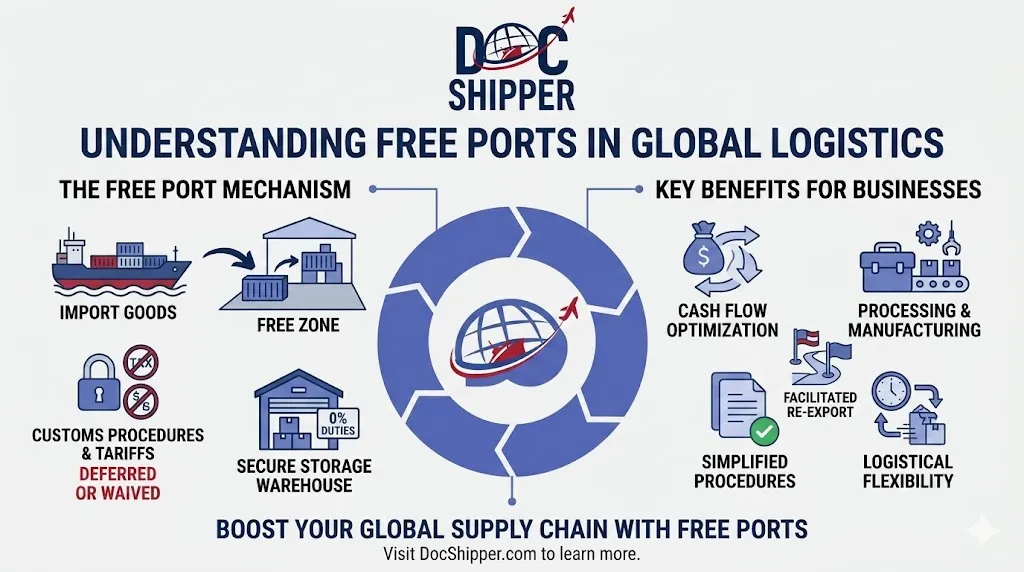
Free ports represent critical infrastructure in international supply chains. They enable businesses to defer, reduce, or eliminate duties while conducting manufacturing, repackaging, quality control, and distribution activities. Unlike standard customs warehouses, free ports offer comprehensive operational freedom within their boundaries.
- Duty suspension: No import taxes until goods enter the domestic market
- Manufacturing capabilities: Value-added processing without customs clearance
- Indefinite storage: No time limits on warehousing (in most jurisdictions)
- Re-export flexibility: Simplified procedures for international redistribution
- Regulatory advantages: Streamlined documentation and reduced bureaucracy
Legal Framework & Operational Mechanisms
Free ports operate under specific legal frameworks that vary by jurisdiction but share common principles. The Revised Kyoto Convention establishes international standards for these zones, defining them as parts of a country’s territory where imported goods are generally regarded as outside customs territory.
Customs supervision in free ports focuses on zone perimeter control rather than individual transactions. Goods entering the zone are recorded but not classified for duty purposes. This distinction enables companies to postpone final customs decisions until commercial certainty exists about the goods’ ultimate destination.
The fiscal neutrality principle governs free port operations. Since goods technically remain “outside” the country for customs purposes, they avoid VAT, excise duties, and import tariffs. This creates significant cash flow advantages for businesses managing international inventories. At DocShipper, we help clients structure their supply chains to maximize these fiscal benefits while ensuring full regulatory compliance.
Permitted activities within free ports extend far beyond simple storage. Most jurisdictions authorize manufacturing, assembly, blending, quality testing, labeling, packaging, and exhibition. Some advanced free ports even permit retail sales to international travelers, creating unique commercial opportunities.
The record-keeping requirements remain stringent despite operational flexibility. Zone operators must maintain detailed inventories tracking each consignment’s origin, quantity, value, and disposition. These records enable customs authorities to verify that goods either exit the zone for export or undergo proper clearance before domestic release.
Global Examples & Economic Impact
Free ports generate substantial economic value worldwide. According to World Bank data, free zones handle approximately 30% of global merchandise trade, demonstrating their centrality to international commerce.
| Free Port | Location | Primary Function | Annual Trade Volume |
|---|---|---|---|
| Singapore Free Trade Zone | Singapore | Electronics & petroleum redistribution | $600+ billion |
| Jebel Ali Free Zone | Dubai, UAE | Regional distribution hub | $88 billion |
| Hong Kong Free Port | Hong Kong | General cargo & transshipment | $550 billion |
| Geneva Freeport | Switzerland | Art & precious goods storage | $100+ billion (estimated value) |
Case Study: Electronics Manufacturing
A European electronics company imports semiconductor components from Asia worth €5 million annually. By utilizing Singapore’s free port, they achieve three advantages: components remain duty-free during the 45-day quality testing period, finished products destined for African markets never trigger European VAT, and only units sold domestically undergo customs clearance. This structure saves approximately €850,000 annually in deferred duties and eliminated VAT on re-exports.
Free ports also serve specialized markets. Geneva Freeport houses fine art, wine, and precious metals valued at over $100 billion. The facility’s climate-controlled vaults and customs-free status make it the world’s premier storage location for valuable collectibles. Owners avoid import taxes while maintaining liquidity through international sales, all within legal frameworks.
Recent developments include digital free ports in jurisdictions like Estonia, where virtual zones facilitate data-driven services and intellectual property transactions without physical goods movement. These innovations extend free port principles to the digital economy.
Conclusion
Free ports remain essential infrastructure for businesses engaged in international trade, offering fiscal optimization, operational flexibility, and strategic positioning. Understanding their mechanisms enables companies to structure efficient, compliant global supply chains.
Need guidance on leveraging free port advantages for your import-export operations? Contact DocShipper for expert consultation on customs strategy and logistics optimization.
📚 Quiz
Test Your Knowledge: Free Port
What is the primary definition of a Free Port?
A company imports €5M of components into a free port for quality testing before re-exporting to third markets. Which fiscal advantage applies?
Your electronics firm wants to assemble imported components in a free port before distributing finished products globally. Which scenario is correct?
🎯 Your Result
📞 Free Quote in 24hFAQ | Free Port: Definition, Functions & Concrete Examples
While often used interchangeably, free ports typically cover entire port areas including maritime facilities, whereas free trade zones may be inland locations. Both offer duty suspension, but free ports emphasize maritime logistics and transshipment operations. The legal framework and permitted activities remain substantially similar across both zone types.
Generally no. Goods must undergo customs clearance before domestic sale. However, some free ports permit retail sales to international travelers departing the country (duty-free shops), and business-to-business transactions between zone operators don't trigger customs procedures if products remain within the zone or exit for export.
Most jurisdictions impose no time limits, allowing indefinite storage provided goods comply with safety regulations and operators maintain current accounts. This contrasts with temporary admission procedures or customs warehouses, which typically require clearance or re-export within specific timeframes (often 6-24 months).
Yes, increasingly so. Following FATF recommendations, many countries now require free port operators to implement Know Your Customer (KYC) protocols, report suspicious transactions, and maintain transparent ownership records. Geneva Freeport, for example, implemented stringent transparency measures in 2016 after regulatory scrutiny.
Permitted activities vary by jurisdiction but typically include assembly, processing, refining, blending, packaging, quality control, labeling, and light manufacturing. Heavy industrial operations requiring environmental permits may face restrictions. Some advanced free ports authorize pharmaceutical compounding and electronics fabrication under controlled conditions.
No. While goods entering the zone avoid immediate classification and duty assessment, operators must file entry declarations, maintain inventory records, and document all movements. When goods leave for domestic consumption, standard customs clearance procedures apply with full documentation requirements.
Yes, though minimum volume requirements exist in many zones. Some free ports offer shared warehousing services allowing smaller importers to benefit from duty deferral without leasing entire facilities. Service providers like DocShipper can consolidate shipments to meet threshold requirements for SME clients.
Manufacturing within free ports can confer origin status if substantial transformation occurs and local content thresholds are met. Rules of origin under trade agreements apply identically inside and outside zones. However, simple repackaging or labeling typically doesn't alter origin, affecting preferential tariff eligibility.
Free ports implement physical perimeter security, electronic surveillance, controlled access points, and cargo tracking systems. They must comply with international security standards including the WCO SAFE Framework and, for air cargo facilities, ICAO Annex 17 requirements. Regular customs audits verify compliance with security protocols.
Yes, provided facilities offer appropriate cold chain infrastructure. Many modern free ports include temperature-controlled zones for pharmaceuticals, fresh produce, and frozen seafood. However, products subject to sanitary inspections may require phytosanitary or health certifications before zone entry, depending on local regulations.
The UK established eight new freeports in 2021 post-Brexit, offering enhanced tax reliefs unavailable under EU state aid rules. EU member states retain existing free zones but must comply with customs union regulations. These diverging approaches create new arbitrage opportunities for businesses structuring UK-EU supply chains strategically.
Standard marine cargo insurance typically covers goods during free port storage, but policies should explicitly include warehouse-to-warehouse clauses. High-value goods may require all-risk coverage with specific endorsements for extended storage periods. Operators' liability insurance usually covers facility damage but not cargo value, making comprehensive coverage essential.
Need Help with
Logistics or Sourcing ?
First, we secure the right products from the right suppliers at the right price by managing the sourcing process from start to finish. Then, we simplify your shipping experience - from pickup to final delivery - ensuring any product, anywhere, is delivered at highly competitive prices.


Fill the Form
Prefer email? Send us your inquiry, and we’ll get back to you as soon as possible.
Contact us




