


In short ⚡
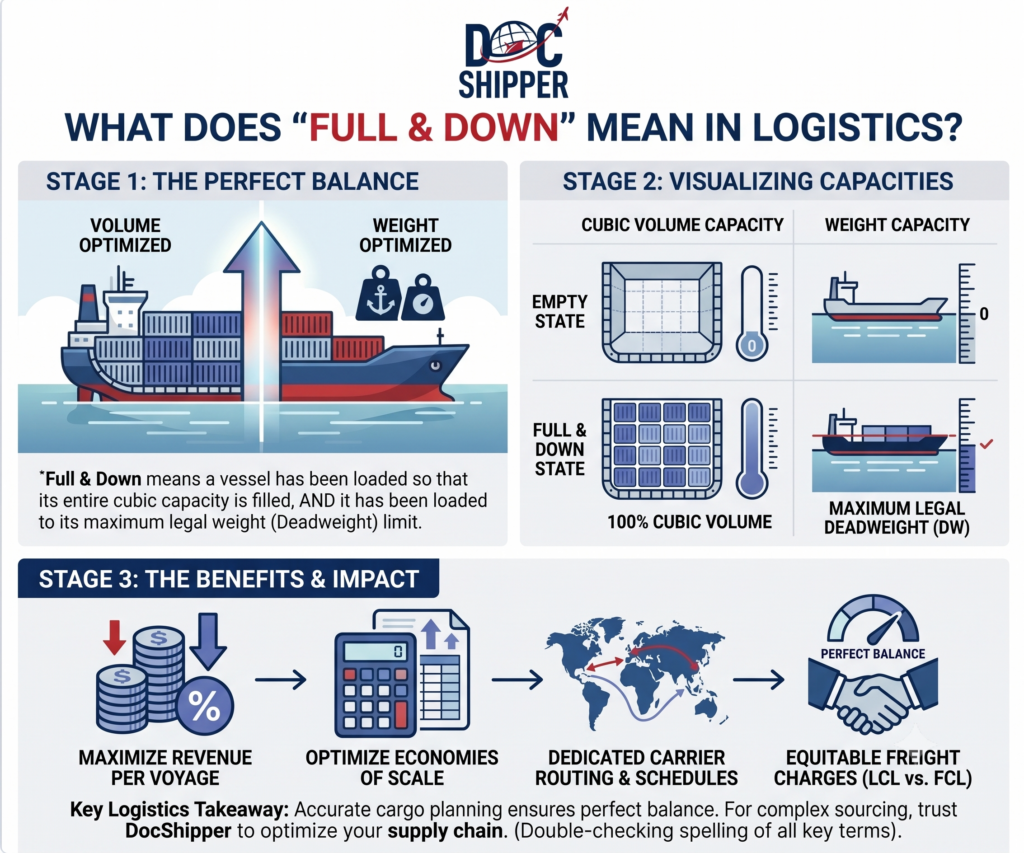
Full and Down is a container shipping term indicating that a shipment occupies the entire container volume while simultaneously reaching the maximum weight limit. This optimal scenario maximizes cost-efficiency by fully utilizing both dimensional capacity and weight allowance, representing the ideal balance in container load planning.Introduction
Many importers and exporters struggle to maximize their shipping investments, often paying for unused container space or leaving weight capacity untapped. Understanding the Full and Down concept is crucial for optimizing freight costs in international logistics.
In container shipping, you face two primary constraints: volumetric capacity (measured in cubic meters or feet) and maximum gross weight (typically 24-28 tons for standard containers). Achieving Full and Down status means you’ve perfectly balanced both parameters, eliminating wasted resources.
Key characteristics of Full and Down shipments include:
- Complete volume utilization – the container is filled to near 100% capacity
- Maximum weight reached – cargo approaches or meets the container’s gross weight limit
- Optimal cost-per-unit ratio – freight expenses are distributed across maximum cargo quantity
- Strategic cargo selection – requires careful mixing of high-density and low-density goods
- Enhanced shipping efficiency – reduces environmental impact per ton shipped
Technical Implications & Container Optimization
Achieving Full and Down status requires understanding payload capacity calculations and the relationship between cargo density and container constraints. Standard 20-foot containers (TEU) have approximately 33 cubic meters of volume with a maximum gross weight of 24,000 kg, while 40-foot containers (FEU) offer 67 cubic meters with similar weight restrictions.
The challenge lies in the container tare weight – the empty container itself weighs 2,200-4,000 kg depending on type. This means your actual payload capacity ranges from 20,000-22,000 kg for standard units. According to International Institute of Container Lessors, proper weight distribution is critical for road transport compliance and vessel stability.
Density becomes the determining factor. Cargo with high stowage factor (low density items like furniture or textiles) fills volume before reaching weight limits – leaving you “full but not down.” Conversely, dense cargo like machinery or metals reaches weight limits with significant empty space remaining – making you “down but not full.”
The optimal cargo density for achieving Full and Down in a standard 20-foot container is approximately 600-700 kg/m³. This sweet spot ensures simultaneous utilization of both constraints. At DocShipper, we systematically analyze cargo density during load planning to maximize container efficiency and reduce our clients’ per-unit shipping costs.
Advanced consolidation strategies include mixed-density loading, where heavy items are strategically combined with lighter goods. This technique requires expertise in weight distribution regulations and cargo compatibility, ensuring compliance with IMO container packing guidelines while achieving maximum efficiency.
Calculation Methods & Practical Examples
Understanding Full and Down requires mastering the volumetric weight calculation and comparing it against actual weight. The fundamental formula determines whether your shipment is volume-limited or weight-limited.
Case Study 1: Textile Import (Volume-Limited)
An importer ships cotton garments in a 40-foot container:
- Container internal volume: 67 m³
- Cargo volume occupied: 65 m³ (97% utilization)
- Total cargo weight: 8,500 kg
- Container weight limit: 26,680 kg (gross) – 3,800 kg (tare) = 22,880 kg payload capacity
- Result: Full but NOT Down – using only 37% of weight capacity
Case Study 2: Machinery Export (Weight-Limited)
A manufacturer ships industrial equipment:
- Container internal volume: 33 m³ (20-foot)
- Cargo volume occupied: 18 m³ (55% utilization)
- Total cargo weight: 21,000 kg
- Container weight limit: 24,000 kg (gross) – 2,300 kg (tare) = 21,700 kg payload capacity
- Result: Down but NOT Full – using 97% weight but only 55% volume
Case Study 3: Optimized Mixed Load (Full and Down)
DocShipper consolidates multiple shipments strategically:
| Cargo Type | Volume (m³) | Weight (kg) | Density (kg/m³) |
|---|---|---|---|
| Electronic components | 8 m³ | 6,400 kg | 800 |
| Home textiles | 15 m³ | 6,000 kg | 400 |
| Auto parts (metal) | 9 m³ | 9,000 kg | 1,000 |
| TOTAL | 32 m³ (97%) | 21,400 kg (99%) | 669 average |
This consolidated shipment achieves Full and Down status by strategically combining cargo types with different densities. The average density of 669 kg/m³ perfectly balances volume and weight utilization in a standard 20-foot container.
The cost savings are substantial. When comparing three separate shipments versus one optimized Full and Down container, clients typically reduce freight costs by 35-50% while maintaining delivery efficiency.
Conclusion
Achieving Full and Down status represents the pinnacle of container shipping efficiency, requiring strategic cargo selection and expert load planning. This optimization directly impacts your bottom line by maximizing payload utilization across both volume and weight constraints.
Need assistance optimizing your container loads? Contact DocShipper for expert consolidation and logistics planning services.
📚 Quiz
Test Your Knowledge: Full and Down
What does "Full and Down" mean in container shipping?
A textile importer fills a 40-foot container to 97% volume capacity but only uses 37% of the weight limit. What is this situation called?
What is the optimal cargo density to achieve Full and Down status in a standard 20-foot container?
🎯 Your Result
📞 Free Quote in 24hFAQ | Full and Down: Definition, Calculation & Practical Examples
"Cube-out" means filling the container volume completely without reaching maximum weight (full but not down). Full and Down achieves both volume capacity and weight limit simultaneously, representing optimal efficiency. Cube-out scenarios are common with low-density cargo like packaging materials or furniture.
Divide the container's maximum payload weight by its internal volume. For a standard 20-foot container with 21,700 kg payload capacity and 33 m³ volume, the ideal density is approximately 658 kg/m³. This calculation helps determine which cargo types can achieve Full and Down status independently or if mixed loading is required.
Yes, but with greater difficulty. Refrigerated containers (reefers) have reduced internal volume due to insulation and cooling equipment, plus higher tare weight. The effective payload capacity is typically 20-25% lower than standard dry containers, requiring denser cargo or strategic product selection to achieve Full and Down loading.
Exceeding container weight limits violates maritime safety regulations and road transport laws. Overweight containers face rejection at ports, additional fees averaging $500-2,000, mandatory destuffing and reloading costs, and potential legal liability. Always verify the container's maximum gross weight (MGW) and safe working load (SWL) before loading.
Individual LCL shipments cannot achieve Full and Down status because they share container space with other shippers. However, freight forwarders consolidate multiple LCL shipments to create Full and Down containers, passing efficiency savings to customers through competitive LCL rates. This is why LCL pricing is volumetric-based rather than weight-based in most cases.
Proper weight distribution is critical even when achieving Full and Down. Regulations require balanced loading with 60% of weight in the front half for road transport. Uneven distribution causes container rejection, handling delays, and safety risks. Professional loading plans account for weight distribution while maintaining Full and Down efficiency.
Industries shipping medium-density goods like automotive parts (600-900 kg/m³), electronics packaging, canned foods, and consolidated retail products regularly achieve Full and Down. Extreme density industries (scrap metal, stone) or extremely light industries (polystyrene, balloons) rarely achieve this without strategic mixed loading.
High-cube containers offer 9.5 feet height versus 8.5 feet standard, providing 15% more volume with identical weight limits. This makes Full and Down harder to achieve with high-cubes unless cargo density is proportionally higher. Open-top, flat-rack, and specialized containers have unique volume-to-weight ratios requiring customized optimization strategies.
Palletized cargo typically uses 10-20% less volume due to pallet dimensions and stacking inefficiencies. Standard Euro pallets (1200x800mm) or American pallets (1200x1000mm) create gaps between container walls. Achieving Full and Down with palletized goods requires higher-density products or accepts slightly reduced volume utilization (90-95%) while maintaining maximum weight.
Optimized packaging directly impacts Full and Down potential. Excessive packaging reduces effective cargo density, while inadequate packaging risks damage requiring protective void-fill that wastes volume. Custom packaging designed for container dimensions (containerization) improves cube utilization by 15-25%, making Full and Down achievable with lower-density products.
The SOLAS VGM (Verified Gross Mass) requirement mandates accurate container weight certification before vessel loading. Full and Down shipments operating near maximum weight limits require precise weighing methods—either weighing the packed container or calculating from individual item weights. VGM compliance prevents overweight penalties while confirming true Full and Down achievement.
Properly executed Full and Down loading typically doesn't increase insurance costs, as it demonstrates professional cargo handling. However, improper weight distribution or exceeding limits while attempting Full and Down optimization can void coverage. Insurance providers may require detailed packing lists and load plans for high-value shipments claiming Full and Down efficiency.
Need Help with
Logistics or Sourcing ?
First, we secure the right products from the right suppliers at the right price by managing the sourcing process from start to finish. Then, we simplify your shipping experience - from pickup to final delivery - ensuring any product, anywhere, is delivered at highly competitive prices.


Fill the Form
Prefer email? Send us your inquiry, and we’ll get back to you as soon as possible.
Contact us




