


In short ⚡
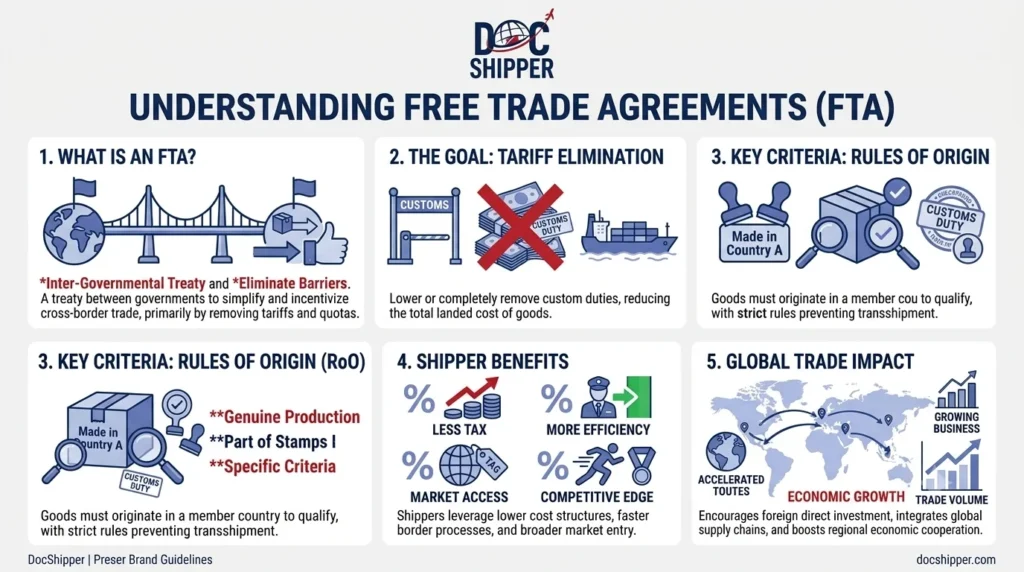
A Free Trade Agreement (FTA) is a bilateral or multilateral treaty between countries that eliminates or significantly reduces tariffs, quotas, and trade barriers on goods and services exchanged between signatory nations. FTAs facilitate cross-border commerce, enhance competitive advantages, and create preferential access to international markets for businesses engaged in import-export operations.
Introduction
Many businesses struggle to understand why identical products face drastically different duty rates when imported from different countries. This confusion stems from the complex network of Free Trade Agreements that govern modern international commerce.
FTAs represent critical instruments in global trade policy, directly impacting pricing strategies, supply chain decisions, and market competitiveness. For companies engaged in international logistics, understanding FTA frameworks is essential to optimizing landed costs and maintaining regulatory compliance.
Key characteristics of Free Trade Agreements include:
- Tariff elimination or reduction on qualifying goods between member countries
- Rules of Origin requirements to verify product eligibility for preferential treatment
- Streamlined customs procedures to accelerate clearance processes
- Intellectual property protections and investment safeguards
- Dispute resolution mechanisms for trade-related conflicts
FTA Mechanisms & Strategic Implications
Free Trade Agreements operate through legally binding provisions that modify standard customs treatment. The most significant component is the tariff schedule, which specifies duty reduction timelines for each product category classified under the Harmonized System (HS) codes.
To qualify for FTA benefits, importers must demonstrate compliance with Rules of Origin (ROO). These regulations determine whether products have undergone sufficient transformation within member territories. Common ROO criteria include change in tariff classification, regional value content thresholds, or specific manufacturing processes. The World Trade Organization provides comprehensive frameworks governing these principles.
Documentation requirements form another critical dimension. Importers typically need Certificates of Origin, commercial invoices with FTA declarations, and detailed supply chain records. Non-compliance or incorrect certification can result in retroactive duty assessments, penalties, or shipment delays.
Beyond tariff benefits, FTAs often include trade facilitation provisions that modernize customs procedures. These may encompass pre-arrival processing, risk-based inspections, and expedited release mechanisms for authorized economic operators.
At DocShipper, we systematically verify FTA eligibility for client shipments, ensuring proper documentation and maximum duty savings. Our compliance team analyzes product classifications against applicable agreements to identify optimal preferential treatment pathways.
Strategic considerations extend to supply chain design. Companies frequently restructure manufacturing footprints or sourcing strategies to maximize FTA advantages. This involves assessing cumulation rules, which allow materials from multiple member countries to count toward origin thresholds.
Practical Examples & Trade Data
The practical impact of FTAs becomes clear through concrete scenarios. Consider the USMCA (United States-Mexico-Canada Agreement), which replaced NAFTA in 2020. This agreement eliminated tariffs on virtually all goods traded between the three nations, provided they meet origin requirements.
Use Case: Automotive Manufacturing
A Canadian automotive parts manufacturer exports brake assemblies to the United States. Under USMCA, these components qualify for duty-free entry if 75% of their value originates from North American sources. Without the agreement, the standard MFN (Most Favored Nation) duty rate would be 2.5%, adding significant costs to competitiveness.
Comparative data illustrates FTA impact across major agreements:
| Agreement | Member Countries | Tariff Elimination | Trade Volume (2023) |
|---|---|---|---|
| USMCA | USA, Canada, Mexico | 99.8% of tariff lines | $1.5 trillion |
| EU-Japan EPA | EU 27 + Japan | 97% of EU tariffs removed | €180 billion |
| CPTPP | 11 Pacific nations | 95% immediate elimination | $500 billion |
| AfCFTA | 54 African countries | 90% over 10 years | $3.4 trillion potential |
The EU-South Korea FTA demonstrates measurable economic effects. Since implementation in 2011, bilateral trade increased by over 50%, with EU exports to Korea rising from €30 billion to €47 billion annually. Industrial machinery and automotive sectors experienced the most significant growth.
Key operational considerations for FTA utilization include:
- HS code precision – Incorrect classification voids preferential treatment
- Documentary compliance – Certificates must match shipment specifications exactly
- Audit preparedness – Customs authorities can request verification years after import
- Agreement-specific rules – Each FTA has unique origin calculation methods
- Cumulation opportunities – Diagonal or full cumulation can enhance qualification
For textile imports from Vietnam to the EU under the EVFTA, products must contain at least 42.5% Vietnamese or EU value content. This threshold requires detailed cost tracking throughout production. At DocShipper, we assist clients in establishing robust origin documentation systems to substantiate FTA claims during customs audits.
Conclusion
Free Trade Agreements fundamentally reshape competitive dynamics in international commerce by eliminating cost barriers and enhancing market access. Effective FTA utilization requires meticulous compliance management, strategic supply chain planning, and continuous monitoring of evolving trade regulations.
Need expert guidance on leveraging FTA benefits for your shipments? Contact DocShipper for comprehensive trade compliance support.
📚 Quiz
Test Your Knowledge: Free Trade Agreement (FTA)
What is the primary defining characteristic of a Free Trade Agreement?
A company imports textiles from Vietnam to the EU under the EVFTA. What is a common misconception about qualifying for FTA benefits?
Your logistics manager wants to claim preferential duty rates under both an FTA and the Generalized System of Preferences (GSP) for the same shipment. Which statement correctly describes this scenario?
🎯 Your Result
📞 Free Quote in 24hFAQ | FTA (Free Trade Agreement): Definition, Benefits & Practical Examples
A Free Trade Agreement eliminates tariffs between member countries but allows each nation to maintain independent external tariff policies with non-members. A customs union goes further by establishing a common external tariff for all members. The EU represents a customs union, while USMCA is an FTA where the US, Canada, and Mexico maintain separate trade policies with third countries.
Most customs authorities allow retroactive claims within specific timeframes, typically one to three years from the import date. Importers must provide valid Certificates of Origin and demonstrate the goods qualified under the relevant FTA at the time of entry. The refund process requires filing formal amendment requests with supporting documentation. Success rates vary depending on documentation quality and customs authority policies.
No. Most FTAs exclude or phase in tariff reductions for sensitive sectors. Agricultural products, textiles, and automotive goods often face longer elimination schedules or quota restrictions. Additionally, products must meet Rules of Origin criteria, which vary by agreement. Some items on "negative lists" remain explicitly excluded from preferential treatment to protect domestic industries.
Applicability depends on three factors: the product's country of origin, the destination country, and whether an FTA exists between them. Importers should consult their destination country's customs authority website for active agreements. Products must genuinely originate from FTA member territories according to specific Rules of Origin, not merely be shipped through them.
Cumulation allows materials from multiple FTA member countries to count toward origin requirements. Bilateral cumulation permits inputs from two agreement parties. Diagonal cumulation extends this to shared FTA networks, such as the Pan-Euro-Mediterranean system. Full cumulation counts all processing stages across member countries. These provisions help manufacturers meet origin thresholds when using multi-country supply chains.
Modern comprehensive FTAs include services chapters covering sectors like telecommunications, finance, professional services, and logistics. These provisions address market access, national treatment, and regulatory transparency. However, service liberalization typically involves fewer binding commitments than goods trade. Restrictions often remain for sensitive sectors like healthcare, education, and government procurement.
Implementation timelines vary significantly. Some agreements provide immediate tariff elimination upon entry into force, while others employ phase-out schedules spanning 5 to 20 years depending on product sensitivity. Countries must complete domestic ratification processes before agreements become effective. Recent examples include the EU-UK Trade Cooperation Agreement (effective January 2021) and RCEP (phased implementation starting January 2022).
Consequences include retroactive duty assessments with interest, financial penalties typically ranging from 10% to 40% of evaded duties, shipment seizures, and potential criminal prosecution for deliberate fraud. Customs authorities increasingly employ post-clearance audits and data analytics to detect non-compliance. Repeat violators may lose trusted trader status, resulting in increased inspection rates and processing delays.
Generally, importers must choose between FTA preferential rates and other programs like GSP (Generalized System of Preferences) or duty drawback schemes. Most customs frameworks prohibit "double-dipping" to prevent excessive preference stacking. However, FTA benefits can often be used alongside trade facilitation programs like AEO (Authorized Economic Operator) status, which expedite clearance without affecting duty calculations.
The UK's EU exit required negotiating replacement agreements to maintain preferential access. Approximately 70 continuity agreements replicated EU FTA terms with third countries. Geopolitical tensions can suspend or renegotiate FTAs, as seen with USMCA replacing NAFTA. Businesses must monitor governmental trade policy announcements and maintain flexible sourcing strategies to adapt to changing preferential landscapes.
Essential records include Certificates of Origin, commercial invoices with FTA declarations, supplier certifications, production records, and cost breakdowns demonstrating origin qualification. Documentation retention periods typically range from 3 to 5 years. Digital record-keeping systems facilitate audit responses. Importers should maintain clear trails linking certificates to specific shipments and underlying manufacturing data supporting origin calculations.
Contemporary FTAs typically include comprehensive IP chapters addressing patents, trademarks, copyrights, trade secrets, and geographical indications. These provisions establish minimum protection standards, enforcement mechanisms, and dispute resolution procedures. The USMCA and CPTPP contain particularly robust IP frameworks requiring member countries to adopt specific legislation. However, enforcement effectiveness varies significantly across jurisdictions despite treaty commitments.
Need Help with
Logistics or Sourcing ?
First, we secure the right products from the right suppliers at the right price by managing the sourcing process from start to finish. Then, we simplify your shipping experience - from pickup to final delivery - ensuring any product, anywhere, is delivered at highly competitive prices.


Fill the Form
Prefer email? Send us your inquiry, and we’ll get back to you as soon as possible.
Contact us




:%20Definition,%20Benefits%20&%20Practical%20Examples)