


In short ⚡
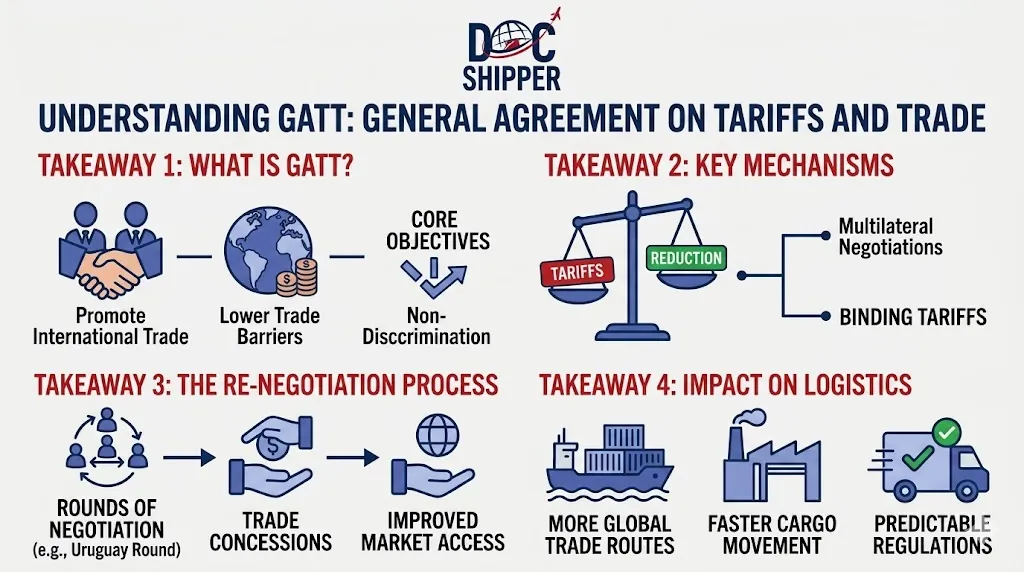
The GATT (General Agreement on Tariffs and Trade) is a multilateral treaty established in 1947 to promote international trade by reducing tariffs, quotas, and discriminatory barriers between member nations. Operating until 1995 when it was succeeded by the WTO, GATT created a rules-based framework that transformed global commerce through eight negotiation rounds, establishing principles like Most-Favored-Nation (MFN) treatment and national treatment that remain fundamental to modern trade law.Introduction
Many importers and exporters today benefit from reduced tariffs and standardized customs procedures without realizing these advantages stem from decades of GATT negotiations. This treaty fundamentally reshaped international commerce after World War II, establishing the legal architecture that underpins modern global supply chains.
Understanding GATT remains essential for logistics professionals because its principles continue governing trade disputes, tariff structures, and preferential agreements. While the World Trade Organization (WTO) replaced GATT institutionally in 1995, the original agreement’s framework still influences how nations negotiate trade terms and resolve commercial conflicts.
Key characteristics of GATT include:
- Tariff reduction commitment – Members agreed to progressively lower customs duties through successive negotiation rounds
- Most-Favored-Nation (MFN) principle – Trade advantages granted to one country must extend to all GATT members equally
- National treatment obligation – Imported goods receive the same regulatory treatment as domestic products after clearing customs
- Prohibition of quantitative restrictions – Quotas and import bans were generally forbidden except under specific circumstances
- Multilateral negotiation framework – Eight major rounds (Geneva 1947 to Uruguay 1986-94) progressively liberalized global trade
GATT Mechanisms & Core Trade Principles
GATT operated through periodic negotiation rounds where member countries committed to specific tariff reductions in exchange for reciprocal market access. Unlike bilateral agreements, this multilateral approach created a unified system where concessions granted to one nation automatically applied to all members through the MFN clause.
The Most-Favored-Nation principle prevented discriminatory trade practices by requiring equal treatment. If Country A reduced tariffs on electronics from Country B to 5%, that same 5% rate had to apply to electronics from all GATT members. This mechanism accelerated global trade liberalization by multiplying the effect of bilateral negotiations across the entire membership.
GATT’s dispute settlement mechanism provided a structured process for resolving trade conflicts. When countries believed trading partners violated agreement terms, they could request consultations and, if unresolved, panel reviews. Though less binding than the current WTO system, this framework established precedent for international commercial arbitration. According to the WTO historical documentation, over 300 disputes were brought under GATT between 1948 and 1995.
The safeguard provisions allowed temporary protection measures when import surges threatened domestic industries. Article XIX permitted countries to suspend obligations or withdraw concessions if serious injury occurred, though compensation or retaliation rights balanced this flexibility. These escape clauses acknowledged that trade liberalization required adjustment mechanisms for affected sectors.
At DocShipper, we help clients navigate preferential tariff structures that evolved from GATT principles, ensuring compliance with origin rules and MFN requirements across international shipments. Our customs experts verify documentation matches the tariff classification systems standardized through GATT negotiations, preventing costly delays or penalty assessments.
Historical Impact & Trade Statistics
GATT’s impact on global commerce appears clearly in tariff reduction statistics. When the agreement launched in 1947, average tariffs on manufactured goods exceeded 40% in major economies. By the Uruguay Round’s conclusion in 1994, these rates had fallen to approximately 4% among developed nations—a reduction exceeding 90% over 47 years.
| Negotiation Round | Years | Participants | Key Achievement |
|---|---|---|---|
| Geneva Round | 1947 | 23 countries | 45,000 tariff concessions covering $10 billion in trade |
| Kennedy Round | 1964-67 | 62 countries | Average 35% tariff reduction on industrial products |
| Tokyo Round | 1973-79 | 102 countries | First agreements on non-tariff barriers (subsidies, licensing) |
| Uruguay Round | 1986-94 | 123 countries | Created WTO; expanded coverage to services and intellectual property |
Concrete Case Study: The textiles sector illustrates GATT’s complex implementation. Under the Multi-Fiber Arrangement (MFA), textile trade remained heavily restricted through quotas from 1974-2005 despite GATT’s prohibition on quantitative limits. This exception demonstrated how political pressures created carve-outs in the liberalization agenda, particularly for labor-intensive industries facing competitive pressure from developing nations.
European integration accelerated through GATT’s regional exception provisions. Article XXIV permitted customs unions and free trade areas that eliminated internal barriers while maintaining common external tariffs. This legal framework enabled the European Economic Community’s formation in 1957, which evolved into today’s European Union—the world’s largest single market.
Agricultural trade remained contentious throughout GATT’s existence. Developed countries maintained substantial subsidies and import barriers for farm products, creating trade distortions that disadvantaged agricultural exporters. By 1986, agricultural support in OECD countries exceeded $240 billion annually, demonstrating the limits of GATT’s liberalization in politically sensitive sectors.
The agreement’s transformation of customs valuation methods standardized import assessments worldwide. The Tokyo Round’s Customs Valuation Code established transaction value as the primary basis for duty calculation, replacing arbitrary systems that created uncertainty for importers. This harmonization reduced disputes and facilitated accurate costing for international shipments.
Conclusion
GATT established the foundational principles—non-discrimination, reciprocity, and transparency—that continue governing international trade through the WTO framework. Its progressive tariff reduction and dispute settlement mechanisms transformed global commerce from protectionist nationalism into rules-based cooperation.
Need expert guidance on tariff classifications or preferential trade agreement compliance? Contact DocShipper for comprehensive customs and logistics support across international markets.
📚 Quiz
Test Your Knowledge: GATT (General Agreement on Tariffs and Trade)
1. What was the primary purpose of GATT established in 1947?
2. Under the Most-Favored-Nation (MFN) principle, if Country A grants a tariff reduction to Country B, what must happen?
3. Your company imports electronics from multiple countries. Which GATT principle ensures that once your products clear customs, they receive the same regulatory treatment as domestically produced electronics?
🎯 Your Result
📞 Free Quote in 24hFAQ | GATT (General Agreement on Tariffs and Trade): Definition, Impact & Global Trade Examples
Need Help with
Logistics or Sourcing ?
First, we secure the right products from the right suppliers at the right price by managing the sourcing process from start to finish. Then, we simplify your shipping experience - from pickup to final delivery - ensuring any product, anywhere, is delivered at highly competitive prices.


Fill the Form
Prefer email? Send us your inquiry, and we’ll get back to you as soon as possible.
Contact us




:%20Definition,%20Impact%20&%20Global%20Trade%20Examples)