


In short ⚡
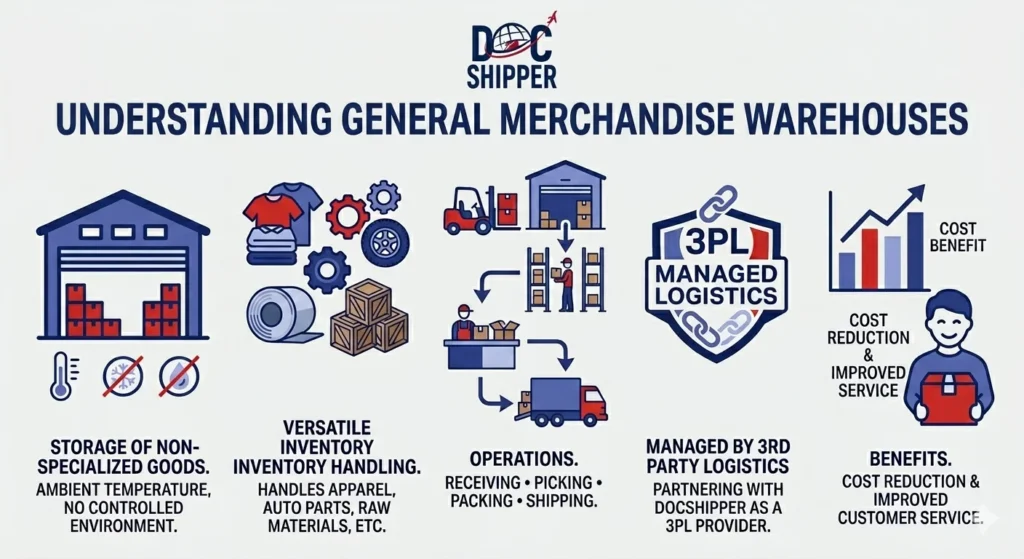
A General-Merchandise Warehouse is a versatile storage facility designed to handle a wide variety of goods across multiple product categories, from consumer electronics to textiles and household items. Unlike specialized warehouses, these facilities provide flexible storage solutions for diverse inventory types, making them essential for importers, distributors, and retailers managing mixed product portfolios in international trade.
Introduction
Many importers struggle to find storage solutions when their shipments contain mixed product types—electronics, apparel, food items, and industrial supplies all arriving simultaneously. Traditional specialized warehouses often reject such diverse cargo or charge premium fees for handling multiple categories.
General-merchandise warehouses solve this challenge by offering comprehensive storage capabilities under one roof. In global logistics, these facilities serve as critical distribution hubs that consolidate, store, and redistribute varied goods efficiently.
Key characteristics include:
- Multi-category storage capacity accommodating diverse product types simultaneously
- Flexible racking systems adaptable to different package sizes and weights
- Climate-controlled zones for temperature-sensitive goods alongside ambient storage
- Cross-docking capabilities enabling rapid product redistribution without long-term storage
- Value-added services including labeling, repackaging, and quality inspection
Warehouse Operations & Strategic Importance
General-merchandise warehouses operate on principles of maximum flexibility and operational efficiency. Unlike bonded warehouses or cold storage facilities with specialized requirements, these facilities maintain adaptable infrastructure to accommodate shifting inventory demands.
The operational framework typically includes zone-based storage systems where products are categorized by handling requirements rather than product type. Fast-moving consumer goods occupy pick-faces near shipping docks, while slower inventory moves to reserve locations. This dynamic allocation optimizes labor productivity and reduces order fulfillment times.
From a regulatory perspective, general-merchandise warehouses must comply with local zoning laws and safety standards that vary by jurisdiction. In the European Union, facilities must adhere to Directive 2006/42/EC on machinery safety, while U.S. operations follow OSHA regulations for warehouse safety.
Technology integration distinguishes modern facilities from traditional storage spaces. Warehouse Management Systems (WMS) track inventory in real-time, automate replenishment orders, and generate picking routes that minimize travel distance. Advanced facilities deploy robotics for palletizing and automated guided vehicles (AGVs) for internal transport.
The location strategy for these warehouses prioritizes proximity to transportation networks—ports, airports, rail terminals, and highway intersections. This positioning reduces drayage costs and accelerates delivery to final destinations. At DocShipper, we systematically evaluate warehouse proximity to customs clearance points when selecting storage partners, ensuring our clients avoid unnecessary detention charges and delays.
Practical Examples & Industry Data
Understanding general-merchandise warehouse economics requires examining real-world operational scenarios and current market conditions. Industry data reveals significant cost variations based on location, facility specifications, and service levels.
Comparative Cost Analysis
| Location | Storage Rate ($/pallet/month) | Handling Fee ($/pallet) | Typical Capacity |
|---|---|---|---|
| Los Angeles Port Area | $18-25 | $8-12 | 50,000-150,000 sq ft |
| Rotterdam Port (Netherlands) | €15-22 | €7-10 | 40,000-120,000 sq m |
| Shanghai Free Trade Zone | ¥120-180 | ¥60-90 | 30,000-100,000 sq m |
| Hamburg Logistics Hub | €14-20 | €6-9 | 35,000-90,000 sq m |
Use Case: E-Commerce Retailer Import Scenario
A mid-sized online retailer imports 15 containers monthly containing mixed merchandise—consumer electronics, apparel, home goods, and beauty products—from Asian manufacturers to a European distribution network.
Challenge: Products require different handling protocols. Electronics need static-free environments, cosmetics require temperature control, and apparel needs hanging storage. Specialized warehouses would necessitate splitting shipments across three facilities.
Solution: Utilizing a general-merchandise warehouse with multi-zone capabilities allowed consolidated storage. The facility provided climate-controlled sections for cosmetics (15-25°C), ESD-protected zones for electronics, and standard racking for apparel and home goods.
Results: Storage costs decreased by 32% compared to multi-facility approach. Inventory visibility improved through unified WMS access. Order fulfillment time reduced from 48 hours to 24 hours through cross-docking capabilities. Transportation costs dropped due to consolidated shipping from single location.
Industry Statistics
- General-merchandise warehouses account for approximately 65% of total warehouse space in North America (2024 CBRE Industrial & Logistics Report)
- Average storage density: 3,500-4,200 pallets per 100,000 sq ft depending on ceiling height and racking configuration
- Labor productivity benchmarks: 120-150 lines picked per hour in optimized facilities with WMS
- Inventory accuracy rates: 99.5%+ in facilities with barcode/RFID systems
- Average dwell time: 18-35 days for import cargo before distribution to retail channels
Conclusion
General-merchandise warehouses provide indispensable flexibility for importers managing diverse product portfolios, offering cost-effective consolidation and distribution capabilities that specialized facilities cannot match. Their strategic positioning within supply chains reduces complexity while maintaining operational efficiency.
Need expert guidance on warehouse selection and logistics optimization? Contact DocShipper for comprehensive warehousing and distribution solutions tailored to your import/export requirements.
📚 Quiz
Test Your Knowledge: General-Merchandise Warehouse
What is the primary defining characteristic of a general-merchandise warehouse?
A common misconception about general-merchandise warehouses is:
An e-commerce retailer imports 15 mixed containers monthly containing electronics, apparel, cosmetics, and home goods. Which storage approach is most cost-effective?
🎯 Your Result
📞 Free Personalized QuoteFAQ | General-Merchandise Warehouse: Definition, Operations & Practical Examples
General-merchandise warehouses handle diverse product categories simultaneously with flexible infrastructure, while specialized warehouses focus on specific goods requiring unique storage conditions—such as cold storage for perishables, bonded warehouses for duty-unpaid goods, or hazmat facilities for dangerous materials. General facilities prioritize versatility over specialization, making them ideal for mixed-inventory operations.
Public warehouses charge variable rates based on actual space and services used, typically $15-30 per pallet monthly plus handling fees. Private warehouses involve fixed costs—lease, utilities, labor—regardless of utilization, making them economical only when consistently operating above 70% capacity. Contract warehouses offer hybrid models with negotiated rates for dedicated space blocks.
Standard warehouse liability covers negligence-based claims but excludes inherent product defects, natural disasters, and theft in most jurisdictions. Importers should maintain cargo insurance throughout storage periods, verifying warehouse coverage limits and obtaining warehouse receipts documenting condition upon receipt. Many facilities require tenants to carry minimum $1-2 million liability coverage naming the warehouse as additional insured.
Some general-merchandise facilities hold customs bonded warehouse licenses allowing duty-deferred storage, but this isn't universal. Bonded status requires separate certification and compliance protocols. Importers needing duty deferral should specifically request bonded facilities when selecting warehouses, as this capability significantly impacts cash flow management for high-duty products.
Contemporary general-merchandise warehouses typically offer WMS with real-time inventory visibility, API integrations for e-commerce platforms, EDI compatibility for automated order transmission, and mobile picking applications. Advanced facilities provide IoT-enabled environmental monitoring, RFID tracking, and predictive analytics for demand forecasting. Integration capabilities directly impact operational transparency and order accuracy.
Proximity to ports reduces drayage costs by $150-400 per container. Access to multiple transportation modes—rail, highway, air—provides routing flexibility during capacity constraints. Local labor markets affect staffing costs and service reliability. Customs district locations may accelerate clearance processing. Free trade zones offer tax advantages for specific operations. Total landed cost analysis should evaluate all location-dependent variables.
Dedicated space becomes cost-effective when consistently occupying 5,000+ square feet or 200+ pallet positions monthly. Below these thresholds, shared public warehousing proves more economical. Break-even analysis should compare fixed dedicated costs against variable public rates, factoring in inventory turnover rates, seasonal fluctuations, and growth projections over 12-24 month horizons.
Reputable facilities conduct receiving inspections with photographic documentation, issuing warehouse receipts detailing quantities and condition. Discrepancy claims must typically be filed within 24-72 hours of discovery with supporting evidence. Damage claims follow warehouse liability terms, often capped at $0.50-2.00 per pound unless higher coverage is purchased. Immediate notification and documentation preservation are critical for successful claims.
Beyond basic storage, leading facilities offer kitting and assembly, retail compliance labeling, quality inspection, product photography, returns processing, and direct-to-consumer fulfillment. These services eliminate need for separate 3PL providers, reducing handling steps and associated costs. Importers should evaluate value-added capabilities against outsourcing alternatives when selecting warehouse partners.
Flexible contracts with tiered pricing accommodate seasonal volume changes—reduced rates for base capacity with premium charges for overflow. Some agreements include demand forecasting requirements 30-60 days advance to ensure capacity availability. Peak season surcharges (October-December for retail) may add 15-30% to standard rates. Long-term contracts often negotiate seasonal clauses protecting both parties.
ISO 9001 certification demonstrates quality management systems. C-TPAT (Customs-Trade Partnership Against Terrorism) certification indicates enhanced security protocols. LEED certification reflects environmental sustainability practices. Industry-specific certifications like AIB for food-grade facilities or TAPA for high-value goods indicate specialized compliance. Certification verification confirms operational standards alignment with import requirements.
Standard retrieval typically occurs within 4-24 hours depending on facility size and order complexity. Expedited services may reduce this to 2-4 hours at premium rates. Cross-docking operations enable same-day transfers without formal warehousing. Real-time WMS access allows remote inventory monitoring and order placement. Service level agreements should specify guaranteed retrieval timeframes for time-sensitive operations.
Need Help with
Logistics or Sourcing ?
First, we secure the right products from the right suppliers at the right price by managing the sourcing process from start to finish. Then, we simplify your shipping experience - from pickup to final delivery - ensuring any product, anywhere, is delivered at highly competitive prices.


Fill the Form
Prefer email? Send us your inquiry, and we’ll get back to you as soon as possible.
Contact us




