


In short ⚡
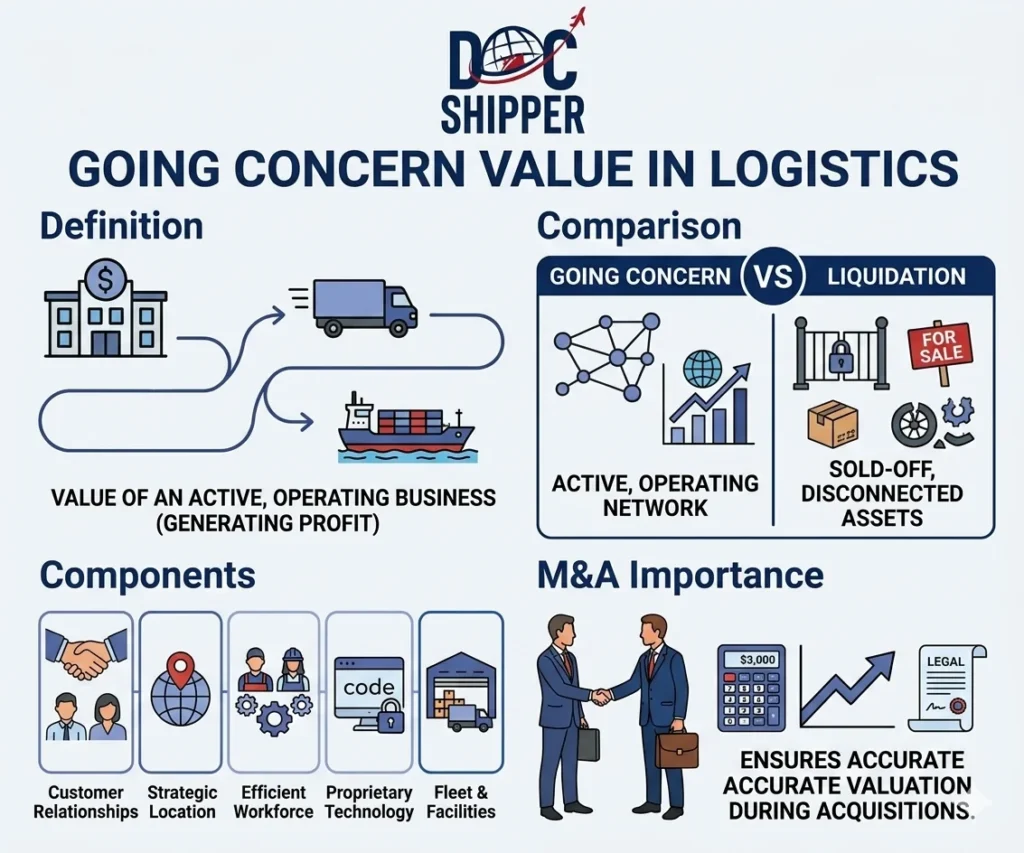
Going-Concern Value represents the total worth of a business as an operating entity, assuming it will continue its activities indefinitely. This valuation includes tangible assets, intangible assets, goodwill, and earning capacity, reflecting the company's ability to generate future profits rather than mere liquidation value.
Introduction
Many businesses mistakenly equate their company’s value with the sum of their physical assets—machinery, inventory, real estate. This oversimplification ignores the premium generated by operational continuity, customer relationships, and market positioning.
In international logistics and trade, understanding going-concern value becomes critical during mergers, acquisitions, or financing negotiations. A freight forwarder with established trade lanes holds significantly more value than its trucks and warehouses combined.
The concept matters because it:
- Reflects future earning potential beyond physical inventory
- Includes intangible assets like brand reputation and customer contracts
- Differs fundamentally from liquidation value in distressed scenarios
- Impacts tax treatment and financial reporting requirements
- Influences insurance coverage and collateral assessments for loans
Technical Framework & Valuation Methods
The going-concern principle assumes a business will continue operating for the foreseeable future, typically defined as at least twelve months from the balance sheet date. This assumption underpins most accounting standards, including IFRS and GAAP.
Professional valuators employ three primary methodologies to determine going-concern value:
The income approach calculates the present value of expected future cash flows. Analysts project revenues, subtract operating costs, and apply a discount rate reflecting business risk. For logistics companies, this includes recurring revenue from long-term contracts with importers and exporters.
The market approach compares the subject company to similar businesses recently sold. This method works well in fragmented industries like freight forwarding, where transaction multiples provide benchmarks. Typical EBITDA multiples range from 4x to 8x depending on geographical coverage and service specialization.
The asset-based approach tallies all tangible and intangible assets, then subtracts liabilities. Unlike liquidation scenarios, this method values assets at their continued-use worth. A warehouse serving active distribution routes holds greater value than one assessed for quick sale.
According to IAS 1 from the IFRS Foundation, management must assess going-concern viability when preparing financial statements. If substantial doubt exists, specific disclosures become mandatory.
At DocShipper, we routinely evaluate partner carriers and warehouses using going-concern principles. This ensures our clients work with financially stable suppliers capable of honoring multi-year service agreements across international corridors.
Practical Applications & Industry Data
Consider two identical freight forwarding companies, each owning $2 million in trucks, warehouses, and office equipment. Company A operates sporadically with project-based clients. Company B holds five-year contracts with major manufacturers, generating predictable monthly revenue.
Under liquidation, both fetch similar asset values. As going concerns, Company B commands a premium—often 200-300% higher—due to contracted cash flows and established trade relationships.
| Valuation Scenario | Liquidation Value | Going-Concern Value | Premium (%) |
|---|---|---|---|
| Regional Logistics Firm | $1.8M | $5.2M | +189% |
| Customs Brokerage | $850K | $3.1M | +265% |
| Warehousing Operation | $2.4M | $6.8M | +183% |
A real-world use case involves a mid-sized customs brokerage processing 12,000 shipments annually. Physical assets—computers, office lease, software licenses—total $400,000. Yet the company sells for $2.9 million due to:
- Client portfolio: 180 active importers with recurring clearance needs
- Regulatory licenses: Authorizations across eight countries, expensive and time-consuming to replicate
- Trained staff: Certified customs specialists with trade compliance expertise
- Software integrations: API connections with major carriers and ERPs
- Brand reputation: Five years of zero penalties from customs authorities
Industry data from transportation M&A advisors shows going-concern transactions in logistics average 5.8x adjusted EBITDA, while distressed sales yield only 0.4x to 0.7x book value of assets.
Conclusion
Going-concern value captures the true economic worth of an operational business, far exceeding asset liquidation figures. For logistics providers, this valuation reflects contractual relationships, regulatory positioning, and revenue predictability that drive sustainable growth.
Need expert guidance on business valuation, due diligence, or structuring international trade operations? Contact DocShipper today for tailored advisory services.
📚 Quiz
Test Your Knowledge: Going-Concern Value
What does going-concern value primarily represent?
A freight forwarder with $2M in physical assets and strong customer contracts typically sells for much more than asset value. Why?
Your customs brokerage client is seeking acquisition financing. The lender asks about going-concern status. What should concern them most?
🎯 Your Result
📞 Free Quote in 24hFAQ | Going-Concern Value: Definition, Calculation & Concrete Examples
Going-concern value assumes the business continues operating and generating revenue, incorporating intangible assets like customer relationships and goodwill. Liquidation value reflects what assets would fetch in a forced quick sale, typically 30-50% lower than continued-use valuations. The difference lies in operational continuity versus distressed disposal.
Auditors review cash flow projections, debt covenants, customer concentration risk, and management plans. Red flags include negative working capital, loan defaults, loss of major clients, or regulatory penalties. Per auditing standards, significant doubt triggers mandatory financial statement disclosures explaining mitigation strategies and potential outcomes.
Yes, when liabilities exceed the present value of future earnings. This scenario arises in declining industries or businesses with unsustainable cost structures. However, even unprofitable companies may hold positive liquidation value through saleable assets. The gap highlights operational versus asset-based worth.
Customs authorities assess bonding requirements based on financial stability. Companies without going-concern certainty face higher bond amounts or may require cash deposits instead of surety bonds. This directly impacts working capital for importers, as bonds typically equal 10% of annual duty liability.
Goodwill represents the excess of purchase price over identifiable net assets, reflecting brand strength, customer loyalty, and market position. In logistics, goodwill might constitute 40-60% of total going-concern value, derived from established trade lanes, carrier relationships, and operational expertise built over years.
Formal assessments occur quarterly when preparing financial statements, but management should monitor continuously. Triggering events—major contract losses, regulatory changes, economic downturns—demand immediate reevaluation. For public companies, SOX compliance requires documented going-concern reviews every reporting period.
Absolutely. Asset sales in liquidation may trigger ordinary income treatment, while going-concern transactions often qualify for capital gains rates. Transfer pricing rules also distinguish functional business sales from piecemeal asset disposals. The IRS and equivalent bodies scrutinize valuations to prevent underreporting through artificial characterizations.
Rates typically range from 12-25% depending on industry risk, company size, and market conditions. Logistics firms with diversified client bases and long-term contracts use lower rates (12-15%), while startups or single-client operations warrant 20%+ to reflect concentration risk and operational uncertainty.
Certain intangibles—trademarks, patents, software—retain value independently. However, items like customer relationships, trained workforce, and operational systems lose most worth outside ongoing operations. A freight forwarder's client list has minimal value if the business ceases operations, as relationships depend on active service delivery.
Banks typically lend against liquidation value for asset-based loans, applying advance rates of 50-80% on eligible collateral. Going-concern value matters more for cash flow lending, where future earnings support debt service. Lenders may require quarterly going-concern certifications as loan covenants to monitor repayment ability.
Reorganization proceedings aim to preserve going-concern value through continued operations. Courts appoint trustees to manage the business, renegotiate contracts, and develop restructuring plans. If reorganization fails, conversion to Chapter 7 liquidation destroys going-concern premium, leaving only asset recovery for creditors.
Business interruption insurance uses going-concern valuation to calculate coverage limits, protecting lost profits and continuing expenses during disruptions. Policies consider projected revenues and fixed costs that persist despite operational halts. Underwriters assess going-concern stability when pricing premiums and setting deductibles for commercial policies.
Need Help with
Logistics or Sourcing ?
First, we secure the right products from the right suppliers at the right price by managing the sourcing process from start to finish. Then, we simplify your shipping experience - from pickup to final delivery - ensuring any product, anywhere, is delivered at highly competitive prices.


Fill the Form
Prefer email? Send us your inquiry, and we’ll get back to you as soon as possible.
Contact us




