


In short ⚡
Guaranteed loans are financing instruments where a third party—typically a government agency, export credit agency, or financial institution—pledges to repay the debt if the borrower defaults. In international trade, these mechanisms reduce lender risk, enabling businesses to secure funding for cross-border transactions, equipment purchases, or working capital needs that would otherwise be deemed too risky.
Introduction
Many importers and exporters struggle to secure traditional financing due to perceived risks in international transactions. Cross-border deals involve currency fluctuations, political instability, and unfamiliar legal frameworks. Banks often hesitate to lend without substantial collateral.
Guaranteed loans solve this problem by transferring default risk to a guarantor. This arrangement unlocks capital for businesses expanding globally, particularly SMEs lacking extensive credit histories. Understanding how these instruments work is essential for optimizing your trade finance strategy.
Key characteristics of guaranteed loans include:
- Risk mitigation: Third-party guarantees reduce lender exposure to borrower default
- Improved access: Companies with limited collateral can obtain financing
- Lower interest rates: Reduced risk typically translates to better loan terms
- Government support: Many programs aim to boost exports and economic growth
- Diverse applications: Used for working capital, equipment purchases, and contract fulfillment
Mechanisms & Expert Insights
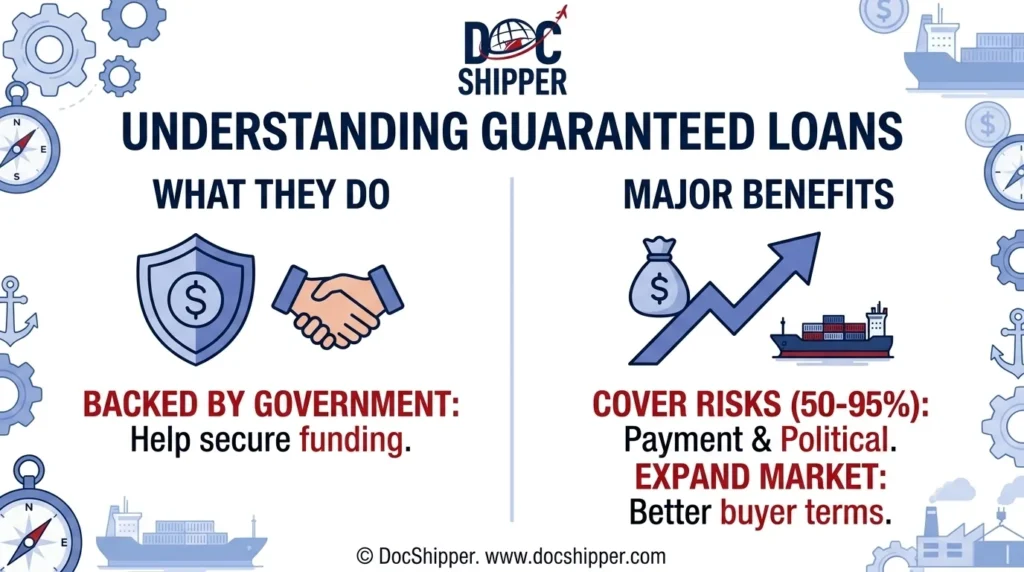
Guaranteed loans operate through a tripartite arrangement involving the borrower, lender, and guarantor. The guarantor evaluates the transaction’s viability and issues a guarantee document, typically covering 50% to 90% of the loan value. This partial coverage ensures the lender maintains due diligence while significantly reducing exposure.
In international trade, export credit agencies (ECAs) serve as primary guarantors. Organizations like the U.S. Export-Import Bank, UK Export Finance, and France’s Bpifrance provide guarantees for exporters selling to foreign buyers. These agencies assess both the exporter’s creditworthiness and the importing country’s political and economic stability.
The legal framework for guaranteed loans varies by jurisdiction but generally follows OECD Arrangement guidelines for officially supported export credits. The OECD Export Credit Arrangement sets minimum interest rates, maximum repayment terms, and transparency standards to prevent unfair competition between nations.
Guarantee fees constitute a critical component of these instruments. ECAs charge annual premiums ranging from 0.5% to 3% of the guaranteed amount, depending on risk classification. Countries are categorized using the OECD Country Risk Classification system, with higher-risk destinations commanding premium rates.
At DocShipper, we regularly assist clients in structuring transactions that qualify for guaranteed loan programs. Our expertise in documentation and compliance ensures applications meet ECA requirements, accelerating approval timelines and improving success rates.
The claim process requires specific trigger events. If a borrower defaults, the lender must demonstrate good-faith collection efforts before submitting a claim. Guarantors typically investigate within 60-90 days and reimburse the covered percentage. This process protects against fraudulent claims while maintaining system integrity.
Practical Examples & Data
Understanding guaranteed loans becomes clearer through concrete scenarios. Consider three common applications in international logistics and trade:
| Loan Type | Typical Amount | Guarantee Coverage | Primary Use Case |
|---|---|---|---|
| Working Capital Guarantee | $500K – $5M | 75-90% | Pre-shipment production financing |
| Export Credit Insurance | $1M – $50M | 85-95% | Large equipment sales with payment terms |
| Small Business Guarantee | $50K – $500K | 50-75% | First-time exporters entering new markets |
Case Study: Machinery Exporter to Southeast Asia
A U.S. manufacturing company received a $3.2 million order from a Vietnamese buyer with 180-day payment terms. Traditional banks declined financing due to limited credit history in Vietnam. The exporter secured an Ex-Im Bank working capital guarantee covering 90% of the loan value.
Financial breakdown:
- Loan amount: $3,200,000
- Guarantee coverage: $2,880,000 (90%)
- Annual guarantee fee: 1.8% = $57,600
- Interest rate: 4.5% (vs. 8.5% without guarantee)
- Annual savings: $128,000 in interest costs
The manufacturer fulfilled the order, received payment on schedule, and has since completed 12 additional transactions totaling over $18 million using the same guarantee facility.
Statistical Overview: According to the International Trade Centre, guaranteed loan programs support approximately $95 billion annually in global trade transactions. SMEs represent 65% of beneficiaries, with average loan sizes of $850,000. Default rates remain below 2.3%, demonstrating the effectiveness of ECA underwriting standards.
When structuring international transactions, DocShipper evaluates whether guaranteed loan programs can optimize your financing costs. Our network includes relationships with major ECAs and commercial lenders, enabling us to recommend the most advantageous structures for your specific supply chain needs. Contact us at DocShipper Contact for a customized assessment.
Conclusion
Guaranteed loans represent a powerful tool for businesses engaged in international trade, transforming risky transactions into bankable opportunities. Understanding the mechanisms, qualification criteria, and cost structures enables strategic decision-making that can significantly improve your competitive position in global markets.
Need assistance evaluating guaranteed loan options for your import/export operations? Contact DocShipper for expert guidance tailored to your specific logistics and financing requirements.
📚 Quiz
Test Your Knowledge: Guaranteed Loans
What is the primary purpose of guaranteed loans in international trade?
A company believes that guaranteed loans completely eliminate their repayment obligation if the foreign buyer defaults. Is this understanding correct?
A startup exporter wants to secure a $2M guaranteed loan for their first international contract. Which scenario reflects realistic expectations?
🎯 Your Result
📞 Free Quote in 24hFAQ | Guaranteed Loans: Definition, Types & Practical Examples in International Trade
A guaranteed loan involves a third-party guarantor (government agency or insurer) who promises to repay the lender if the borrower defaults. This reduces the lender's risk, often resulting in lower interest rates and more favorable terms. Traditional bank financing relies solely on the borrower's creditworthiness and collateral without external guarantees.
Qualification criteria vary by agency but generally require: proof of export activity, financial statements demonstrating viability, contracts or purchase orders from foreign buyers, and compliance with content requirements (typically 50-85% domestic content). Most ECAs prioritize SMEs and first-time exporters while excluding certain sensitive industries.
Standard applications typically require 4-8 weeks for initial approval, though expedited processing is available for established clients. Complex transactions involving large amounts or high-risk countries may extend to 12-16 weeks. Proper documentation preparation significantly accelerates timelines.
Coverage ranges from 50% to 95% depending on the program, borrower profile, and transaction risk. Working capital guarantees typically cover 75-90%, while export credit insurance for large capital goods may reach 95%. Higher coverage percentages generally require stronger borrower credentials and lower country risk ratings.
Yes, most modern ECA programs support service exports including engineering, consulting, software development, and technical training. The service must create demonstrable export value, and documentation requirements are similar to goods exports. Some agencies have minimum transaction thresholds for service exports.
The exporter (borrower) must notify the lender and guarantor immediately. After demonstrating good-faith collection efforts (typically 90-120 days), the lender files a claim with the guarantor. Upon verification, the guarantor reimburses the covered percentage, and the exporter remains liable for the unguaranteed portion.
In most jurisdictions, guarantee fees paid to ECAs constitute ordinary business expenses and are tax-deductible. However, tax treatment varies by country and entity structure. Consult with a tax professional familiar with international trade to ensure proper classification and maximize deductions.
Political risk guarantees cover losses from government actions (expropriation, currency inconvertibility, war) while commercial guarantees address buyer insolvency or payment refusal. Many comprehensive programs combine both coverages. Political risk premiums are generally higher for countries with unstable governance or economic volatility.
Yes, though requirements are stricter. Startups typically need demonstrated export contracts, detailed business plans, and personal guarantees from principals. Some ECAs offer specialized programs for emerging exporters with lower minimum thresholds and mentoring support, though coverage percentages may be reduced to 50-65%.
Standard requirements include: three years of financial statements, export contracts or purchase orders, proforma invoices, company registration documents, beneficial ownership disclosure, compliance certifications, and buyer credit reports. Additional documentation may be needed for specific industries or high-value transactions.
Guaranteed loans appear on credit reports like conventional financing. Timely payments improve credit scores, while defaults negatively impact ratings even if the guarantor covers losses. The guarantee itself doesn't affect credit scores, but the underlying debt obligations do. Maintaining good payment history strengthens future borrowing capacity.
Yes, most ECAs maintain prohibited or restricted country lists based on international sanctions, political instability, or poor payment histories. High-risk countries may receive coverage only for specific sectors or with enhanced due diligence. The OECD Country Risk Classification system guides these determinations, with annual updates reflecting changing conditions.
Need Help with
Logistics or Sourcing ?
First, we secure the right products from the right suppliers at the right price by managing the sourcing process from start to finish. Then, we simplify your shipping experience - from pickup to final delivery - ensuring any product, anywhere, is delivered at highly competitive prices.


Fill the Form
Prefer email? Send us your inquiry, and we’ll get back to you as soon as possible.
Contact us




