


In short ⚡
Hierarchy of Cost Assignability is a systematic framework that classifies costs based on how directly they can be traced to specific cost objects (products, services, or activities). This hierarchical structure ranges from direct costs (easily traceable) to indirect costs (requiring allocation methods), enabling precise cost management and strategic pricing decisions in international logistics.
Introduction
Many logistics companies struggle with accurate cost allocation when handling multi-client shipments or complex supply chains. Without a clear hierarchy of cost assignability, businesses risk underpricing services, misidentifying profit margins, or making flawed strategic decisions based on incomplete financial data.
In international freight and customs operations, understanding which costs are directly traceable versus those requiring proportional allocation becomes critical. This framework directly impacts quotation accuracy, operational efficiency, and compliance with transfer pricing regulations.
Key characteristics of cost assignability hierarchy include:
- Traceability: How precisely costs connect to specific shipments or operations
- Causality: Whether costs result directly from a particular activity or service
- Measurement feasibility: The practicality of tracking and recording cost consumption
- Economic significance: Whether the benefit of precise tracking justifies the effort
- Time relationship: How immediately costs relate to revenue-generating activities
Framework & Expert Insights
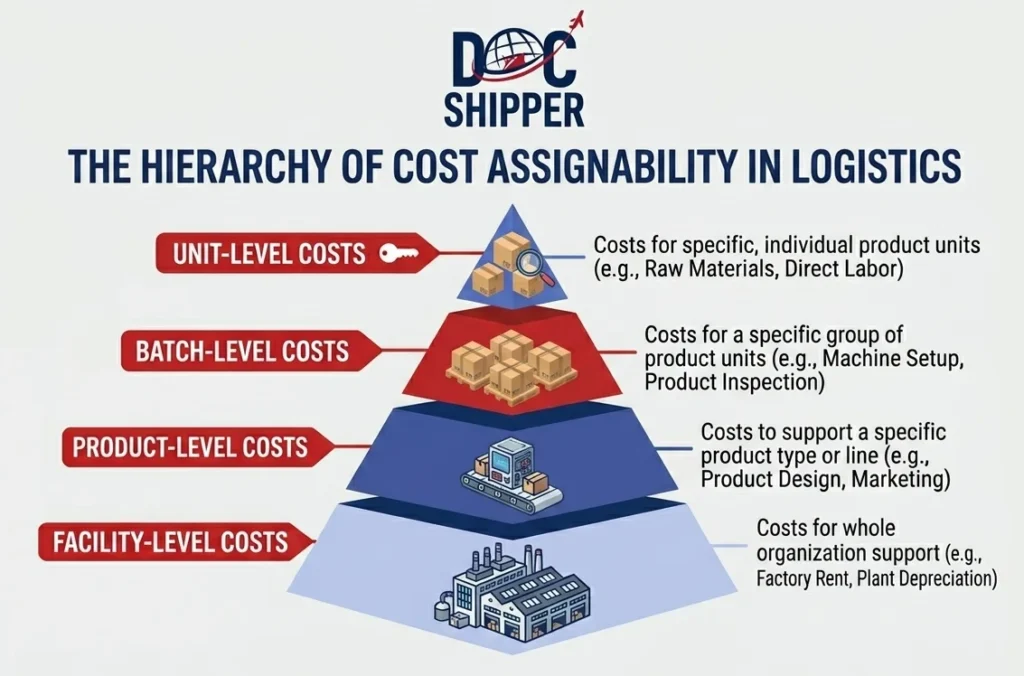
The hierarchy of cost assignability typically establishes four distinct levels. Direct costs represent the most traceable category—expenses clearly attributable to a single cost object without allocation. In freight forwarding, this includes ocean freight charges for a specific container or customs duties for a particular consignment.
Traceable indirect costs form the second tier. These expenses benefit specific cost objects but require measurement systems to assign accurately. Warehouse labor dedicated to a client’s goods or fuel consumption for dedicated truck routes exemplify this category. At DocShipper, we implement time-tracking systems that convert these indirect costs into assignable metrics for transparent client billing.
The third level comprises common indirect costs that serve multiple cost objects simultaneously. Facility rent, administrative salaries, and shared equipment depreciation fall here. These require allocation bases—often square footage, headcount, or transaction volume—to distribute proportionally across operations.
At the hierarchy’s base lie arbitrary allocations—costs with tenuous connections to specific activities. Corporate marketing expenses or executive salaries typically resist logical assignment beyond arbitrary methods. International Accounting Standards (IAS 2) provide guidance on which costs legitimately attach to inventory versus period expenses.
Transfer pricing regulations further complicate this hierarchy in multinational logistics operations. Tax authorities scrutinize intercompany cost allocations to ensure arm’s-length pricing. The OECD Transfer Pricing Guidelines establish that cost assignment methods must reflect economic reality and commercial rationality.
Practical Examples & Data Analysis
Consider a freight forwarder managing three simultaneous ocean shipments from Shanghai to Rotterdam. The assignability hierarchy determines how each cost category flows to client invoices:
| Cost Category | Assignability Level | Allocation Method | Example Amount |
|---|---|---|---|
| Ocean freight (specific container) | Direct | Direct assignment | $2,400 |
| Customs clearance staff time | Traceable indirect | Hours logged per shipment | $320 |
| Warehouse rental (shared space) | Common indirect | Cubic meters × days stored | $185 |
| Office administrative costs | Arbitrary allocation | Percentage of revenue | $95 |
Use Case: Multi-Client Consolidation
A logistics provider consolidates cargo from 12 exporters into a single container. The container freight charge ($3,600) becomes a common indirect cost requiring allocation. Three rational methods emerge:
- Weight-based allocation: Each shipper pays proportionally to cargo weight (18,000 kg total)
- Volume-based allocation: Distribution according to cubic meters occupied (28 CBM total)
- Declared value allocation: Higher-value goods absorb more cost due to liability risk
If Shipper A contributes 4,500 kg (25% of weight), they’d be assigned $900 under weight-based allocation. However, if their cargo occupies 9 CBM (32% of volume), the volume method yields $1,152—a significant difference impacting profitability analysis.
At DocShipper, we apply the dominant factor principle: selecting the allocation base that best reflects actual resource consumption. For dense cargo, weight drives costs; for lightweight bulky items, volume determines capacity usage. This precision prevents cross-subsidization between clients and ensures equitable pricing structures.
Conclusion
Mastering the hierarchy of cost assignability transforms financial management from guesswork into strategic advantage. Properly classifying and allocating costs ensures accurate quotations, regulatory compliance, and informed business decisions in complex international logistics environments.
Need expert guidance on cost allocation for your logistics operations? Contact DocShipper for customized solutions that align with your business model and compliance requirements.
📚 Quiz
Test Your Knowledge: Hierarchy of Cost Assignability
Which statement best defines the hierarchy of cost assignability?
A freight forwarder consolidates cargo from 12 exporters into one container. The $3,600 container freight charge should be classified as:
Your logistics company uses arbitrary allocation for significant cost pools when calculating transfer prices between international subsidiaries. What is the primary compliance risk?
🎯 Your Result
📞 Free Quote in 24hFAQ | Hierarchy of Cost Assignability: Definition, Framework & Practical Examples
Direct costs trace to a single shipment without allocation (ocean freight for a specific container, customs duties for one consignment). Indirect costs serve multiple shipments simultaneously, requiring allocation methods based on weight, volume, or time consumption to assign proportionally across operations.
Tax authorities examine whether intercompany cost allocations reflect arm's-length principles. Using arbitrary allocations for significant cost pools may trigger adjustments. Maintaining documented allocation bases tied to economic reality—like actual resource consumption—strengthens defensibility during audits and ensures compliance with OECD guidelines.
Modern TMS and ERP systems convert previously indirect costs into traceable categories. GPS tracking measures fuel consumption per route, RFID systems track handling time per SKU, and automated time-logging assigns labor to specific shipments. This technology migration elevates costs from arbitrary to traceable tiers in the hierarchy.
The optimal base depends on cost drivers. Rent typically allocates by square meters occupied, utilities by cubic meters (climate control costs), and labor by handling units processed. Combining multiple bases in a composite allocation often yields more accurate results than single-factor methods, especially in diversified warehouse operations.
Annual reviews ensure allocation bases reflect current operations. Trigger additional reviews when introducing new service lines, changing facility layouts, adopting automation, or experiencing significant business model shifts. Outdated methodologies create cross-subsidization, distorting profitability analysis and competitive positioning.
While no universal standards exist, FIATA guidelines recommend allocations tied to causal relationships. Incoterms define cost responsibility boundaries between buyers and sellers. Industry practice favors weight-volume combined methods for freight, transaction counts for administrative costs, and time-based allocations for labor-intensive services.
Establish hierarchy rules prioritizing causality over convenience. For consolidated shipments, volume typically governs transport costs while weight influences handling. Document decision logic consistently. When conflicts persist, activity-based costing segregates cost pools by service type, applying appropriate bases to each category rather than forcing uniform treatment.
Direct cost visibility enables precise floor pricing—the minimum rate covering incremental expenses. Traceable indirect costs inform competitive positioning by revealing true service costs. Common indirect and arbitrary allocations determine overhead recovery rates, influencing whether to pursue volume-based or premium pricing strategies.
Yes, particularly in transfer pricing contexts where incorrect allocations trigger tax adjustments and penalties. Misallocated costs in government contracts may constitute False Claims Act violations. Publicly traded companies face securities fraud risks if cost misallocation materially misstates financial results, affecting investor decisions.
Accurate assignability reveals the true cost of internal operations versus outsourcing. Companies often underestimate internal costs by excluding difficult-to-assign overheads, making insourcing appear cheaper than reality. Properly hierarchical analysis ensures decisions compare total economic costs, including capacity opportunity costs and allocated support functions.
Scale impacts which costs remain fixed versus variable. High-volume operations convert previously common indirect costs into traceable categories through dedicated resources. Conversely, low volumes increase the proportion of arbitrary allocations as fixed costs spread across fewer units, complicating marginal cost identification for pricing decisions.
Maintain allocation policy manuals defining methodologies, bases, and update frequencies. Retain calculation worksheets showing data sources and formulas. Document business rationale for base selection. Archive historical allocation percentages to demonstrate consistency. External benchmarking studies strengthen defensibility by proving alignment with industry norms and economic substance.
Need Help with
Logistics or Sourcing ?
First, we secure the right products from the right suppliers at the right price by managing the sourcing process from start to finish. Then, we simplify your shipping experience - from pickup to final delivery - ensuring any product, anywhere, is delivered at highly competitive prices.


Fill the Form
Prefer email? Send us your inquiry, and we’ll get back to you as soon as possible.
Contact us




