


In short ⚡
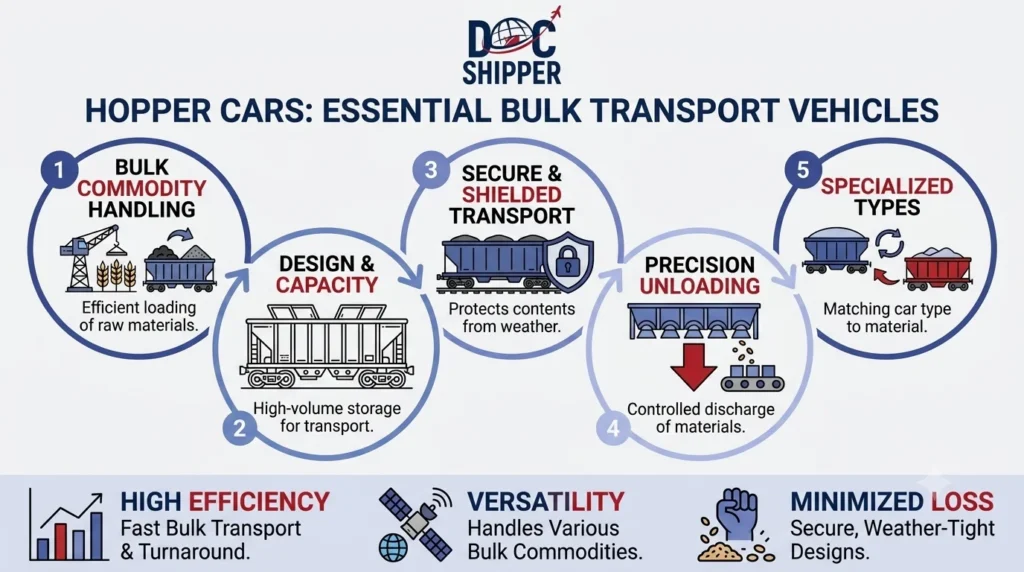
Hopper cars are specialized railway freight wagons designed with sloped floors and bottom discharge gates, enabling efficient gravity-based unloading of bulk commodities like coal, grain, aggregates, and minerals. Their unique configuration eliminates manual unloading, reducing handling costs and transit time in global supply chains.Introduction
When importing bulk raw materials or agricultural commodities, selecting the wrong transportation method can result in contamination, excessive handling fees, or damaged goods. Hopper cars solve this problem by offering a seamless, cost-efficient solution for transporting granular and free-flowing materials across continents.
These specialized railcars have become indispensable in industries ranging from agriculture to mining, particularly for transcontinental shipments where road transport proves impractical. Their design directly impacts loading efficiency, product integrity, and overall logistics costs.
Key characteristics of hopper cars include:
- Bottom discharge capability: Gravity-fed unloading through gates or doors
- Capacity range: Typically 70-120 tons, depending on configuration
- Covered or open designs: Protection levels adapted to cargo sensitivity
- Specialized linings: Materials resistant to corrosion, abrasion, or contamination
- Regulatory compliance: Designed to meet AAR (Association of American Railroads) or UIC (International Union of Railways) standards
Technical Overview & Expert Insights
Hopper cars fall into two primary categories: open-top hoppers for weather-resistant materials (coal, ores, aggregates) and covered hoppers for moisture-sensitive commodities (grain, cement, plastic pellets). The choice depends on cargo characteristics and environmental exposure during transit.
The discharge mechanism varies by design. Traditional models use manually operated gates, while modern variants incorporate pneumatic or hydraulic systems for faster, safer unloading. Slope angles typically range from 45° to 60°, ensuring complete evacuation without residue—critical for food-grade shipments requiring sanitation between loads.
Structural engineering plays a crucial role in maximizing payload while maintaining track compatibility. High-strength steel construction allows for thin-gauge walls, increasing cubic capacity without exceeding axle load limits set by rail authorities. Advanced models feature center partition walls to prevent lateral cargo shifts during curves, enhancing stability.
Regulatory compliance involves multiple frameworks. In North America, the AAR’s Manual of Standards governs design specifications, while European operations must align with TSI (Technical Specifications for Interoperability) requirements. Customs documentation for international rail freight requires precise cargo identification, as hopper cars carrying hazardous materials face additional scrutiny.
At DocShipper, we coordinate hopper car bookings with Class I railroads and verify compliance documentation to prevent cross-border delays. Our expertise ensures proper car allocation based on cargo density, moisture content, and destination infrastructure—factors often overlooked in standard freight arrangements.
Practical Applications & Industry Data
The global hopper car fleet exceeds 1.2 million units, with North American operators managing approximately 40% of this capacity. According to the Association of American Railroads, covered hoppers transported 62 million carloads in 2023, representing 18% of total U.S. rail freight volume.
Use Case 1: Canadian Wheat Exports
A Saskatchewan grain exporter ships 50,000 metric tons of durum wheat to Morocco annually. Using covered hoppers with 100-ton capacity, the shipment requires 500 railcar movements to the Port of Vancouver. Compared to truck transport (28 tons per vehicle), hopper cars reduce the requirement to 500 trips versus 1,786 truck loads—cutting fuel costs by 64% and reducing carbon emissions proportionally.
Use Case 2: Coal Transportation Economics
A U.S. utility company sources coal from Wyoming’s Powder River Basin. Open-top hoppers transport the material 1,200 miles to a Texas power plant. With an average freight rate of $0.03 per ton-mile, a single 110-ton hopper car incurs $3,960 in rail charges. The same volume via truck (30 tons per vehicle) would require 4 trucks at $0.18 per ton-mile, totaling $23,760—making rail transport 83% cheaper for bulk commodities.
| Hopper Type | Typical Capacity | Common Cargo | Unloading Time | Cost per Ton-Mile |
|---|---|---|---|---|
| Open-Top Hopper | 100-120 tons | Coal, aggregates, ores | 15-30 minutes | $0.025-$0.035 |
| Covered Hopper (Standard) | 70-100 tons | Grain, cement, fertilizers | 20-40 minutes | $0.030-$0.040 |
| Pressure-Differential Hopper | 50-70 tons | Plastic pellets, flour | 10-15 minutes | $0.040-$0.055 |
| Rotary Dump Hopper | 110-130 tons | Iron ore, bauxite | 5-10 minutes | $0.028-$0.038 |
Key operational insights:
- Turnaround efficiency: Covered hoppers achieve 12-day cycles (load-transit-unload-return) versus 18-day cycles for containerized bulk cargo
- Product contamination: Food-grade hoppers require ATP sanitation testing, with acceptable limits below 150 RLU (Relative Light Units)
- Infrastructure requirements: Receiving facilities need hopper pits (12-15 feet deep) with grate systems to accommodate discharge gates
- Seasonal demand spikes: North American grain harvests (September-November) see hopper car utilization rates exceed 95%, increasing spot rental rates by 40-60%
- Intermodal limitations: Standard hoppers cannot transfer to ocean vessels without transloading, adding $8-15 per ton in handling costs at port terminals
Conclusion
Hopper cars represent the most economical solution for bulk commodity transportation over long distances, offering unmatched efficiency in loading, transit, and discharge operations. Their specialized designs cater to diverse cargo requirements while maintaining stringent safety and regulatory standards.
Need expert guidance on hopper car logistics or bulk freight optimization? Contact DocShipper for tailored solutions in rail freight management and international supply chain coordination.
📚 Quiz
Test Your Knowledge: Hopper Cars
What is the primary defining feature of hopper cars that distinguishes them from other railway freight wagons?
A logistics manager wants to transport 5,000 metric tons of liquid chemicals via rail. Can hopper cars handle this shipment?
An exporter is shipping 10,000 tons of grain from Canada to a U.S. port terminal using covered hoppers. What will happen at the port?
🎯 Your Results
📞 Free Personalized QuoteFAQ | Hopper Cars: Definition, Types & Practical Use Cases
Hopper cars feature sloped floors and bottom discharge gates for gravity unloading, while gondola cars have flat floors and require overhead equipment (cranes, clamshells) for unloading. Hoppers are ideal for free-flowing materials, whereas gondolas handle scrap metal, pipes, or items needing top access.
No. Hopper cars are designed exclusively for dry bulk materials. Liquid commodities require tank cars with sealed compartments and specialized fittings. Attempting to load liquids into hoppers would cause leakage through discharge gates and violate DOT hazardous materials regulations.
Food-grade hoppers undergo high-pressure washing, followed by compressed air drying and ATP sanitation testing. Industrial hoppers may receive mechanical sweeping or specialized coatings. Cleaning costs range from $200-$800 per car, depending on contamination risk and regulatory requirements.
North American hopper cars typically operate under a 286,000-pound gross weight limit (car + cargo). In Europe, the standard is 90 tons (198,416 pounds). Exceeding these limits results in overweight penalties ranging from $500-$5,000 per violation, plus potential track damage liability.
Yes, but gauge compatibility is critical. North America uses 4 feet 8.5 inches (standard gauge), while former Soviet states use 5 feet (broad gauge). Gauge-changing facilities at borders (e.g., Poland-Ukraine) add 2-4 hours to transit time. Always verify track compatibility before booking cross-border hopper movements.
Divide total shipment weight by the hopper's payload capacity (typically 100 tons for standard models). For example, a 5,000-ton grain shipment requires 50 hopper cars. Add 10% buffer for operational flexibility. Factor in car availability, especially during peak agricultural seasons.
Shippers must carry all-risk cargo insurance covering theft, contamination, and transit damage. Minimum coverage typically equals 110% of CIF value. High-value commodities (specialty grains, rare earth minerals) may require additional war risk or terrorism clauses, increasing premiums by 0.15-0.30% of insured value.
Hopper cars deliver bulk cargo to port terminals, where materials are transloaded into ship holds or containers. Direct rail-to-ship transfer is rare outside specialized facilities. Transloading adds 3-7 days to supply chain timelines but enables efficient ocean freight integration for international deliveries.
Discharge gate failures account for 35% of hopper car service delays, often caused by frozen mechanisms in cold climates or sediment buildup. Regular inspections should check gate seals, pneumatic systems, and structural integrity. Unscheduled repairs average $1,200-$3,500 per incident, impacting delivery schedules.
Open-top hoppers transporting coal or dusty materials must comply with fugitive dust emission standards. Many jurisdictions require spray systems or cover tarps during transit. Violations result in fines up to $25,000 per incident. Covered hoppers avoid these issues but cost 15-20% more to lease.
Essential documents include the rail waybill, commercial invoice, phytosanitary certificates (for agricultural goods), and customs declarations. NAFTA/USMCA shipments require proof of origin. Incomplete documentation can delay clearance by 48-72 hours at border crossings, incurring demurrage charges of $100-$200 per day.
Yes. DOT-approved hazmat hoppers feature reinforced construction, pressure relief valves, and explosion-proof discharge systems. They transport materials like ammonium nitrate or sulfur. Leasing these cars costs 40-60% more than standard hoppers, and operators must maintain HAZMAT endorsements and emergency response plans.
Need Help with
Logistics or Sourcing ?
First, we secure the right products from the right suppliers at the right price by managing the sourcing process from start to finish. Then, we simplify your shipping experience - from pickup to final delivery - ensuring any product, anywhere, is delivered at highly competitive prices.


Fill the Form
Prefer email? Send us your inquiry, and we’ll get back to you as soon as possible.
Contact us




