


In short ⚡
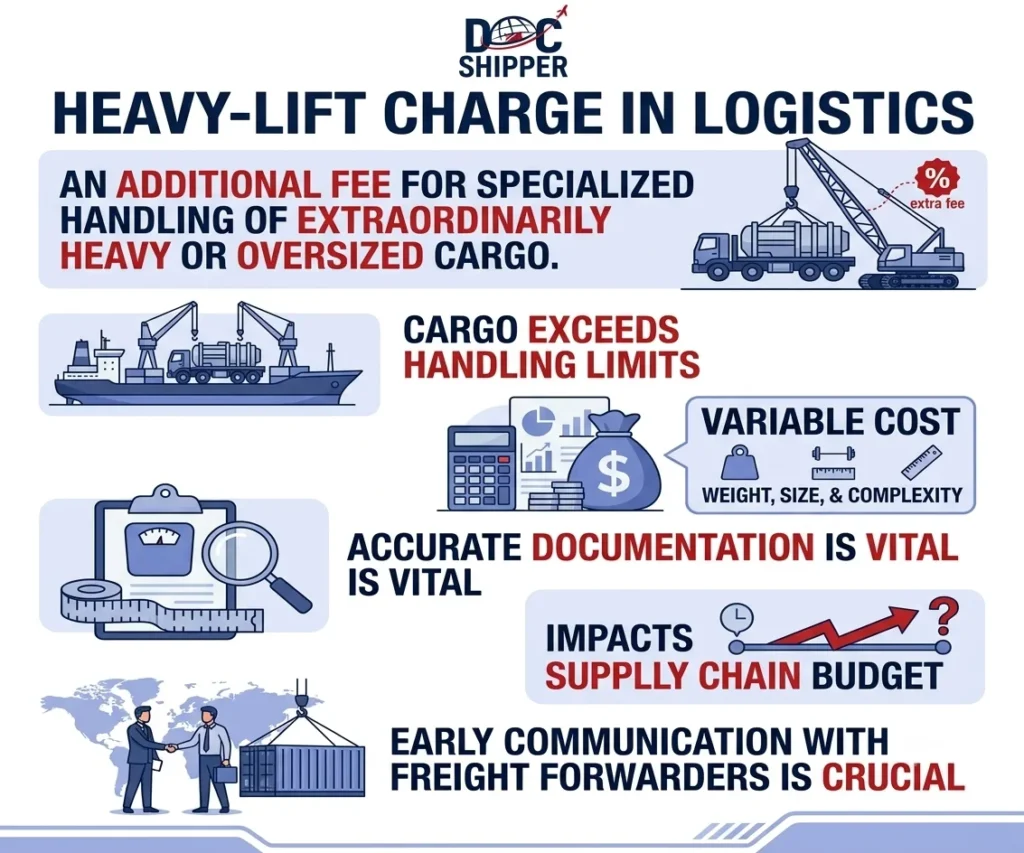
Heavy-Lift Charge is a supplementary freight fee applied when cargo exceeds standard weight or dimension limits, requiring specialized handling equipment, reinforced transportation modes, or additional manpower. This surcharge compensates carriers for operational complexities, equipment costs, and safety protocols associated with oversized or overweight shipments in international logistics.
Introduction
Many importers discover unexpected costs when shipping industrial machinery, construction materials, or large equipment internationally. The confusion often stems from misunderstanding when and how heavy-lift charges apply versus standard freight rates.
In global supply chains, heavy-lift charges represent a critical cost component for businesses handling oversized cargo. These fees directly impact total landed costs and require strategic planning during shipment preparation. Misjudging these charges can derail project budgets, delay deliveries, and compromise profit margins.
Key characteristics of heavy-lift charges include:
- Weight thresholds: Typically triggered above 1,000 kg (2,205 lbs) per piece for air freight, or 10-20 metric tons for ocean cargo
- Dimensional limits: Applied when cargo exceeds standard container dimensions or requires deck space on vessels
- Equipment dependency: Costs vary based on specialized cranes, forklifts, or gantry systems required
- Carrier-specific policies: Each shipping line, airline, or freight forwarder maintains unique heavy-lift classification criteria
- Documentation requirements: Technical specifications, engineering drawings, and center-of-gravity calculations mandatory for most heavy shipments
Technical Framework & Regulatory Aspects
Heavy-lift charges operate within a complex regulatory environment governed by international maritime conventions, aviation standards, and national transport regulations. The International Maritime Organization (IMO) establishes baseline safety protocols for cargo weighing procedures and stowage requirements that directly influence these surcharges.
Classification triggers vary significantly across transport modes. Ocean freight carriers generally invoke heavy-lift charges when individual pieces exceed standard container capacity, requiring flat-rack or open-top containers. Air cargo operators apply premiums when shipments surpass aircraft hold dimensions or floor loading limits, typically around 150 kg per square meter.
Equipment mobilization costs form the primary justification for these fees. Specialized cranes with 100-ton lifting capacity can cost $15,000-$30,000 per day to operate. Mobile harbor cranes, heavy-duty forklifts, and reinforced transport trailers add measurable expenses that carriers must recover through dedicated surcharges.
The liability component significantly impacts pricing. Heavy cargo presents elevated risks of equipment damage, structural strain on vessels or aircraft, and potential delays from specialized loading procedures. Insurance premiums for high-value industrial equipment often require additional coverage beyond standard carrier liability limits of $20 per kilogram.
Port infrastructure variations create geographic pricing differences. Facilities equipped with heavy-lift cranes may charge $500-$2,000 per lift operation, while ports lacking specialized equipment require third-party contractors at premium rates. At DocShipper, we pre-assess destination port capabilities to optimize routing and minimize unexpected handling charges for oversized cargo projects.
Regulatory compliance obligations add administrative complexity. Many jurisdictions require advance notification for heavy cargo movements, special permits for road transport, and certified rigging plans verified by marine surveyors. The European Union’s EN 12195 standard for cargo securing directly influences handling procedures that carriers factor into heavy-lift surcharges.
Calculation Methods & Practical Examples
Heavy-lift charge calculations employ multiple methodologies depending on carrier policies, cargo characteristics, and transport mode. Understanding these variables enables accurate budget forecasting and informed carrier selection.
Weight-based pricing remains the most common approach. Carriers establish tiered rates that escalate with cargo mass. A typical ocean freight structure might charge an additional $50 per metric ton for cargo between 10-20 tons, increasing to $100-$150 per ton above 20 tons. These rates apply per shipping piece, not total shipment weight.
| Weight Range (per piece) | Ocean Freight Surcharge | Air Freight Surcharge |
|---|---|---|
| 1,000 – 5,000 kg | $200 – $500 flat fee | $8 – $12 per kg above 1,000 kg |
| 5,000 – 20,000 kg | $50 – $100 per metric ton | Not typically accepted |
| 20,000+ kg | $100 – $250 per metric ton | Charter flight required |
Practical Case Study: A manufacturing company ships a 45-ton industrial press from Hamburg to Shanghai. The base ocean freight rate is $3,500 per 40-foot container. However, the press requires a flat-rack container with specialized lashing.
Cost breakdown:
- Base flat-rack rate: $5,200 (premium over standard container)
- Heavy-lift charge: 45 tons × $120/ton = $5,400
- Port handling surcharge (origin): $1,800
- Port handling surcharge (destination): $2,200
- Total heavy-lift related costs: $9,400 (64% increase over base rate)
Dimensional calculation methods apply when cargo size exceeds weight as the limiting factor. Airlines use volumetric weight formulas (Length × Width × Height / 6000) to determine chargeable weight. If volumetric weight exceeds actual weight, carriers apply heavy-lift premiums based on the cubic displacement rather than mass.
Combination pricing models assess both weight and equipment requirements. A carrier might charge $75 per ton plus $1,500 for specialized crane mobilization. This approach ensures cost recovery for fixed operational expenses regardless of cargo weight variations. At DocShipper, we negotiate consolidated rates with carriers for clients shipping regular heavy equipment, reducing per-shipment surcharges by 15-30%.
Data from industry analysis: The global heavy-lift shipping market experienced a 22% price increase between 2020 and 2023, driven by crane equipment shortages and heightened insurance costs. Average heavy-lift surcharges now represent 35-50% of total freight costs for cargo exceeding 30 tons, compared to 25-35% pre-pandemic levels.
Conclusion
Heavy-lift charges represent an inevitable cost for businesses handling oversized or overweight cargo, requiring detailed planning and carrier expertise to optimize expenses. Understanding calculation methods, equipment requirements, and regulatory frameworks enables accurate budgeting and routing decisions that protect profit margins.
Need expert guidance on managing heavy-lift shipments or reducing associated surcharges? Contact DocShipper for tailored logistics solutions that streamline oversized cargo operations.
📚 Quiz
Test Your Knowledge: Heavy-Lift Charge
What is the primary purpose of a heavy-lift charge in international logistics?
A client believes heavy-lift charges only apply to cargo exceeding 50 tons. What is the correct understanding?
Your company ships a 35-ton industrial machine requiring specialized crane handling. Which approach best manages heavy-lift costs?
🎯 Your Result
📞 Get Your Custom Heavy-Lift QuoteFAQ | Heavy-Lift Charge: Definition, Calculation & Practical Examples
Ocean freight generally applies heavy-lift charges above 10-20 metric tons per piece, while air cargo triggers surcharges at 1,000 kg (2,205 lbs). However, thresholds vary significantly by carrier, route, and equipment availability at origin and destination ports. Always verify specific weight limits with your freight forwarder during quotation stages to avoid unexpected fees.
Yes, particularly for regular shippers or consolidated volumes. Carriers may offer reduced rates for advance bookings, off-peak shipping periods, or multi-shipment contracts. Freight forwarders with established carrier relationships typically secure 10-25% discounts on published heavy-lift tariffs. Volume commitments and flexible scheduling provide the strongest negotiation leverage.
Essential documents include detailed cargo dimensions (length, width, height), exact weight with center-of-gravity calculations, engineering drawings for irregularly shaped items, and lifting point specifications. Most carriers require these submissions 7-14 days before shipment to arrange appropriate equipment and verify vessel or aircraft compatibility. Non-compliance may result in booking cancellations or additional emergency handling fees.
Full Container Load (FCL) shipments using flat-rack or open-top containers incur fixed heavy-lift charges based on total piece weight and equipment requirements. Less than Container Load (LCL) heavy cargo faces per-ton surcharges plus consolidation fees, often 40-60% higher than FCL equivalents due to specialized handling and limited consolidation opportunities for oversized items.
No universal regulation governs heavy-lift pricing. Each carrier establishes proprietary tariffs based on operational costs, equipment investments, and competitive positioning. However, industry associations like FIATA and BIMCO publish guidance documents that influence pricing structures. Regional variations are significant, with European and North American routes typically commanding 20-35% premiums over Asian corridors due to higher labor and equipment costs.
Underestimating cargo weight triggers immediate surcharges and potential shipment delays. Carriers verify weights using certified scales before loading, and discrepancies exceeding 10% often result in booking cancellations requiring re-quotation. Penalties may include emergency equipment procurement fees ($2,000-$5,000), vessel rescheduling costs, and detention charges for delayed container returns. Accurate pre-shipment weighing is critical.
Standard heavy-lift surcharges cover equipment and handling costs, not cargo insurance. Carriers typically limit liability to $20 per kilogram under international conventions, insufficient for high-value industrial equipment. Separate all-risk cargo insurance is essential, with premiums ranging from 0.5-2.5% of cargo value depending on item fragility, route risk, and coverage limits. Always verify insurance adequacy for expensive heavy machinery.
Ocean freight heavy-lift bookings require 14-21 days advance notice to secure specialized equipment and vessel space. Air cargo typically needs 7-10 days for charter flight arrangements or commercial aircraft capacity confirmation. Complex projects involving break-bulk cargo or project cargo may need 30-45 days for engineering reviews, port approvals, and equipment mobilization planning.
Consolidating multiple heavy items on a single flat-rack or break-bulk vessel can reduce per-piece handling fees by 15-30%, but total weight must remain within equipment capacity limits (typically 40-60 tons per flat-rack). Carriers apply tiered pricing where combined weight surcharges may be lower than individual piece charges, though specialized lashing and segregation requirements can offset savings.
Disassembling oversized equipment into standard-size components eliminates heavy-lift surcharges but increases reassembly costs and technical risks. Roll-on/Roll-off (RoRo) shipping offers lower handling fees for wheeled heavy equipment compared to container shipping. For extremely heavy cargo, chartering dedicated vessels or using project cargo specialists may provide better per-ton rates than commercial carrier heavy-lift tariffs.
Ports with modern heavy-lift cranes (100+ ton capacity) charge $500-$1,500 per lift operation, while facilities lacking equipment require third-party mobile crane rentals at $3,000-$8,000 daily rates. Developing markets often impose 40-80% higher heavy-lift fees due to limited infrastructure and equipment scarcity. Route selection based on port capabilities significantly impacts total heavy-lift costs for budget-sensitive projects.
Yes, heavy-lift surcharges increase 10-20% during peak shipping seasons (September-November for ocean freight) due to equipment shortages and vessel space competition. Winter months in Northern Hemisphere ports may add weather delay premiums for exposed deck cargo. Off-peak booking (January-March, post-Chinese New Year) often secures reduced rates and better equipment availability for non-urgent shipments.
Need Help with
Logistics or Sourcing ?
First, we secure the right products from the right suppliers at the right price by managing the sourcing process from start to finish. Then, we simplify your shipping experience - from pickup to final delivery - ensuring any product, anywhere, is delivered at highly competitive prices.


Fill the Form
Prefer email? Send us your inquiry, and we’ll get back to you as soon as possible.
Contact us




