


In short ⚡
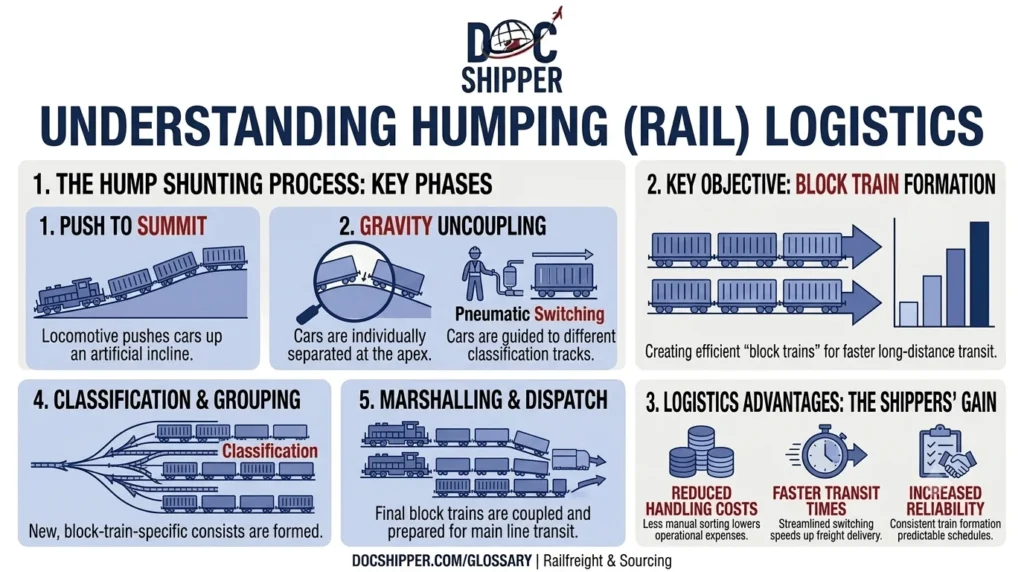
Humping is a rail yard switching technique where railcars are pushed over an artificial elevation (hump) and then roll by gravity into designated classification tracks. This automated sorting method enables efficient railcar organization in large marshalling yards, optimizing freight train assembly for intermodal and international shipping operations.
Introduction
In international freight logistics, rail transport efficiency depends heavily on how quickly railcars can be sorted and reassembled into outbound trains. Traditional flat switching requires locomotives to manually position each car—a time-consuming process that creates bottlenecks in high-volume operations.
Humping revolutionized rail yard operations by introducing gravity-assisted classification. This technique remains essential for intercontinental shipments moving through major rail hubs, particularly in North America, Europe, and Asia where multimodal chains depend on rapid train turnaround.
Key characteristics of humping operations include:
- Gravity propulsion: Railcars roll autonomously after being pushed over the hump crest
- Automated retarders: Hydraulic or pneumatic brakes control descent speed and collision prevention
- Classification capacity: Major hump yards process 2,000-4,000 railcars daily
- Track assignment: Computer systems determine optimal track routing based on destination and train schedules
- Safety protocols: Speed regulations and coupling mechanisms prevent cargo damage during sorting
Technical Mechanisms & Operational Expertise
The humping process begins when a switch engine pushes a string of railcars toward the hump crest at controlled speeds (typically 3-5 mph). As each car reaches the peak, an automated uncoupling mechanism releases it from the preceding car, allowing gravity to take over.
During descent, the railcar passes through retarder zones—specialized braking sections that apply pressure to wheel flanges. Modern systems use laser scanners and weight sensors to calculate the precise braking force needed, accounting for car weight, weather conditions, and distance to the target track.
Track switches are controlled by centralized computer systems that receive real-time data about each car’s destination code (typically derived from waybill information). The Association of American Railroads maintains technical standards for hump yard operations to ensure interoperability across networks.
Three primary hump yard configurations exist: single-ended (cars enter and exit from the same direction), double-ended (bidirectional processing), and directional (specialized for through traffic). The choice depends on geographical constraints and operational volumes.
At DocShipper, we coordinate with rail operators to ensure your containers are classified through appropriate hump facilities, minimizing dwell time and reducing the risk of misrouting—a critical factor in maintaining schedule reliability for international shipments.
Operational Data & Real-World Applications
To illustrate humping’s operational impact, consider these comparative scenarios:
| Classification Method | Daily Capacity | Average Processing Time | Labor Requirements |
|---|---|---|---|
| Flat Switching | 500-800 cars | 6-8 hours per train | High (manual positioning) |
| Hump Yard Operation | 2,500-4,000 cars | 90-120 minutes per train | Reduced (automated controls) |
Real-world case: A major European logistics provider shipping automotive parts from Germany to Poland routes containers through the Maschen Marshalling Yard near Hamburg—one of Europe’s largest automated hump facilities. By utilizing humping classification, the shipper achieves 18-hour transit improvements compared to alternative flat-switching routes.
Critical operational considerations include:
- Fragile cargo restrictions: High-value electronics and perishables often bypass hump yards due to impact risks during coupling
- Winter operations: Ice buildup can reduce retarder effectiveness by up to 30%, requiring speed adjustments
- Hazmat protocols: Dangerous goods may be manually switched to avoid classification mixing
- Dwell time metrics: Industry benchmarks target sub-24-hour railcar residence in classification yards
- Network efficiency: Hump yards enable 40-50% faster train makeup compared to conventional methods
For intercontinental shipments involving rail segments—such as China-Europe routes via the Trans-Siberian Railway—understanding hump yard locations helps predict transit variability. Major facilities like Chicago’s Clearing Yard or Russia’s Insk Station serve as critical nodes where humping operations directly influence delivery schedules.
Conclusion
Humping remains a cornerstone of high-volume rail freight operations, enabling the rapid classification essential for competitive intermodal services. Understanding its mechanics helps shippers anticipate transit behaviors and select appropriate routing strategies.
Need expert guidance on rail routing optimization for your international shipments? Contact DocShipper to leverage our network knowledge and ensure your cargo moves through the most efficient classification channels.
📚 Quiz
Test Your Knowledge: Humping Operations
What is the primary mechanism that enables humping to sort railcars?
Which cargo types are typically excluded from hump yard classification?
A logistics coordinator is routing automotive components from Germany to Poland. The shipment contains precision electronics sensitive to impacts. Which classification method should be specified?
🎯 Your Result
📞 Free Quote in 24hFAQ | Humping: Definition, Rail Yard Classification & Operational Examples
Hump yards process 3-5 times more railcars daily with significantly reduced labor requirements. Gravity-assisted sorting eliminates the need for locomotives to manually position each car, cutting classification time from hours to minutes and improving overall network fluidity for time-sensitive freight.
No. Fragile goods, high-value electronics, perishables, and certain hazardous materials are typically excluded from hump classification due to potential impacts during automated coupling. Shippers must declare cargo sensitivity to ensure appropriate handling methods are applied throughout the rail journey.
Retarders use hydraulic or pneumatic pressure applied to wheel flanges to control descent speed. Modern systems employ laser scanners measuring car velocity, weight sensors calculating momentum, and weather stations adjusting for wind resistance—all processed in real-time to apply precise braking forces that ensure safe coupling speeds below 4 mph.
Advanced facilities use automated systems for car identification (via RFID or optical scanners), switch alignment, retarder control, and track assignment. Computer algorithms optimize classification sequences based on train schedules, reducing human error and enabling 24/7 operations with minimal staffing compared to manual methods.
Cold temperatures cause retarder shoe freezing and reduced braking effectiveness, while heavy rain increases wheel-rail friction. Operators compensate by adjusting hump push speeds and retarder pressures. Severe winter conditions may reduce throughput by 20-30% as safety protocols require slower processing to prevent runaway cars.
Yes. Modern rail carriers provide digital tracking showing when cars enter classification yards, their assigned outbound trains, and departure times. However, granular real-time positioning within the yard itself is typically unavailable to shippers—visibility resumes once the car is assigned to a departing train consist.
Industry benchmarks target 18-24 hours from arrival to departure, though high-efficiency facilities achieve sub-12-hour turnarounds for priority traffic. Dwell time depends on train schedules, classification complexity, and whether cars require mechanical inspections before release to outbound service.
Major border crossings like Brest (Belarus-Poland) and Alashankou (China-Kazakhstan) feature hump yards for gauge-change operations and customs clearance sorting. These facilities enable efficient train reorganization as cargo transitions between rail systems, critical for maintaining competitiveness of Eurasian land bridges versus ocean routes.
In the U.S., the Federal Railroad Administration mandates maximum coupling speeds, retarder inspection intervals, and crew certification requirements. European Union standards (TSI for rail operations) specify similar technical parameters. Violations can result in facility shutdowns and liability for cargo damage claims.
While some carriers have closed aging hump facilities in favor of flat switching with advanced locomotive controls, major high-volume corridors still rely on humping for cost efficiency. Investments in automated retarder systems and AI-driven classification algorithms suggest continued relevance, particularly for bulk commodity flows and intermodal traffic.
Properly loaded containers meeting ISO standards withstand humping impacts, which typically generate forces below 5 mph coupling speeds. However, poor internal bracing or overweight conditions can cause cargo shifts. Experienced freight forwarders like DocShipper verify load securement before rail handoff to minimize damage risks during classification.
Humping reduces fuel consumption compared to flat switching by minimizing locomotive movements—gravity does the work instead of diesel engines. However, retarder systems require hydraulic fluid maintenance with potential spill risks. Modern facilities implement closed-loop systems and advanced filtration to mitigate environmental exposure while maintaining operational efficiency.
Need Help with
Logistics or Sourcing ?
First, we secure the right products from the right suppliers at the right price by managing the sourcing process from start to finish. Then, we simplify your shipping experience - from pickup to final delivery - ensuring any product, anywhere, is delivered at highly competitive prices.


Fill the Form
Prefer email? Send us your inquiry, and we’ll get back to you as soon as possible.
Contact us




